




Just three automakers control the majority of one of the hottest segments in the U.S. car market — and none of them are American companies.
In the first half of 2026, sales of hybrid cars — not long ago considered a bridge to fully electric vehicles — have risen nearly 20% year over year to a record market share of 15.4%, according to the Center for Automotive Research, almost three times the share of pure EVs.
“The only growth we’re seeing is in hybrid market share,” said Elizabeth Krear, CEO of the Center for Automotive Research. “All other propulsion systems have lost market share year to date.”
It has been a boon to the few automakers that invested heavily in the hybrid vehicle market. Toyota, Hyundai Motor Group and Honda together control 86% of it, according to automotive market analysis firm Baum & Associates.
“Consumers want the vehicles. The problem is there are relatively few automakers that offer those vehicles,” said Alan Baum, principal at Baum & Associates.
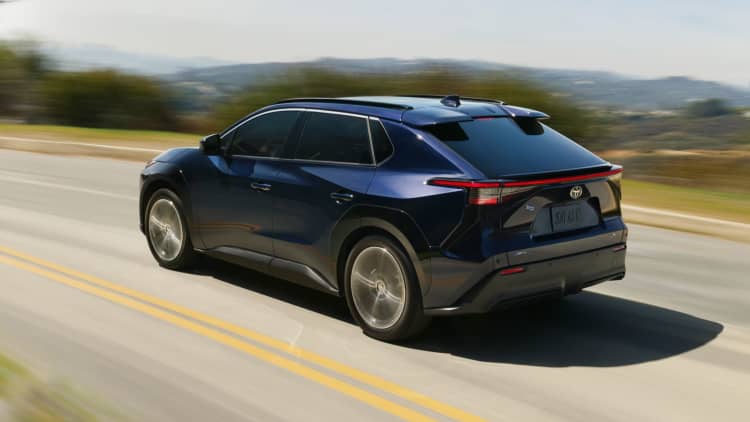
Toyota sold more than 600,000 hybrids in the first half of 2026 between its two brands, Toyota and Lexus. It controls half the market. Toyota’s hybrid lineup has pushed overall U.S. volumes closer to top seller General Motors, which has bet big on EVs and has only one hybrid in its U.S. lineup in the Corvette E-Ray. GM told CNBC in an email that “hybrids do have a role in our future product plans.”
The other automaker that has invested heavily in hybrids is Hyundai Motor Group, which owns the Hyundai, Genesis and Kia brands. It just barely surpassed Honda in the first half of 2026, according to data from Baum & Associates.
Hyundai has added hybrids to a wide range of vehicles, including large SUVs.
Honda is still the second-bestselling hybrid brand in the country behind Toyota. Hybrids account for 31% of American Honda’s sales, according to the company, and it set a U.S. hybrid sales record in the first half of 2026.
“We’re, extremely happy with how our hybrids have been doing,” said Gary Robinson, vice president of auto strategy at American Honda Motor Co., the Japanese carmaker’s U.S. arm.
Hybrids past and present
High fuel prices, broader selection and lingering skittishness around EV range and charging are pushing an unprecedented number of buyers toward hybrids. Historically, hybrid versions of cars have cost more up front than gas vehicles, due to the more complex powertrains required, Krear said.
But buyers can save somewhere between 30% and 50% on fuel costs, given hybrids’ better economy, Krear said. A hybrid buyer can recover the added up-front cost in two to three years, she added.
That’s evolved since the powertrain was introduced.
“The consumer value proposition wasn’t as compelling as it is today,” Krear said. “Gas prices were lower, so the up-front premium was harder to justify. Early hybrids were mostly small cars, while American consumers were moving towards SUVs and trucks. It took time for the consumers to understand the value proposition and the economics, as well as for the product availability to align up with consumer preferences.”
Though Toyota created the Prius in 1997, the Honda Insight sedan was the first to the U.S. market, in 1999. The Prius followed in 2000 and, from there, Toyota claimed about 75% of the market share in the mid-2000s, according to CAR’s Krear. But around that time, hybrid sales made up only 2% of overall new-vehicle sales.
“If you go back at that time to some of the media reports, a lot of the the comments were, ‘What is it and why do we need it?,'” said Dave Christ, group vice president and general manager of the Toyota brand in the U.S. “We really brought it out at a time when hybrid technology probably wasn’t necessary, but we felt a long-term commitment to the technology, and we felt that putting it in our lineup was good for consumers.”
Toyota and Honda stuck with the technology, investing in it far more than rivals. They persisted even after Tesla and other automakers started churning out pure EVs — something for which both automakers, especially Toyota, took criticism from activists and their own shareholders.
Honda, which has long been a leading maker of fuel-burning engines, saw its first loss in almost 70 years as a public company in 2026 due in part to a $16 billion charge it took on restructuring its EV division.
But now the hybrid bet seems prescient.
“Toyota had a very much a North Star strategy,” Krear said.
The company argued it could reduce carbon emissions more effectively at scale by making huge quantities of fuel-sipping hybrids that had smaller batteries, rather than a small number of EVs with big ones. It also “met the customers where they were at,” she said.
“Hybrids deliver that meaningful fuel savings without requiring changes in driving habits or charging infrastructure,” Krear said.
It also gave the companies the chance to improve the technology, Robinson said. This has positioned them well for the future.
In 2030, Baum & Associates expects EV market share to climb to 9.5% and hybrids to be a quarter of the market.
Meanwhile, Honda is planning the release of a new hybrid system that will better fit larger vehicles, in order to maintain its position in the face of the onslaught.
“At that point, there’s really nothing to stop us in terms of battling it out with anybody in terms of hybrids,” Honda’s Robinson said.