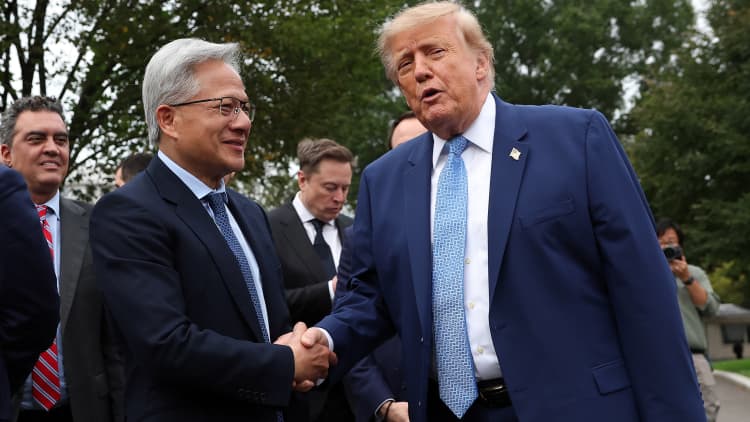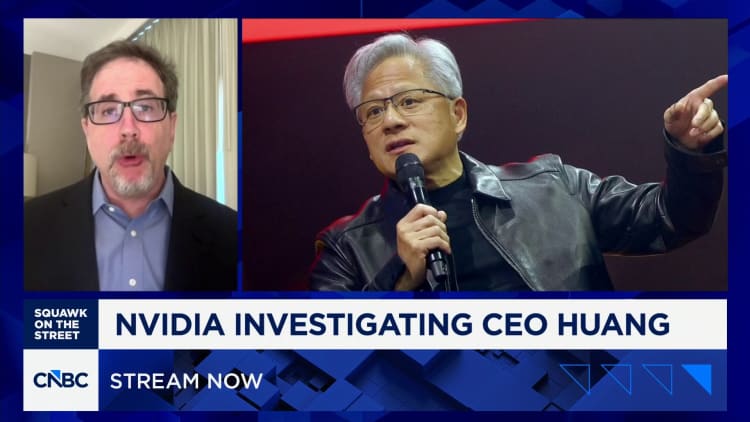







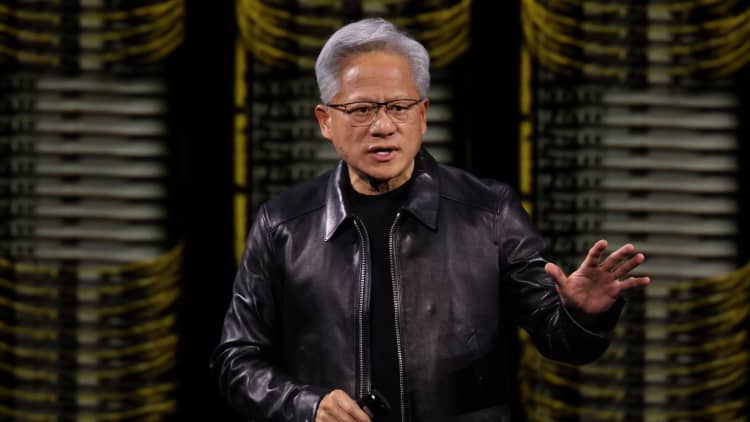

Nvidia CEO Jensen Huang is facing an internal investigation after admitting to an affair with a Chinese businesswoman who U.S. intelligence agencies believe is a Chinese spy.
While the company has not yet named specific investigators, that probe is being helmed by the board with help from outside counsel, according to Nvidia. Lawyer Stephen Neal is the board’s lead independent director and head of corporate governance, likely making him a key figure in the investigation.
In a statement, Nvidia’s board said it has “no reason to believe that either national security or Nvidia secrets were compromised,” though it will examine all evidence. China has dismissed the espionage claims. Huang, one of the most powerful businessmen in the artificial intelligence boom, said he would “cooperate fully” with the process.
Yet the probe has sparked uncertainty around Huang’s future at the chipmaker and raised concerns of broader ripple effects to companies in the tech sector that are exposed to the AI build-out.
In a Monday note, Citi analysts wrote that one of the key issues for investors moving forward will be “potential governance implications” and “increased regulatory scrutiny” as the company navigates the investigation.
Leading the probe
Nvidia’s board has 10 independent members, including a former president of Taco Bell, a former Eli Lilly executive and a former vice chairman from Goldman Sachs. Neal, who joined Nvidia’s board of directors in 2019, is a chairman emeritus and senior counsel of the law firm Cooley LLP, where he also served as CEO from 2001 to 2008.
Neal did not immediately respond to a request for comment.
It won’t be his first corporate governance probe. According to Cooley, Neal has litigated cases across securities, bankruptcies, antitrust, takeovers and more. And he’s conducted several investigations for multiple boards of directors, including at General Motors, where he advised the company in disputes with Ross Perot.
He also guided Walter Hewlett and the Hewlett Trust to stop a merger between Hewlett-Packard Co. and Compaq Computer Corp. and helped PacifiCare Health Systems with transactional matters.
According to the firm, Neal has conducted several investigations for committees of directors and independent directors, though most of those client names are confidential. He’s also handled investigations with the Securities and Exchange Commission for both corporations and individuals.
When he joined Nvidia, Neal was also the chairman of the board of directors at Levi Strauss & Co. He stepped down in 2021 after reaching the mandatory board retirement age of 72, the company said at the time. The retailer did not immediately respond to a request for comment from CNBC on Monday.
Cooley has a long history with Nvidia, too. The law firm said it incorporated the company in 1993 and has served as its principal outside corporate and litigation counsel for roughly three decades. Cooley handled Nvidia’s initial public offering in 1999.
Investors will be closely watching the investigation, and its emphasis on independence, as the process unfolds, according to Brayden King, a professor of management and organizations at Northwestern University’s Kellogg School of Management.
“You definitely want somebody leading it who people can look at and say, ‘OK, we believe this is a report that we can fully believe and trust that the outcome is the right outcome,'” King told CNBC. “That’s what investors are looking for. They just don’t like the instability that comes with all of this.”
Looking to corporate governance
King said the Nvidia investigation lies at a unique intersection of Wall Street and Washington, D.C., where the company is likely navigating its next steps to try to appease both groups.
Because Nvidia’s reputation is highly correlated with Huang’s reputation, King said, conducting a transparent investigation will be key to regaining and retaining shareholders’ trust. Not having an immediate CEO succession plan in place is only impeding that confidence, he added.
“I think the board realizes that they’re doing an independent investigation in part because they really need to understand to what extent there are real problems here, and they also know that if they don’t do an independent investigation, then there will be lingering concerns about whether their key stakeholders can trust the company,” King said.
If the investigation shows that national security was indeed put at risk, King said, the company will need to take “very strong measures” to restore its reputation.
“That will basically come down to having to put structures in place in corporate governance to assure that this can’t happen again,” King said. “The independent review is going to have to be truly independent, and it’s going to have to be candid enough that people believe that we can restore some normalcy around how the company operates.”
It’s also likely influencing how other tech companies, particularly those in the AI space, are thinking about their own corporate governance structures and how they might navigate increased scrutiny on their leaders, he added.
Broader implications
Marcel Kahan, a professor of law at New York University, said he’s not surprised that Nvidia has been potentially exposed to industrial espionage.
Because the company operates in such a high-visibility and crucial sector, Kahan said companies like Nvidia have to be careful in their operations and whom they trust with their information. The investigation could mean the company may consider adding additional governance committees to ensure this doesn’t happen again.
The revelations about its CEO will also likely mean more specialized training from Nvidia and its law firms to ensure trade secrets are kept close.
He also said the company is likely prioritizing an in-depth investigation over transparency to investors, focusing on recruiting “the best of the best” to assist with the probe.
“Nvidia is one of the most valuable companies on Wall Street,” Kahan told CNBC. “I think, given all the attention that’s being paid to it, this is one of the instances where I would not be that worried about anything being done in an underhanded way.”
Still, although Nvidia is a major company with massive influence on the market, the controversy may not end up making too large of a dent in corporate governance structures, according to Kathryn Harrigan, a professor of business leadership at Columbia Business School.
Harrigan said because Wall Street and Silicon Valley have seen similar controversies play out before, this scandal may simply be following the script of its predecessors.
“Is it going to change the basic structure of the AI build-out? Probably not,” she told CNBC. “You sometimes wait years to get on their schedule if you have an order for chips. It’s not like you can magically switch from one vendor to another.”