




U.S. President Donald Trump speaks on stage on the first day of the 2026 Republican National Convention at the American Airlines Center on September 09, 2026 in Dallas, Texas.
Alex Wong | Getty Images
President Donald Trump‘s promise of a $5,000 election “dividend” check to every adult in the U.S. comes at a time when many Americans are feeling particularly strained.
However, economists CNBC spoke with say the proposal is unlikely to become a reality. And even if it did, a one-time direct payment would do little to ease affordability pressures, they said, and could raise consumer prices more in the months ahead.
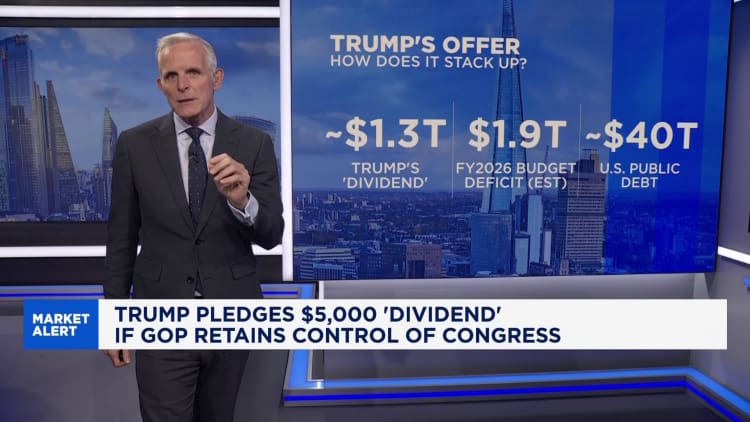
Just weeks before the November midterm elections — with consumers’ views of their financial situation largely pessimistic — Trump on Wednesday said his administration would give every adult American citizen $5,000 if the Republicans win control of the U.S. House of Representatives and Senate.
High prices have weighed on voters and are largely to blame for a long-term decline in consumer sentiment, according to a data analysis from PNC Financial Services.
In August, consumers’ short-term outlook slipped further into negative territory, according to a Conference Board report. The University of Michigan’s latest consumer survey also showed sentiment worsened amid worries that inflation will remain elevated.
Yet direct payments to consumers are often considered inflationary, economists say, and could cause prices to rise further — eroding the intended impact of a stimulus check.
“It simply makes no economic sense,” Brian Bethune, an economics professor at Boston College, said of Trump’s announcement.
Why stimulus checks can fuel inflation
With oil prices topping $100 per barrel amid the ongoing war between the U.S. and Iran, and escalating trade tensions with Canada and other countries, supply-side issues are driving prices up, Bethune said.
“If you add spending to a supply problem, it will make that problem worse,” Bethune said. “It’s like bailing the water out of the boat and drilling a hole in the bottom of the boat at the same time.”
There is recent precedent, he said: “We ran into this problem in Covid. We poured all kinds of spending out there… and we got an acceleration in inflation.”
Pandemic-era fiscal stimulus contributed to an increase in inflation of about 2.6 percentage points in the U.S., according to 2023 research from the Federal Reserve Bank of St. Louis.
Economists said 2021’s American Rescue Plan indirectly raised prices by putting more money in consumers’ pockets. The consumer price index peaked at 9.1% in June 2022, the highest since 1981. It is now at 3.4%.

“Americans loved the stimulus checks during the pandemic, and many people would welcome a $5,000 check now as they struggle to make ends meet,” Heather Long, chief economist at Navy Federal Credit Union, said in an email.
“But it would be a short-term gain followed by a lot of long-term pain,” she said. “It would exacerbate inflation and spike borrowing costs for homes, cars, credit cards, and businesses even higher.”
CNBC contacted the White House for comment on the potential inflationary effects of Trump’s proposal.
‘Pushing the economy in the direction of a crisis’
With inflation persistently tracking above the Federal Reserve’s 2% target, the perceived odds that the central bank will raise interest rates at its upcoming September meeting are increasing.
“The Federal Reserve should hike in September because the risks to inflation staying hot have risen,” Long said. “The bottom line is prices are still rising.”
Meanwhile, high borrowing costs and higher prices for necessities like groceries and gasoline have been a particular pain point for most U.S. households.
But in this context, sending out “mad money,” which is estimated to cost more than $1 trillion, is a bad idea, Bethune said. “You are increasing the deficit. You’ve got an [Federal Open Market Committee] that’s sitting on an inflation rate above target. You are pushing the economy in the direction of a crisis.”
The U.S. national deficit, which occurs when the federal government’s spending exceeds its revenues, is nearing $1.8 trillion, the Treasury Department reported in August.
Any direct payments “would push up the already-high federal deficit, push up inflation, push up interest rates, and put America’s economy overall in a weaker position,” said Brett House, economics professor at Columbia Business School.
Still, Trump’s latest dividend pledge is not likely to become policy, House said.
Although the president has floated the idea of making direct distributions to Americans before, any such broad-based benefit program would require legislation passed by Congress.
“Even if the president delivers on his new promise of dividend checks, such a politically driven initiative could be stopped by the courts or simply clawed back later by taxes,” House said.