






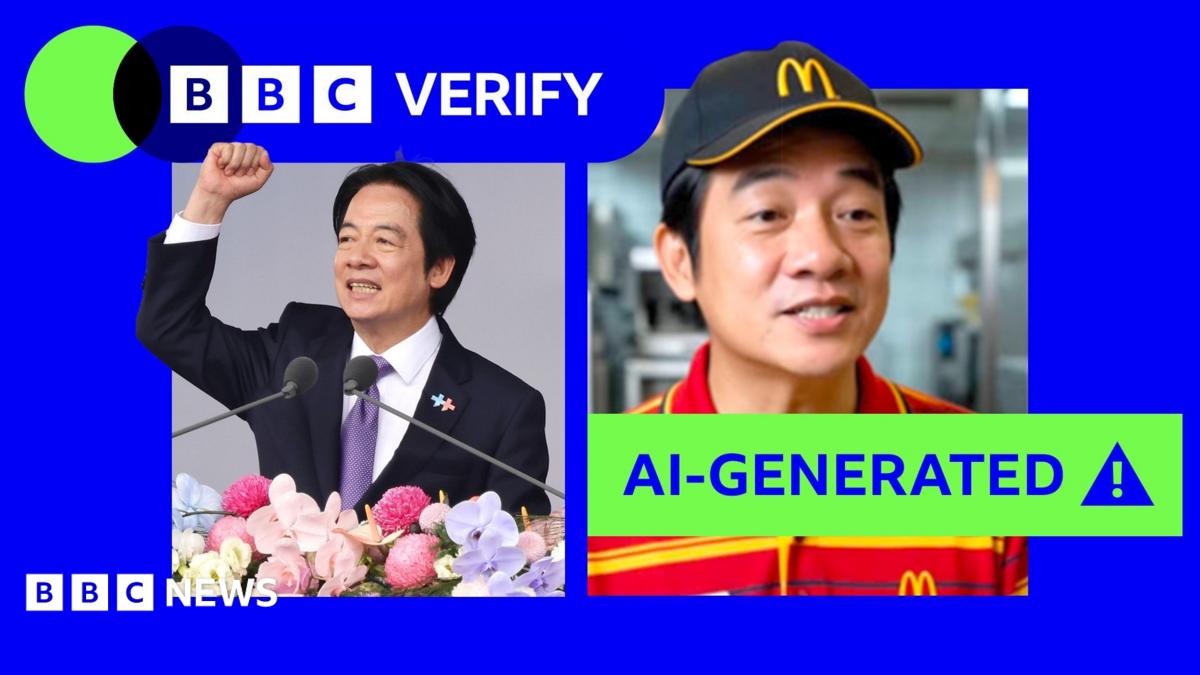
Other debunked claims include allegations that Lai’s predecessor Tsai Ing-wen had fraudulently obtained her PhD from the London School of Economics. The university pushed back on identical allegations in 2019 and confirmed it had awarded her the doctorate.
A number of the social media accounts BBC Verify identified as sharing the disinformation videos appeared to be linked to Chinese firm Borderless, which produces websites that blend apolitical content with pro-China messaging. The network has also been investigated by journalists at the Taiwanese independent media outlet The Reporter, who shared their findings with BBC Verify. Borderless has previously been accused of carrying out “cognitive warfare” against Taiwan by Taipei’s National Security Bureau and the firm has been contacted for comment.
Analysts confirmed to BBC Verify there were also linguistic clues that the accounts, which presented themselves as based in Taiwan, were actually posting from China. The posts occasionally used a simplified Chinese script introduced by the Communist government which was never adopted in Taiwan.
The posts mostly appeared during regular office hours, which Wang suggested showed a “professional” operation, while the accounts originating outside Taiwan showed evidence of election interfering. “When they pretended to be citizens in another country and used these accounts to manipulate the public opinion of the other country during the campaign, it is definitely election interference,” Wang added.
Earlier this month, Taiwan’s central election commission aired an advert warning voters to “beware of AI-generated deepfake videos” circulating online that could seek to influence the upcoming election. It comes as government officials flagged nearly 2,700 social media accounts to Meta that it claimed were part of a Chinese information warfare campaign, Reuters reported. Meta said it had removed the accounts.
Andrew Yeh of the China Strategic Risk Institute said the ultimate goal is not to favour any party. “China’s information operations succeed not just by backing one candidate or opposing another, but by diluting Taiwan’s policy debates, driving polarisation and degrading Taiwanese citizens’ trust in their democratic processes,” he said.
“Regardless of whether the KMT or DPP comes out on top, a more fractured and more divided Taiwan is in Beijing’s interests.”