

The attacks culminated in an RSF raid on 8 June. Hospital staff were taken by surprise – many of them escaped over the back wall as the RSF fighters entered the building, says Dr Mustafa Ahmed, a pharmaceutical specialist.
But the director general of the hospital, surgeon Izzeldin Ahmed Dawaud Asow, encountered a group of the paramilitaries outside his office.
They did not know he was a doctor, he said, but denounced him with ethnic slurs.
“There are no citizens here. You are Falangi,” they said, using a derogatory term implying that non-Arab Sudanese are foreigners.
Dr Asow says he was beaten with rifle butts and lost consciousness at one point. Ultimately, he saved himself by pretending to be dead.
“They put their hand on my chest, and I stopped breathing. And they said: ‘Leave him, leave him. The rubbish has died. Leave him.’ They left me.”
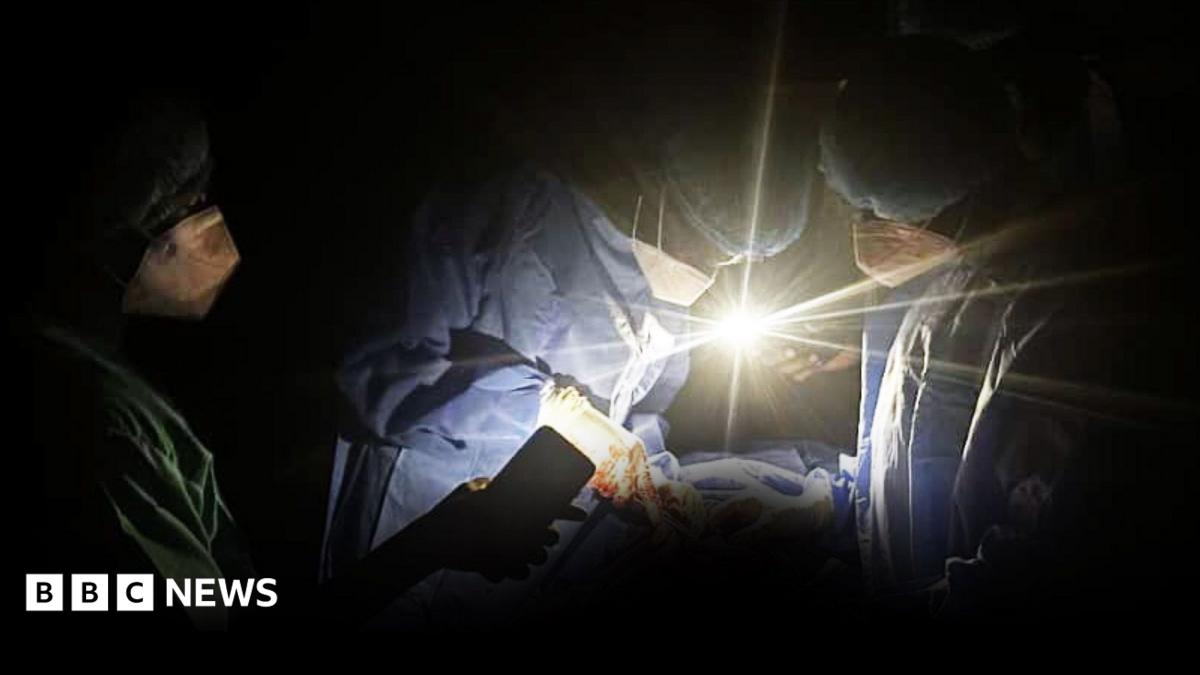
That same day the RSF was driven out by the Sudanese military and its allies and Dr Asow returned to find the bodies of several patients and the surgical equipment in his operating room thoroughly destroyed, he said.
The hospital closed and later fell into RSF hands when the army retreated.
Dr Alaa Eldin Nugud, a prominent Sudanese surgeon who has joined the RSF-backed civilian government as health minister, insisted the South Hospital was being used as a military base.
According to international law, hospitals can lose their protection if they are used by a party to the conflict to commit an “act harmful to the enemy”.
In an interview with the BBC, Dr Nugud declared that missile launchers were set up on the grounds and shared a video showing remains of weapons filmed more than a year after the hospital closed, which he said supported his claim.
He also showed us what he called maps of landmines planted around the Teaching Hospital, which is located next to Sudanese military headquarters.
Doctors told us the hospital was not incorporated into the base and said they visited it to pick up medical equipment during the war.
The BBC has found no independent evidence of Dr Nugud’s allegations. And the government of the Darfur region categorically rejected the charges.
After the South Hospital shut, its staff and remaining equipment were moved to the Saudi Maternity Hospital in the west of the city, where the army had its main bases.
Within days the pace of attacks on the facility picked up. At this stage the medical charity Médecins Sans Frontières (MSF) sounded the alarm.
“We do not know if hospitals are being intentionally targeted, but… the belligerents are not taking any precautions to spare them,” it said in a statement.
However, in the course of our investigation we spoke to six doctors who described a pattern of systematic targeting.
They told us how Saudi Hospital was repeatedly struck – on some days up to 25 times, with a mix of shelling and drones, the latter “intelligent rockets” with precision-guided attacks.
Smaller medical facilities also came under fire. The BBC’s timeline records the steady closure of private hospitals and neighbourhood clinics.
Furthermore, when some of these healthcare buildings shifted locations, the alternate venues were also attacked.
The Specialised Children’s Hospital, which shut down at the beginning of the war along with the Teaching Hospital, moved to two other locations, both of which were then shelled and forced to close.
Similarly, the main dialysis centre was struck and then attacked again after it relocated.