








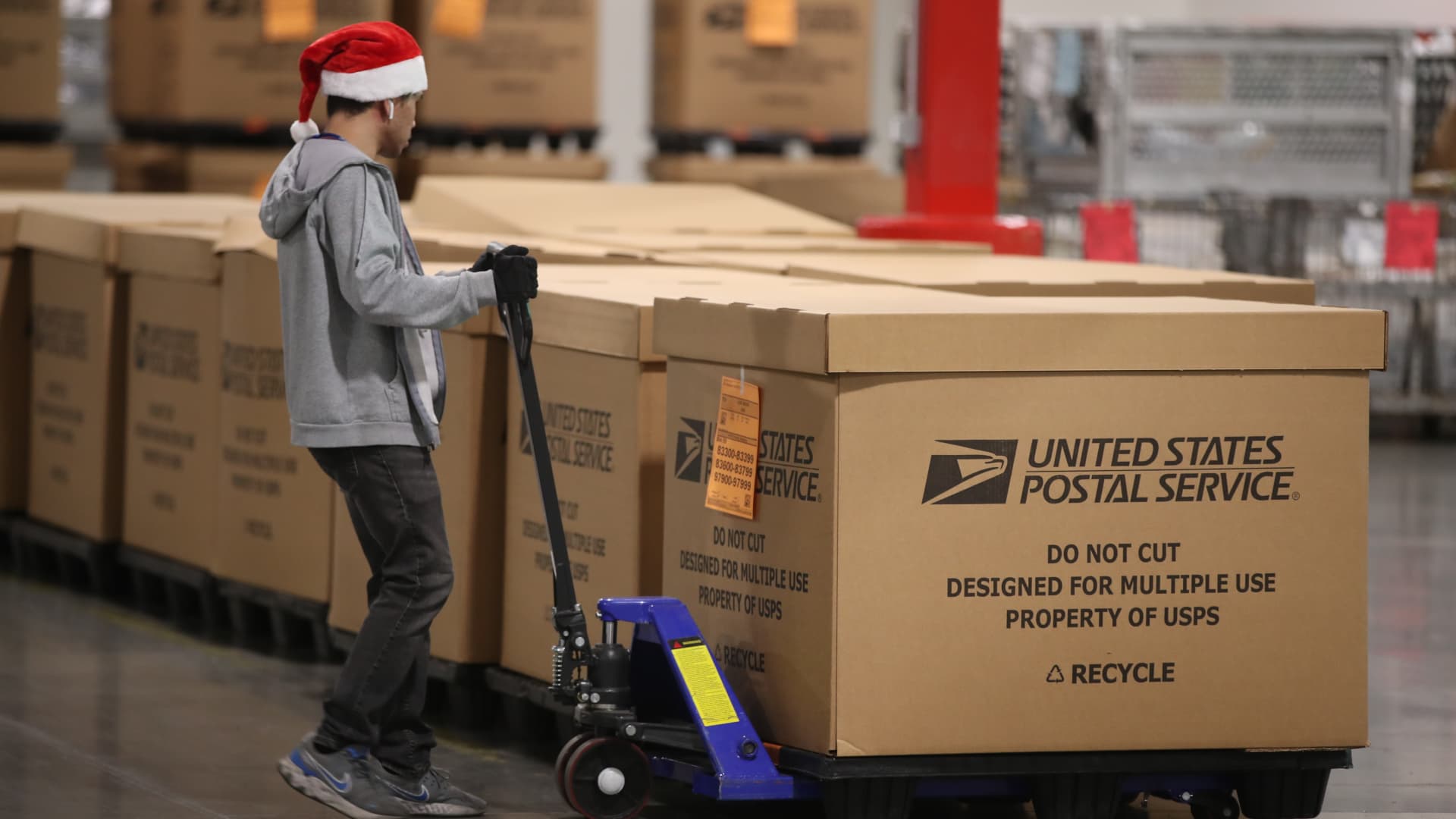
An employee moves large boxes of mail at the United States Postal Service Los Angeles Processing and Distribution Center, in Los Angeles, Nov. 30, 2022.
Allen J. Schaben | Los Angeles Times | Getty Images
When Jenni Shields began her small business eight years ago selling handmade hair accessories, she paid $2.93 to ship an order, or close to $4 in today’s dollars when adjusted for inflation.
Last year, Shields said, an average shipping label for her products cost around $4.50. But when she took a typical batch of orders to her local U.S. Postal Service office last month in Kansas City, Kansas, she was shocked to see that it was an average of nearly $6 per package.
Shields is just one of the small- and medium-sized retailers who are struggling to keep up with rising shipping costs as the price of fuel continues to trend upward.
Small business owners such as Shields are facing a difficult holiday season. Customer demand is strong, but some retailers said their profits will be dented — if not eaten up entirely — by higher shipping and other costs.
Shields said she charges her customers $6 in shipping fees, which includes roughly $1.50 to cover her packaging supplies. The dramatic upswing this year means she’s no longer breaking even on her orders and instead eating the added costs, she said.
“I am losing money at this point, and I’ve really taken a huge hit this year,” said Shields, the owner of Evie Pearl Handmade, which sells bows, quilted headbands and other accessories. “I feel like it’s just been this slow increase up [in shipping costs], and I feel horrible.”
Rethinking free shipping
The surge in fuel prices since the U.S. and Israel attacked Iran in February has driven up the cost of shipping by sea, air, rail and road.
That means higher costs across the board, including for shipping giant Amazon, which reported an 11% increase in shipping expenses in the third quarter compared with last year, to individual retailers.
Globally, air cargo is going for about $3.37 per kilogram, up 43% from a similar period a year ago, according to transportation marketplace Freightos. Judah Levine, Freightos’ head of research, said in addition to higher fuel, demand for fast shipping of hardware used to build data centers is helping to boost air freight rates, even weeks before peak last-minute holiday packages take to the skies.
For businesses, that runup is going to “squeeze their margins in the near-term,” said Jason Seidl, managing director and transportation analyst at TD Cowen. “Larger companies tend not to be exposed to the spot market, and they’ll have what we call dedicated deals in place.”
But that doesn’t help smaller companies, which are walking a delicate line of not wanting to alienate customers who have enjoyed free shipping for nearly a generation.
Todd Shelton, founder of the eponymous 23-year-old New Jersey clothing company that makes high-end men’s jeans, T-shirts and button-up shirts locally, said he started charging customers for return shipping this week for the first time after absorbing the higher expenses this year. The shipping is deducted from customers’ refunds.
Shelton said his costs have been rising for materials, too, such as his imported Japanese denim and shirt fabric from Portugal. The company is still profitable, but the higher costs have eaten into profit margins as they stay elevated, he’s considering raising prices or charging for shipping to customers, he said.
Shields said she’s considering raising her shipping fees for the first time in six years to keep up with the increases.
The holiday season is one of Shields’ busiest. But she said she’s seen a slowdown in sales because of shipping fees.
Jenni Shields owns Evie Pearl Handmade, which sells bows, quilted headbands and other accessories.
Jenni Shields
“I can’t compete with Amazon on the free shipping. I can’t do that. I can’t afford that,” she said. “I’m seeing so much of my percentage that’s supposed to come back to me and my family being put towards the shipping costs.”
With no sign of fuel prices declining significantly, Shields, who runs her business out of her spare bedroom at home, said she’s not sure that small businesses will be able to emerge on the other side of the holidays.
Surcharges and strong demand
Shippers including UPS, FedEx and USPS have all instituted holiday surcharges, with prices varying by package type and lasting through the end of the season. Though that’s typical during the peak holiday period each year, those charges have continued to rise over the past few years.
But even as costs everywhere climb, consumers are still spending.
According to the National Retail Federation, retail sales through the end of the year are expected to grow 4.2%, translating to total spending of $1.01 trillion. That’s compared with last year’s holiday sales totaling $972 billion, which was 3.1% growth.
Some of that growth is from inflation, meaning consumers are simply paying more for the same goods.
“Customers all expect to spend more this holiday, but part of why they expect to spend more is they expect things to cost more, not because they’d like to spend more or they were hoping to get more quantity of stuff,” said Aaron Cheris, the global retail practice head at Bain & Company. “So what I suspect happens is that non-discretionary categories do fine, because you buy the food you were going to need to buy anyway, but then the amount of cash that’s left over for [discretionary] goods is less.”
Still, Cheris said it’s shaping up to be a record year for shipping costs, which is putting immense pressure on smaller retailers. That means many retailers may find themselves in financial distress in the first quarter of next year as they struggle to make it through the holiday season.
He added that larger retail companies will also have to reckon with rising costs, though they may not feel those effects until later quarters because they have shipping contracts that have already been locked in and have control over their own delivery fleets.
“If anything, it benefits the scale players over the little players, but it’s kind of a little bit bad for everybody,” Cheris said. “I think that is the challenge.”