




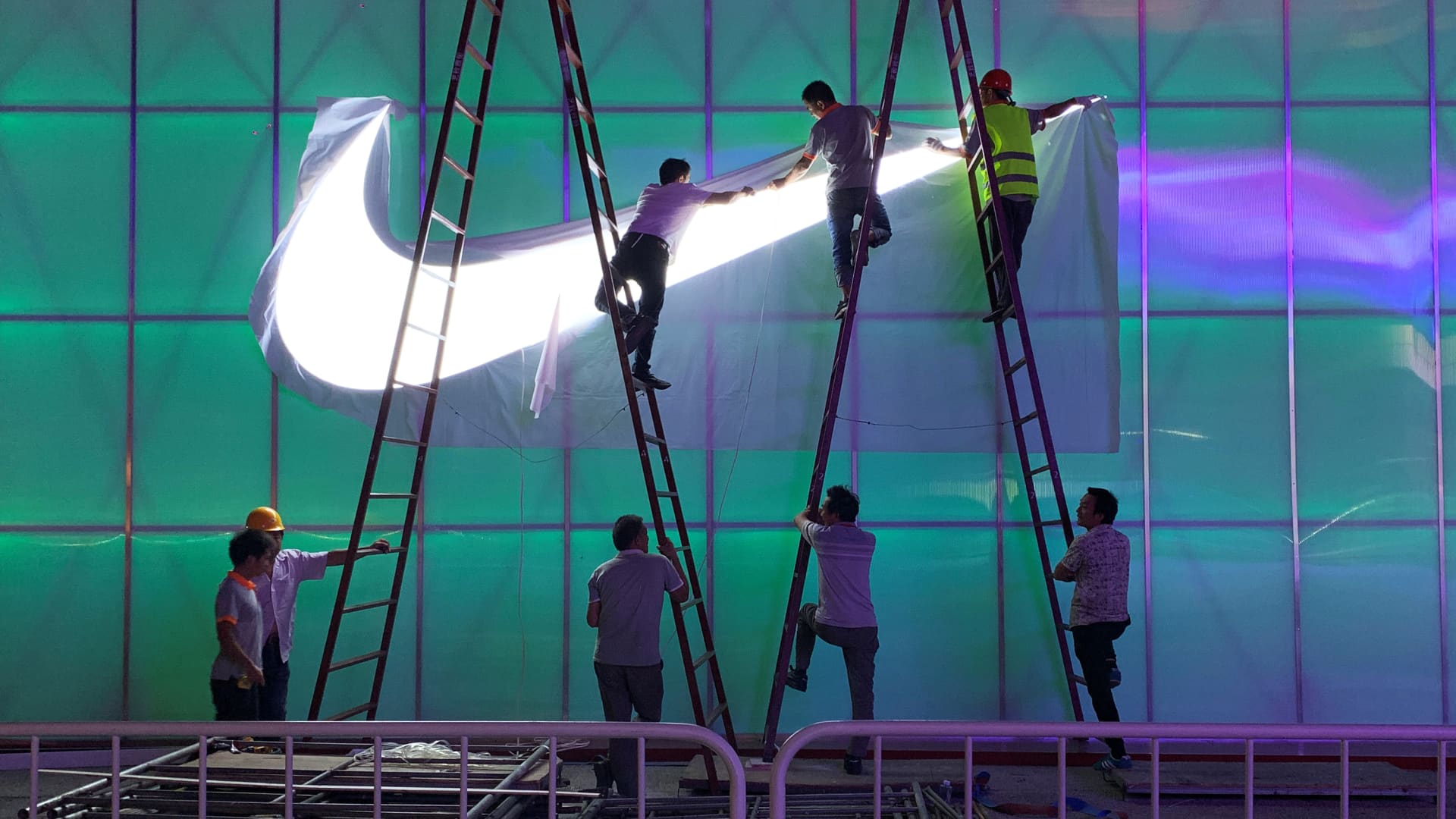
Workers install a Nike logo lamp outside the Wukesong Arena in Beijing, Aug. 28, 2019.
Tingshu Wang | Reuters
By all accounts, Nike’s business in China should be firing on all cylinders.
Sports-related products are the fastest growing consumer category in China and participation in sports and exercise is at its highest level in decades. The overall sportswear market has ballooned 51% in the past five years, fueled by a new focus on healthy living, according to GlobalData.
But instead of thriving during China’s sports renaissance, Nike’s business in the region is languishing. Sales have fallen from the prior year eight quarters in a row, and the overall business has shrunk 30% since 2021, with annual revenue hitting its lowest level in eight years at the end of May.
China was once Nike’s fastest-growing region, beloved by investors for its high margins and potential for sustained growth. Now, it’s the company’s smallest market and has become a drain on a global turnaround that some on Wall Street believe is taking too long.
Some U.S. analysts expect Nike’s China business to recover once its North America operations stabilize, but experts on the ground told CNBC its challenges in the region are deeper, and far different, from what it faces at home. Young Chinese shoppers are increasingly choosing domestic brands over expensive foreign names as part of a larger “China Chic” movement, and consumers are hungry for a localized assortment — not the same product that’s being replicated from Utah to Shanghai. Nike is also working to overhaul its distribution model in China, which critics say has become messy, overly complex and driven by discounts.
“In a way, Nike has just become irrelevant,” said Yaling Jiang, the founder of consumer research firm ApertureChina and an expert on the Chinese consumer. “I don’t think young people can remember what’s the last new thing they’ve done. But if you mention Adidas to them, they will tell you about … their pet clothes, pet jerseys, or their China jackets.”
During its most recent earnings call, Nike’s outgoing finance chief Matt Friend couldn’t say when the China business would return to growth, telling analysts that revenue trends in the near term “will be in line” with recent performance and “profitability will bottom before sales.”
In January, Nike CEO Elliott Hill announced Cathy Sparks, a 25-year Nike veteran, would become the next vice president and general manager of Greater China, reporting directly to him.
In an interview with CNBC, she said Nike is taking the steps it needs to reconnect with Chinese consumers.
“The one thing that I have certainly learned over the last six months is that the Chinese consumer has changed and they have high standards for what they want through product connections, engagement with the brand,” said Sparks. “We know that if we can design footwear and apparel, lifestyle or performance, that’s specifically targeted towards the unique needs of Chinese consumers, we’ll drive full price revenue.”
A Nike spokesperson pushed back on the idea that the company has lost relevance in the region and said what’s changed is younger shoppers are looking for “hyperlocal connections,” including through events and broader cultural moments.
“Nike has been in China for more than 40 years, and from day one, our approach has been to start with local consumer insight and turn that insight into inspiration, innovation and storytelling that can spark movement,” the spokesperson said.
How ‘China Chic’ changed the sneaker market
When Nike turned to China as its next major growth market in the mid-2000s, it won by largely replicating its global strategy and betting that popular clothes and shoes in the Western world would also land with Chinese shoppers.
For a time, the bet was right.
“The premium brand at the time that was available was Nike. Nike was just clearly better. They had cooler designs. They were more expensive. There was more brand cache,” said a retail consultant based in Shanghai who advises domestic and international brands, including Deckers and Adidas, and asked not to be named to protect client relationships.
“If you go back to the early 2000s, if consumers had some money to spend, they were really quite image conscious. They wanted to show that they had whatever the nice thing was and at the time, Nike was it.”
By the end of fiscal 2021, Nike’s annual revenue in China hit an all time high of $8.29 billion. But in the backdrop, the tide was starting to shift against Western brands.
A general view shows a Nike store in Guangzhou, Guangdong Province of China, July 22, 2026.
Qin Zihang | Visual China Group | Getty Images
In March 2021, a previous statement Nike made saying it was “concerned” about reports of forced labor in the Xinjiang region resurfaced, leading some Chinese consumers to call for a nationwide boycott and post videos online of them burning their sneakers. Popular Chinese actor Wang Yibo terminated his contract as a representative for Nike as domestic competitors Anta and Li-Ning doubled down on their use of Xinjiang cotton, using the conflict as a nationalistic marketing opportunity.
The controversy, which also impacted other Western brands that put out similar messaging, helped supercharge a political campaign that Chinese President Xi Jinping started years earlier called Guochao, or “China Chic” in English. It was designed to drum up pride in Chinese made and designed products and promote domestic brands over international ones.
“In line with the period of 2010 to just before Covid, people did feel like maybe they were inferior if they wear Chinese brands … but the elevating cultural confidence campaign really shifted that mindset,” Jiang said. “What this political campaign does is it also encouraged a lot of e-commerce platforms, including Alibaba’s Taobao, Tmall and JD.com, to have a separate section just for the China Chic brands and … people started adopting this China Chic mindset and started feeling like owning something from your own culture is cooler than owning foreign brand.”
Now, many younger consumers feel more connected to domestic brands like Anta and Li-Ning over premium, foreign brands like Nike, said Tracy Dai, the director of operations at consulting firm China Skinny, which helps overseas companies enter China or expand there.
“Years ago when you’re talking to a high school boy asking which sports shoes you may want, they probably say Nike or Adidas, but right now if you ask them, they say Anta or Li-Ning,” Dai said. “[Nike] probably is not that cool to them anymore.”
A Nike spokesperson said all brands in China are facing intense competition and a “more demanding consumer environment” and it believes its efforts to reset the region “put us on the right path to win back consumers.”
Beyond nationalism, Nike’s decline in China is also about value.
In the 20 years since Nike started supercharging its expansion in China, domestic brands have gotten better at production, marketing and brand building.
At the same time, Chinese consumers have become more practical and selective, prioritizing value and innovation over branding, said Wei Kan, who spent around 15 years at Nike and Converse in China and Taiwan before starting his own brand consultancy firm Conduit Asia. As shoppers become more involved with sports and niche fitness activities, highly technical products are becoming more popular than Nike’s assortment.
“Nike is still more like a global, generalist brand at this moment. At the same time, a lot of products, the innovation pipeline is actually slower than the local brands and also the competitors,” said Kan. “Chinese consumers are very sophisticated compared with like five or 10 years ago … it all goes back to how the consumer perceives what kind of value they want to get from a shoe.”
Nanjing styles via Portland, Oregon
While domestic brands have become major market leaders in China, some international brands are still winning, too. Lululemon‘s comparable sales, which exclude new store openings, grew 20% in China in fiscal 2025, while Adidas brand revenue grew 13% in the region during the same period.
Similar to Nike, Adidas had seen its business dramatically slow in China, but it’s now growing again after the company shifted its focus to local product creation, decentralized decision-making and empowered local teams.
For example, Adidas’s local team designed and released its mega-viral Chinese Track Top jacket earlier this year in celebration of the Chinese New Year. The jacket sold out within 27 minutes and became a global phenomenon, with some on social media saying they flew to China specifically to buy the item or spent hundreds to snag one through reseller sites like StockX.
It’s also nailing local marketing. Recently, Adidas botched a translation on its website in the product description for a jacket and ended up becoming a viral meme. Rather than ignoring the meme, it created a T-shirt with the mistranslation on the front, Jiang said.
Meanwhile, experts said Nike has struggled to create the same kind of localized products and marketing. During the World Cup, its marketing campaigns came off as similar to what it was doing a decade ago, said Jiang.
Part of the issue is that the Greater China team gets limited autonomy to release products and campaigns quickly without oversight from the corporate office in Portland, analysts said.
“So everything, especially in terms of design, everything is actually coming from global,” said Kan, who worked in marketing and branding for Nike and Converse in the region before leaving the company in November 2024. “There are very limited room for the local teams to build and also design the locally relevant products to the consumers. I think that is actually the biggest issue for the Chinese consumers here.”
When asked about Nike’s decision-making being concentrated at its headquarters, Sparks said the characterization was “not unfair” but added there is “nobody checking any of this work telling us yes or no.”
“I have felt from the moment I’ve landed in China that our local team has full autonomy to do what we need. Of course, working within the guardrails that are brand right,” said Sparks. “I’m seeing that come to action with the marketing that we’ve put out. We are localizing retail concepts. The product design that you’re gonna see from this team is really authentically Chinese, very relevant.”
Last week, Sparks announced the company had hired its first-ever Greater China vice president of local product creation, who will be focused on building an assortment that’s designed, developed and made in China for Chinese shoppers.
The company plans to start with two lifestyle capsules — one for Nike sportswear and one for Jordan streetwear — that’ll be ready in time for the holidays, followed later by performance apparel and footwear.
“We’ll be doing this over the next 18 months, bringing all these new capabilities on board so that we can complement global innovation with local innovation needs, styling needs, fit needs, even color, which can be unique in China,” said Sparks.
Why Nike is resetting China distribution
Marketing and localization aside, Nike’s China distribution model has become a complex web that Sparks is now working to unwind after the company allowed its brick-and-mortar distributors to start selling online during the Covid-19 pandemic even though their distribution agreements didn’t include digital.
“What we didn’t do was reset that coming out of Covid as consumers returned to brick and mortar,” said Sparks. “And because of that, it just created this incredibly fragmented marketplace where the consumer journey became really messy. Our ability to tell clear innovation stories, nearly impossible.”
Sparks said the decision to shut down those online storefronts is necessary to repair Nike’s China business, but BNP Paribas equity analyst Laurent Vasilescu estimates the change could reduce the company’s revenue by as much as $1 billion annually, representing about 17% of total sales in the region.
In response, Sparks said the change means some distribution will inevitably go away but “we believe we’ll be able to replace total value with full-price sales and a more premium experience.”
“We actually believe it is critical. If we don’t reset is where the long-term impact will continue to slide in a direction that we don’t want to see,” said Sparks. “We don’t actually believe that we will have a long-term negative impact. We think it’ll be stronger.”