







Thousands of flights were canceled or delayed Saturday morning as airlines struggled to recover from a nationwide ground stop that halted U.S. departures for more than four hours Friday.
By 9:30 a.m. ET Saturday, flight tracking service FlightAware had logged more than 3,700 cancellations and 1,990 delays. Hartsfield-Jackson Atlanta International Airport, Chicago O’Hare International Airport and New York’s John F. Kennedy International Airport were among the hubs experiencing the most disruptions, according to FlightAware.
The Federal Aviation Administration lifted the ground stop at 8:15 p.m. ET Friday. More than 7,000 flights were canceled Friday, and airports across the country filled with stranded passengers. Delta Air Lines, United Airlines and American Airlines said Friday evening that they were resuming flights.
A senior government official told NBC News on Saturday that the system that caused the outage had been identified and taken offline. The FAA said a router sent too much data, overloading older air traffic control equipment.
What caused the ground stop
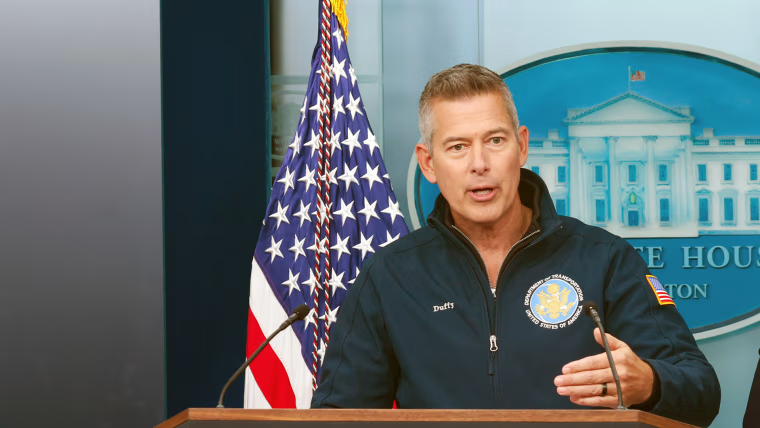
Transportation Secretary Sean Duffy said Friday evening that controllers began seeing inconsistencies in radar data and communications with aircraft at 3:36 p.m. ET. The FAA issued the ground stop at 3:54 p.m. ET, “due to extraordinary circumstances and for reasons of safety.”
Duffy said the FAA retained some radar and communications capabilities and halted departures as a precaution. Medical flights, including those transporting organs for transplant, were allowed to continue.
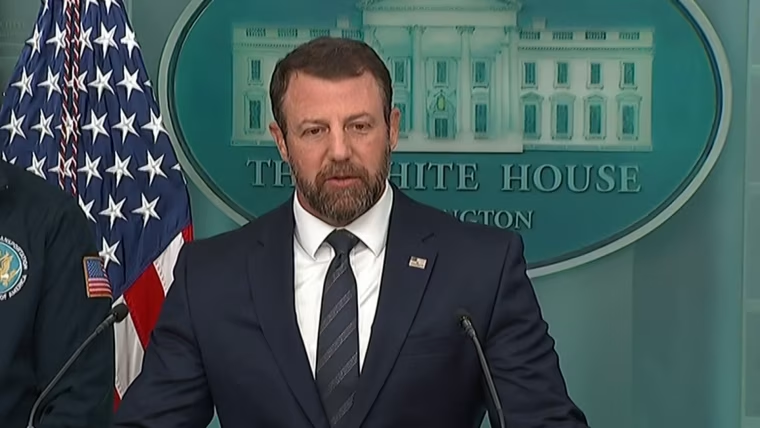
Homeland Security Secretary Markwayne Mullin said Friday night that authorities had found no evidence of a cyberattack.
“FAA was able to handle it. We did it out of an abundance of caution,” he said in a news conference from the White House Friday night. Earlier on Friday, he described the issue as a telecommunications outage.
Why disruptions continued Saturday
Airlines had to get planes and crews back into position after the ground stop, and some crews may have reached limits on how long they could stay on duty. Duffy said he expected air traffic to recover before the Thanksgiving rush.
But by 6 p.m., Reagan Washington National Airport had run out of room to park aircraft and Chicago O’Hare International Airport was nearing capacity, a source with knowledge told NBC News.
Deveren Werne was on an American Airlines jet that was about to take off from Indianapolis to Chicago when suddenly the pilots announced that all flights were grounded.
“At first, the pilot announced that there was some kind of radio issue,” Werne, 55, of Greenville, South Carolina, told NBC News in a telephone interview. “Then a little while later, the pilot said something like, ‘There is something going on that’s more serious than that.’”
Werne said he began hearing from friends who were also stuck on planes, including one on a runway in Chicago. His plane headed back to the terminal so passengers could get off.

Friday’s ground stop is perhaps the most severe consequence of what Duffy described as a decades-old air traffic control system that uses analog equipment, which has led to several issues and outages over the past few years.
In May 2025, radar screens at Newark Liberty International Airport went black during a 90-second outage.
Duffy said the legacy equipment will continue to fail and pushed Congress to approve $50 billion to overhaul the system. Congress last year approved $12.5 billion over five years to upgrade air traffic control, Reuters reported.
Mullin said although authorities cannot rule out a cyberattack, there was no evidence to suggest there was one. “There’s nothing completely certain right now. It doesn’t appear that way,” he said.
Meanwhile, Air Space Intelligence, the AI tech startup that is a vendor for the FAA on its new SMART system for air traffic control, insisted its software was not responsible for the nationwide ground stop.
“The current ground stop is not based on or a result of the SMART system, any product of ASI or our integration with FAA and ATC,” the company said in a statement posted to X.
Duffy said the SMART system is “completely disconnected” from the equipment that suffered issues Friday.
Several hours after the ground stop was announced, a top aviation expert estimated that anywhere from 300,000 to 400,000 passengers were stranded — and it was anybody’s guess when they would get to their destinations.

“Daily, we have about 25,000 flights in U.S. domestic markets,” Vikrant Vaze, a Dartmouth professor who specializes in commercial aviation logistics, wrote in an email to NBC News. “I would say we should have around 3,000 to 4,000 flights held up at this time over the past 2 plus hours.”
With planes stranded on runways, the likelihood increased that some of these planes would have to be diverted to other airports, the source said.
Aviation safety expert Jeff Guzzetti called the outage “extraordinary.”
Guzzetti emphasized that pilots are trained to operate through communications outages and that there are redundancies in place for such instances. Pilots “could get information relayed through other means” to ensure planes are spaced properly for landing.
There are different layers of communications — high-altitude, midlevel and the towers on the ground. The high-altitude control centers are the ones affected by the outage.

Nationwide ground stops are extremely rare
Ground stops across the nation are a rarity in U.S. history.
After the Sept. 11, 2001, terrorist attacks, the FAA ordered an unprecedented nationwide ground stop. All civilian air traffic across U.S. airspace was halted and airborne planes were ordered to land at the nearest available airports.
In January 2023, the FAA grounded all flights for a few hours, blaming a failure in the Notice to Air Missions system, which alerts pilots to a host of potential dangers.
Officials at the time blamed contract personnel for the outage, saying they accidentally deleted files while working to correct the synchronization between databases. The error prompted a computer outage that lasted approximately an hour and a half, Department of Transportation officials said at the time.