



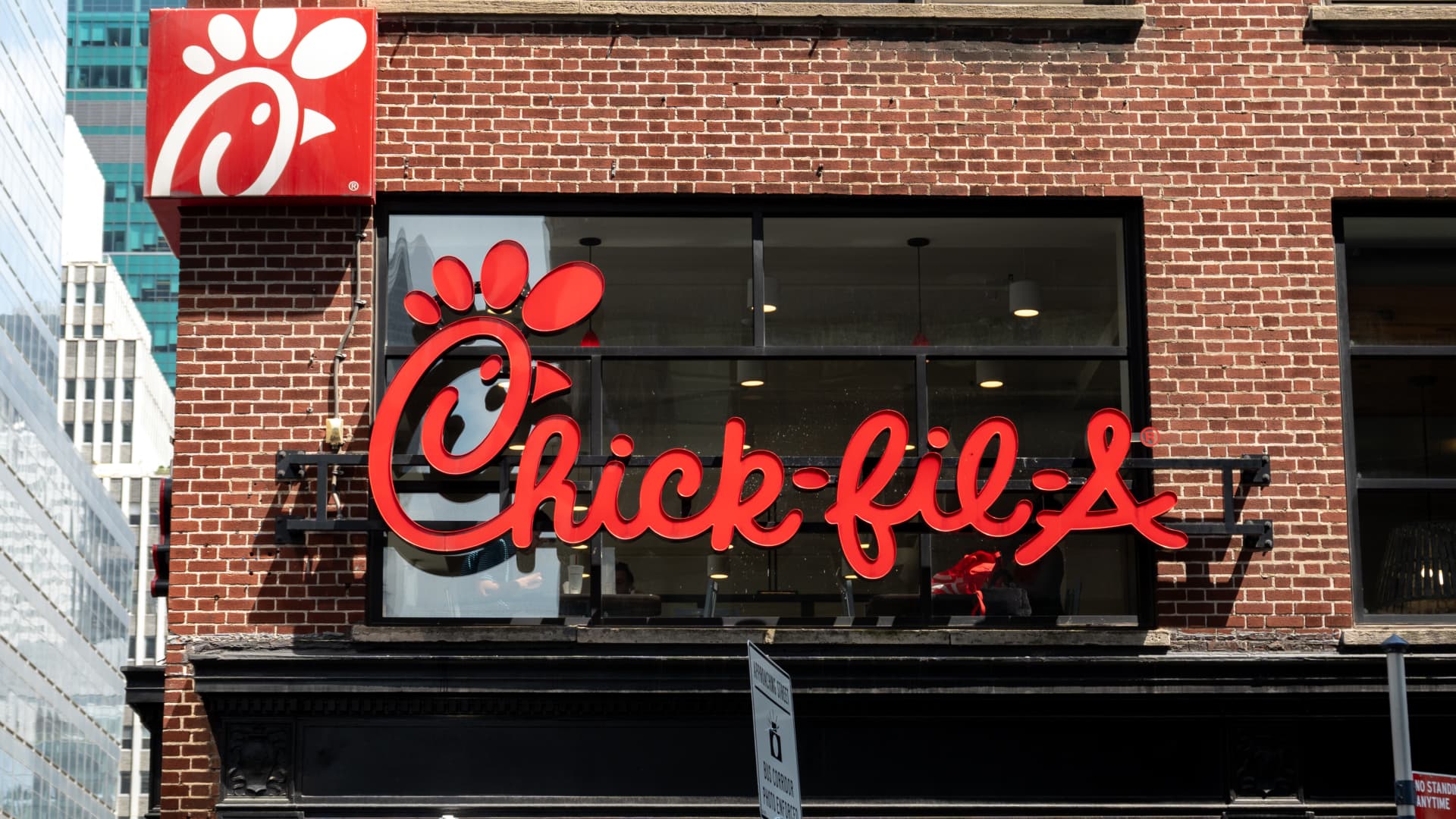
Chick-fil-A location in New York City, Aug. 6, 2026.
Marcin Golba | Nurphoto | Getty Images
With restaurants as far-flung as Singapore, Chick-fil-A has expanded far beyond its Southeastern stronghold in recent years, but CEO Andrew Cathy still wants the family-owned business to stay true to its roots.
Nearly five years ago, Cathy succeeded his father, Dan, as chief executive of the chicken chain his grandfather, S. Truett, founded. He took the reins as elevated inflation rocked the restaurant industry and a bevy of new chicken rivals looked to challenge Chick-fil-A’s dominance. Since then, not much has changed — except for sluggish traffic across the industry as consumers have become more selective about their dining choices.
The challenging conditions have led to disappointing results for McDonald’s, Popeyes, KFC and other restaurant competitors. While Chick-fil-A is not immune to these headaches, Cathy told CNBC that the chain’s restaurants have not seen the same downturn.
“This has been a good year,” the Atlanta-based Cathy said in downtown Manhattan before a planned activation to raise awareness for the chain’s Shared Table hunger relief program.
“Our operators have done such a good job executing on the fundamentals and adding the hospitality to it,” he added.
As a privately held business, Chick-fil-A does not report quarterly results. However, franchise disclosures reveal that the company’s revenue in 2025 rose 14% to $10.3 billion, while its net income ticked up 1% to $1.05 billion. Its roughly 3,000 locations generated $23.92 billion in system sales last year, making it the third-largest U.S. restaurant by sales, trailing only McDonald’s and Starbucks.
Chick-fil-A has no plans for an initial public offering or any other opportunities for outside investment. Cathy said the company plans to stick with its “calculated” and “conservative” growth.
Chick-fil-A CEO Andrew Cathy.
Source: Chick-fil-A
But he may be underselling Chick-fil-A’s recent expansion. It opened 179 restaurants last year and has launched in international markets like Canada, Singapore and the United Kingdom in recent years.
Staying private also has advantages, particularly as restaurant stocks have broadly struggled this year. Shares of Jersey Mike’s have fallen nearly 28% since its initial public offering in July, while Dunkin’ owner Inspire Brands is reportedly unlikely to go public this year unless the sector’s performance improves.
“We’re able to plan for the quarter century, and we don’t have to plan for the quarter,” Cathy said.
Balancing Chick-fil-A’s past and future
During Cathy’s tenure so far, Chick-fil-A has pursued bold ideas for future growth, like a $1 billion international expansion plan and Daybright, a new beverage-focused restaurant concept created by its venture arm.
But the company is trying to balance those new strategies with its existing traditions.
“I look at driving this business like driving a race car — there’s a reason that the windshield’s bigger than the rearview mirror,” Cathy said. “It’s important for the rear view to be grounded on where you are, and there are things that we think about our purpose, our mission, that won’t change, but everything else we have to be able to evolve and change.”
Some tenets, like staying closed on Sundays, will never change. Others, like its restaurants’ signature Southern hospitality, will evolve as diners change their ordering and eating habits.
People eat at a Chick-fil-A restaurant in Penn Station on Aug. 9, 2025, in New York City.
Gary Hershorn | Corbis News | Getty Images
Cathy said that Chick-fil-A takes a “human plus” approach to technology in its restaurants.
“We think about all these new things into the future, about how will people want to receive food in the future?” he said. “As you think about drone delivery and all the other kind of things that could be coming, it’s a fun time in the industry, to think about all the possibilities of what we can do to make a better experience for our guests.”
While Chick-fil-A is exploring opportunities to use artificial intelligence behind the scenes, he said that its restaurants will not pursue AI voice ordering in its drive-thru lanes, unlike many of its industry rivals. McDonald’s, for example, said at its investor day in September that it plans to test Archy, its voice AI tech, to take orders in both English and Spanish.
“From our experience, we really want that hospitality to be human to human,” Cathy said. “We’re not gonna substitute that interaction with technology, because we feel like that hospitality is so important to create that warm environment for consumers.”
Other restaurants are also refocusing on hospitality, hoping that the extra effort from employees will encourage customers to come back. Starbucks bought around 200,000 Sharpie markers so its baristas could write friendly messages on customers’ coffee cups. Burger King has redefined its restaurant manager role into a “Your Way Champion,” who greets diners and fixes botched orders. And starting Monday, McDonald’s will begin its “Make It Golden” training program for franchisees and employees, which focuses on hospitality as well as food quality.
Chick-fil-A’s long-standing focus on service has made it the fast-food leader in customer satisfaction for more than a decade, according to the annual American Customer Satisfaction Index. That reputation can also help the chain stand out from other dining options as consumers have grown more choosy about how they spend their money. Jersey Mike’s recently toppled Chick-fil-A in the 2026 study, although Chick-fil-A’s score was unchanged from a year ago.
Waffles and pimento
Another enduring element of Chick-fil-A is its famously simple menu. But the chain has even been carefully expanding its offerings, typically through seasonal limited-time items like chicken and waffles or its Honey Pepper Pimento Chicken Sandwich. If a menu item is a “home run,” as Cathy calls it, then Chick-fil-A might add it permanently, like its Pineapple Dragonfruit drink line.
“We’re very careful about what we want to do, because we want to keep it really focused on unique Chick-fil-A items that they can only get at Chick-fil-A,” Cathy said. “But we do want to bring in new flavors and profiles, and that’s what we’ll do with a lot of our seasonal items that we do, and we learn a lot from our customers about trying those things.”
The Chicken & Waffles Sandwiches with the grilled filet from Chick-fil-A at a restaurant in Washington, Aug. 25, 2026.
The Washington Post | Getty Images
Other fast-food chains are trying to edge into Chick-fil-A’s territory. In 2019, Restaurant Brands International’s Popeyes sparked the “chicken sandwich wars” by releasing its own version. Chick-fil-A remains the dominant chicken chain in the U.S., with roughly a 43% market share as of 2024, according to Barclays. However, the chicken sandwich helped catapult Popeyes to the No. 2 spot, with about 11% share.
McDonald’s could reignite the battle as it prepares to test hand-breaded chicken strips and sandwiches.
But Cathy said that he loves the competition.
“I’m grateful that there’s competition in the chicken space, because that means we’re in a good space to be,” Cathy said. “Competition just makes us better …. What little details can we do to make that environment even more welcoming for customers?”
Red Wagon Ventures
Chick-fil-A has also innovated outside its restaurants.
In 2017, the company created Red Wagon Ventures, named for the vehicle Truett used to sell bottles of Coca-Cola in his first entrepreneurial gambit at age 6.
“The lion’s share of our time and effort is continuing to make sure that we’re getting better and better at Chick-fil-A, but we do have a small team that’s working and incubating some of these new ideas and thinking about what could be some things that could help us grow into the future,” Andrew Cathy said.
Some of those ventures are based in the restaurant industry. Its experimental Little Blue Menu concept served traditional Chick-fil-A menu items along with burgers, pizza and onion rings; the chain will convert its final location into a traditional Chick-fil-A next year. More recently, the subsidiary opened Daybright, which serves coffees, smoothies, juices and doughnuts — but no chicken sandwiches or waffle fries.
Another Red Wagon Ventures bet is even further from Chick-fil-A. Last year, it launched Acrew Home Professionals, a home repair and maintenance business that nodded to the Chick-fil-A ties by promoting “service with a smile,” according to its website.
“I think from a family business standpoint, we’ve got to build off of our core competencies and look at other types of things that we can get into, so we can continue to serve customers in unique ways,” Cathy said.
Cathy said that he studies family businesses, and those that have been around for more than 100 years still have to think about innovation and think ahead. At 80 years old, Chick-fil-A still has a few more decades to go before it hits the century mark.
“My grandfather was entrepreneurial to the core. He died at 93, and he opened a new business at 92 years old that he created himself,” Cathy said, referring to Truett’s Luau, a Hawaiian-themed restaurant concept that opened during the same month that Truett handed over the reins of the family business to his son.
In addition to starting its own brands, Red Wagon Ventures will explore acquisitions of family businesses, Cathy said. Most likely, those will be companies without a succession plan or just looking to sell — in other words, very different from Chick-fil-A.