



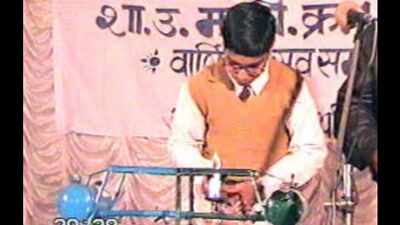
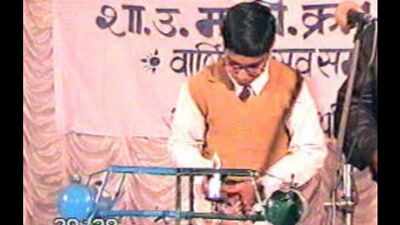
At a time when most teenagers were focused on school and science assignments, 16-year-old Vyasji Mishra was trying to solve a practical problem with an unusual idea. A Class 11 student from Devsar in Madhya Pradesh, Mishra developed a hybrid stove that used kerosene for initial heating and water converted into steam as an alternative heat source. The invention attracted attention at science exhibitions and eventually won him first prize at a science exhibition in 2003. However, the device was not a stove that could run on water alone. It combined kerosene heating with steam to reduce the amount of kerosene needed. Later testing also found that the prototype could save around 20% of kerosene, making the invention more accurately described as a fuel-efficient hybrid stove rather than a water-powered stove.
How Vyasji Mishra developed the unusual stove
Mishra’s interest in science had started early. Before developing the stove, he had already participated in several science competitions. In 2000, he created a model of a drip irrigation system that won first prize at a science exhibition. The idea for the hybrid stove came from an earlier attempt by his elder brother, Pawanji Mishra. Pawanji had tried to develop a similar model for a science fair in 2001-02 but could not successfully complete it. When Vyasji decided to enter the “Sources of Energy” section of a school science exhibition in 2002-03, the brothers returned to the idea and began working on a new design. According to National Innovation Foundation, they spent around six months developing and manufacturing the prototype.Their design combined two conventional kerosene stoves and used three regulators. One regulator controlled the flow of kerosene, another controlled water and the third was used to switch the burner on and off. Controlling the flow of both liquids was one of the biggest challenges. The three-regulator system helped the brothers manage the process and switch between the two heat sources.
Two tanks, one burner and a steam-based heating system
The prototype had two separate tanks, one for kerosene and another for water. Both were connected to a common burner assembly. Pumps were used to create air pressure, while pipes carried the kerosene and water towards the burner. The stove had to be started with kerosene. The burner was heated until it became sufficiently hot. The kerosene supply could then be reduced or stopped and the water supply opened. The heated water produced steam, which was then used as part of the heating process. When the burner became too cool and the flame weakened, the system had to switch back to kerosene to raise the temperature again. The process could then be repeated.This explains why describing the invention simply as a “stove that runs on water” can be misleading. Water was not replacing kerosene completely. Instead, the invention explored how steam could be incorporated into the heating system to reduce kerosene consumption. The National Innovation Foundation’s records list the invention as “Stove (Kerosene and Steam Heated)” by Vyasji Mishra. Its Grassroots Innovation Database, developed with the United Nations Development Programme, describes it as a fuel-efficient hybrid stove based on kerosene and water.
The idea showed promise, but still needed more research

Mishra himself recognised that the prototype had limitations. Since the system relied on water and steam, the burner could eventually cool down and stop working. He wanted to develop a version that could continue operating without interruption until the user switched it off. The design also required safety precautions. When the water regulator was opened, the kerosene regulator needed to remain closed. The tanks also had to be kept clean to prevent dirt from interfering with the system. The broader goal was to reduce kerosene consumption and smoke. The concept was considered potentially useful for households that depended on kerosene, as well as small establishments and certain industrial settings.However, the invention required independent testing before its performance could be established. The National Innovation Foundation reported that the Indian Institute of Petroleum in Dehradun had reservations about the concept, while IIT Guwahati worked on optimising it. After calibration, IIT Guwahati found that the stove could save about 20% of kerosene, rather than achieving the much higher savings initially claimed. The National Innovation Foundation later supported the development and market research of the stove through its Micro Venture Innovation Fund. Its 2004-05 annual report lists Vyasji Mishra among innovators whose projects received support under the programme.For Mishra, the project was also a story of persistence and family support. His father worked as a clerk at the Devsar Tehsil Office, and the family had limited financial resources. His elder brother provided technical and financial assistance while they worked on the prototype. The invention may not have created a revolutionary water-only cooking system, but it demonstrated something equally important: how a young student could take a practical problem, experiment with basic materials and turn an idea into a working prototype. Its recognition at science exhibitions and later support from innovation institutions showed that grassroots ideas can attract serious attention when they offer a possible solution to everyday problems.