

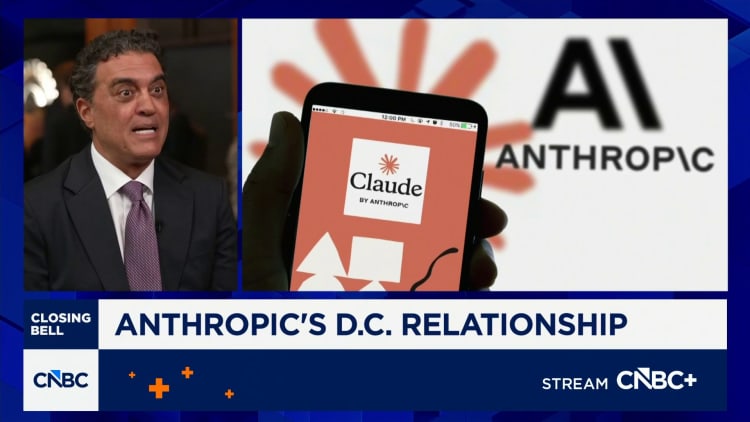
In this photo illustration, the Anthropic logo is seen on a smartphone with a Claude Mythos logo in the background.
Sopa Images | Lightrocket | Getty Images
Anthropic’s suspension of its top AI models late last week drove home a hard truth for the companies that were counting on them: access can be cut off at any time.
It’s been a big theme this week, and one that Wall Street will be watching closely as Anthropic and OpenAI gear up for potentially massive IPOs in the coming months.
Microsoft CEO Satya Nadella is warning of the risks, even as his company is the principal investor in OpenAI, and backed Anthropic last year to the tune of billions of dollars. He wrote Monday in a post on X that companies need to “build agentic systems that improve over time, while still retaining control over their IP.”
“The last thing any of us want is a world where every company across every sector is ceding value to a few models that eat everything they see,” Nadella wrote.
Investors have been trading on that theme. MiniMax and Zhipu, the Chinese open-source AI lab, both surged on Monday as the Anthropic fight put a spotlight on downloadable models that companies can run themselves.
The Anthropic-Fable news landed at an awkward moment late Friday. Roughly two hours earlier, SpaceX had wrapped up its first day of trading following the biggest IPO on record. SpaceX’s xAI unit is a niche player in artificial intelligence, but CEO Elon Musk is an outspoken voice on the topic.
Anthropic announced it had pulled access to its Fable 5 and Mythos 5 models to comply with an export control directive from the U.S. government that cited “national security authorities.” Anthropic abruptly disabled the models for all of its customers in order to ensure compliance, but said all of its other models would not be affected.
For developers who want full control over model access, there’s another approach. An open-source model can be downloaded, run on a company’s own infrastructure, and customized for its data and needs. When the model lives on a company’s own servers, no political fight can switch it off.
Yash Patel, CEO of Applied Compute, which helps companies train and run custom models, said the Anthropic fight “highlighted the significance of owning your own model.” He said the shift has become much more mainstream of late.
“What we’ve been hearing increasingly, probably more so in the last month than the entire year, is the fact that they want a multimodal future,” Patel said. “They don’t want to be locked into a single vendor.”
That could be a problem for the U.S., as the the open models winning the most adoption are from China, just as the world’s two biggest economies are in a battle over controlling the future of AI.
Models from DeepSeek, Tencent, Xiaomi, and MiniMax all rank among OpenRouter’s most-used this month, even against closed competitors. Zhipu framed its latest release as a rebuttal of sorts to Washington. Cutting-edge AI, the company argued, shouldn’t belong to a handful of players or be withdrawn at will.
Cost could also speed adoption. As the price of state-of-the-art AI climbs, companies are already routing routine work to cheaper models and saving the most expensive ones for the hardest tasks.
Patel said customers are reacting to what he called a “token-pocalypse” as AI products move toward usage-based pricing.
“The era of token maxing is over,” he said. Companies are now looking for “better, cheaper, faster models.”
That is pushing some enterprises to reconsider models they would have dismissed months ago, including open models from China.
“Before it was just kind of like I don’t even want to talk about it,” Patel said. “Now they’re like, OK, how good could it be, and if it’s good, we’ll figure it out.”
It’s a reminder that the AI market is still in its infancy, with ChatGPT’s public release occurring less than four years ago. For investors, that reframes who is actually leading the AI race. The winners may not just be the big closed model labs, despite what their current valuations suggest.