





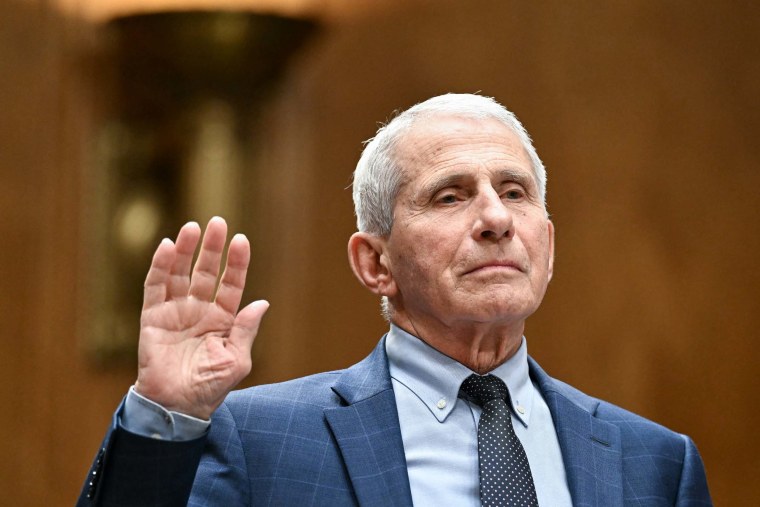
Dr. Anthony Fauci declined to answer senators’ questions at a hearing Wednesday on the origins of Covid and the government’s handling of the pandemic, saying he would invoke his Fifth Amendment right to avoid the possibility that Republicans could try to use his testimony to prosecute him for perjury.
The surprise decision shook up the hearing, which was expected to be contentious given Fauci’s previous public clashes with Chairman Rand Paul, R-Ky.
In his opening statement to the Senate Homeland Security and Governmental Affairs Committee, Fauci pointed to Paul’s “obvious obsession with calling for my prosecution, his repeated slanderous comments about me” and his decision to publicly release the doctor’s personal journal.
“The only conclusion I can reach is that the sole reason he is calling me before this committee is to get me to say something — anything — that could vindicate his repeated public pledges that I end up, in his words — quote — ‘behind bars,’” Fauci said.
“Any reasonable person who has followed his unhinged obsession with me would readily come to the same conclusion,” he continued. “Therefore, although it pains me to do so because of the respect I have for the legislative branch of government and my decades-long record of cooperating with Congress, under the advice of my attorneys, I will invoke my right under the 5th Amendment of the Constitution to refrain from answering your questions.”

Fauci also pointed to his previous appearances before House and Senate committees. He said in his opening remarks that during the nearly 40 years that he served as the director of the National Institute of Allergy and Infectious Diseases, he testified before or briefed congressional committees “well over 200 times.” During his tenure, he said he “proved that I believe in and respect the value of legitimate congressional oversight.”
Despite Fauci’s refusal to respond, Paul still used his time at the hearing to ask the doctor a series of questions.
Fauci answered each question with the same line: “On the advice of counsel, I respectfully decline to answer based upon my rights under the 5th Amendment to the Constitution.”
At the end of his questioning, Paul told Fauci that he would face “repercussions” for not answering questions.
“The committee will have to consider after this hearing what appropriate action should be taken against you for the failure to testify after being directed to do so,” Paul said. “It’s against the law to obstruct an investigation of Congress. There will be repercussions to your refusal to testify today.”

When Paul concluded, Fauci’s attorney tried to say something to the lawmakers. He was repeatedly cut off by Paul, who said he was not recognized to speak. Moments later, Paul ordered security to remove Fauci’s lawyer from the committee room.
Shortly after Fauci’s lawyer left the hearing, he told NBC News that Fauci “has a valid Fifth Amendment privilege, and he has the right to assert it.”
“That’s what I was trying to tell the committee, and that’s all I was trying to tell the committee,” the lawyer said.
The top Democrat on the committee, Sen. Gary Peters, D-Mich., slammed the Republicans’ handling of the hearing, saying in his period of questioning that he believed the hearing “does real damage.”
“It’s tempting to turn one person into the scapegoat for a crisis that hundreds of officials across both the Trump and the Biden administration were responsible for handling,” Peters said, adding that people were facing death threats.
“This is only going to, unfortunately, deter other scientific experts from public service to understand that this is what they would have to go through as they provide their advice to us,” he added.
Ahead of the hearing, Paul pointed to the possibility of Fauci facing prosecution for perjury if he lied to Congress. Paul has previously alleged that Fauci has lied to Congress, an allegation that Fauci has denied.
On Tuesday, Paul responded to a reporter’s question about how he would respond to people who argue that the senator was trying to put Fauci in a position to perjure himself.
“There’s no risk to perjury if you tell the truth,” Paul said. “In fact, he can even admit to not telling the truth in the past. He can admit destroying records. He can admit to, you know not adequately presenting both sides of equations, which isn’t really a crime. He can admit to anything. The only thing he can’t do is lie again.”
Former President Joe Biden issued a preemptive pardon for Fauci in the final hours of his administration. Fauci responded at the time by saying that he had been “the subject of politically motivated threats of investigation and prosecution.” The doctor said he “committed no crime.”
Responding to a question earlier this week about whether he believed Fauci should face prosecution, Paul said, “I think there are a couple of questions,” adding that “we’re going to find out” at the hearing. Paul referenced Fauci’s pardon and expressed the possibility that it could be challenged.
“Whether that will be challenged, I don’t know,” Paul said.
Fauci’s lawyer, David Schertler, said in a statement that the circumstances surrounding Fauci’s appearance “regrettably made his continued cooperation impossible.”
Schertler said Paul has had “an intense and seemingly pathological course of retribution, revenge, and obsession with Dr. Fauci,” which has ultimately led to Fauci and his family facing threats and harassment.
“Dr. Fauci devoted his lengthy career to saving millions of lives globally through scientific discovery and sound public health policy,” Schertler said in the statement. “The accusations that Chairman Paul continues to propagate are false and disgraceful, and we will examine all options to hold him accountable.”
Ahead of the hearing, Paul told reporters that he thinks Americans “would be very disappointed” if Fauci invoked his Fifth Amendment privileges.