


This is CNBC’s Morning Squawk newsletter. Subscribe here to receive future editions in your inbox.
Happy Friday. Microsoft added nearly $450 billion to its market cap yesterday as the stock climbed 15% — its best day since 2008.
Stock futures are rising before the bell following Thursday’s rally on Wall Street.
Here are five key things investors need to know to start the trading day:
1. Big Tech finale
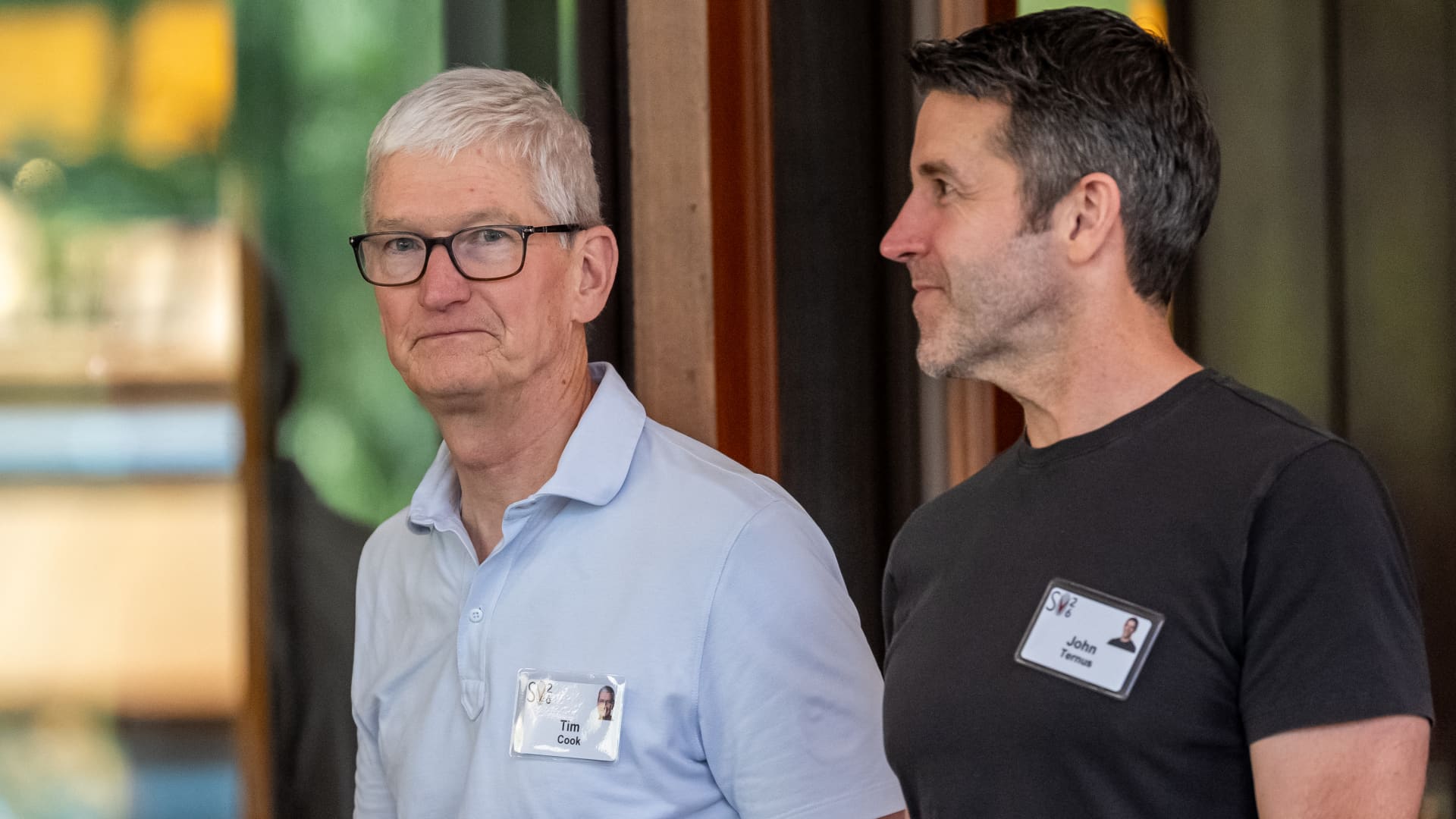
Tim Cook, chief executive officer of Apple Inc., left, and John Ternus, incoming chief executive officer of Apple Inc., during the Allen & Co. Media and Technology Conference in Sun Valley, Idaho, US, on Tuesday, July 7, 2026.
David Paul Morris | Bloomberg | Getty Images
Amazon and Apple closed out a packed week of mega-cap technology earnings, and investors are having starkly different reactions to the two reports.
Here’s what to know:
- Shares of Amazon are up more than 10% this morning after the company topped revenue estimates and reported booming cloud growth. AWS sales jumped 37% in the quarter, the cloud division’s fastest growth since 2021.
- Amazon also hiked its 2026 capital expenditures forecast to $220 billion, up $20 billion from its last projection.
- Meanwhile, Apple shares are more than 7% lower premarket after supply constraints led the iPhone maker to give weak guidance for the current quarter. The disappointing forecast overshadowed a revenue beat and a 22% jump in iPhone sales.
- On his last earning call as Apple’s CEO, Tim Cook told analysts that the company has “enormous opportunities” in AI. Current hardware chief John Ternus will become CEO on Sept. 1.
- The two reports followed a positive day on Wall Street. The Nasdaq Composite climbed 2.8%, rebounding from a six-day losing streak as semiconductor stocks rallied.
- Follow live market updates here.
2. Situational Awareness
Leopold Aschenbrenner
Photo: Josh Edelson
One of the AI trade’s most closely watched investors is unwinding his public stock portfolio.
Leopold Aschenbrenner’s hedge fund, Situational Awareness, suffered steep losses as AI infrastructure stocks fell and short positions in software names moved against it, people familiar with the matter told CNBC’s David Faber. The fund was left scrambling to raise cash to meet margin requirements, and Citadel agreed to buy the fund’s publicly traded assets, according to people familiar with the deal.
The fund founded by Aschenbrenner — a 25-year-old former OpenAI researcher — had grown to as much as $45 billion before the losses hit.
3. Crude results
The ExxonMobil and Chevron company logos are displayed on the floor of the New York Stock Exchange during morning trading on July 24, 2026 in New York City.
Michael M. Santiago | Getty Images
Rising crude prices led to surging second-quarter profits for ExxonMobil and Chevron, which both reported earnings this morning.
Chevron’s net income for the period jumped nearly 400% from the same time last year to $12 billion, while Exxon’s profits nearly doubled. As CNBC’s Spencer Kimball reports, the average closing price of U.S. crude futures from April through June was 27% higher than the previous quarter, as the Iran war caused major supply disruptions.
“We’re kind of firing on all cylinders, which is good, because the world needs it,” Chevron CEO Mike Wirth told CNBC’s Becky Quick.
4. Tariff reflex
US President Donald Trump speaks during an announcement on the Freedom Haulers initiative at the White House in Washington, DC, US, on Thursday, July 30, 2026.
Jim Lo Scalzo | Bloomberg | Getty Images
President Donald Trump wants to add tariffs on Iran to a bipartisan sanctions bill targeting Tehran and Russia — even though the U.S. imports almost nothing from Iran.
The U.S. imported just $1.4 million in Iranian goods last year, making the president’s proposal “entirely symbolic,” Villanova School of Business professor Jonathan Doh told CNBC. Existing sanctions already restrict nearly all trade with Iran.
But as CNBC’s Kevin Breuninger writes, Trump’s demand could complicate the bipartisan bill, which on Tuesday advanced in the Senate in an 86-12 procedural vote.
5. IP-No?
Actor Danny DeVito, from left, Charlie Morrison, chief executive officer of Jersey Mike’s Subs Inc., Eli Manning, former National Football League (NFL) quarterback and founding partner of Brand Velocity Partners, and Peter Cancro, founder and chairman of Jersey Mike’s Subs Inc., during the company’s initial public offering (IPO) at the New York Stock Exchange (NYSE) in New York, US, on Thursday, July 30, 2026.
Michael Nagle | Bloomberg | Getty Images
Five years after the 2021 IPO boom, more companies are choosing to stay private.
As Laya Neelakandan reports, the rise of secondary markets is giving founders access to capital and liquidity without the scrutiny and reporting burden of being public. “The secondaries market is acting as this pressure release valve to this artificial clock of having to go public,” said Sunaina Sinha Haldea, the global head of Private Capital Advisory at Raymond James.
Thursday’s debuts showed why some may hesitate. Reformation finished roughly flat in its first day of trading, while Jersey Mike’s opened below its IPO price and closed nearly 6% lower.
The Daily Dividend
Here are some articles to bookmark for the weekend:
— CNBC’s Arjun Kharpal, Annie Palmer, Jordan Novet, Kif Leswing, Samantha Subin, Hugh Leask, Lee Ying Shan, Yun Li, David Faber, Spencer Kimball, Kevin Breuninger, Laya Neelakandan and Amelia Lucas contributed to this report.
Josephine Rozzelle assisted in the production of this newsletter and edited this edition.