



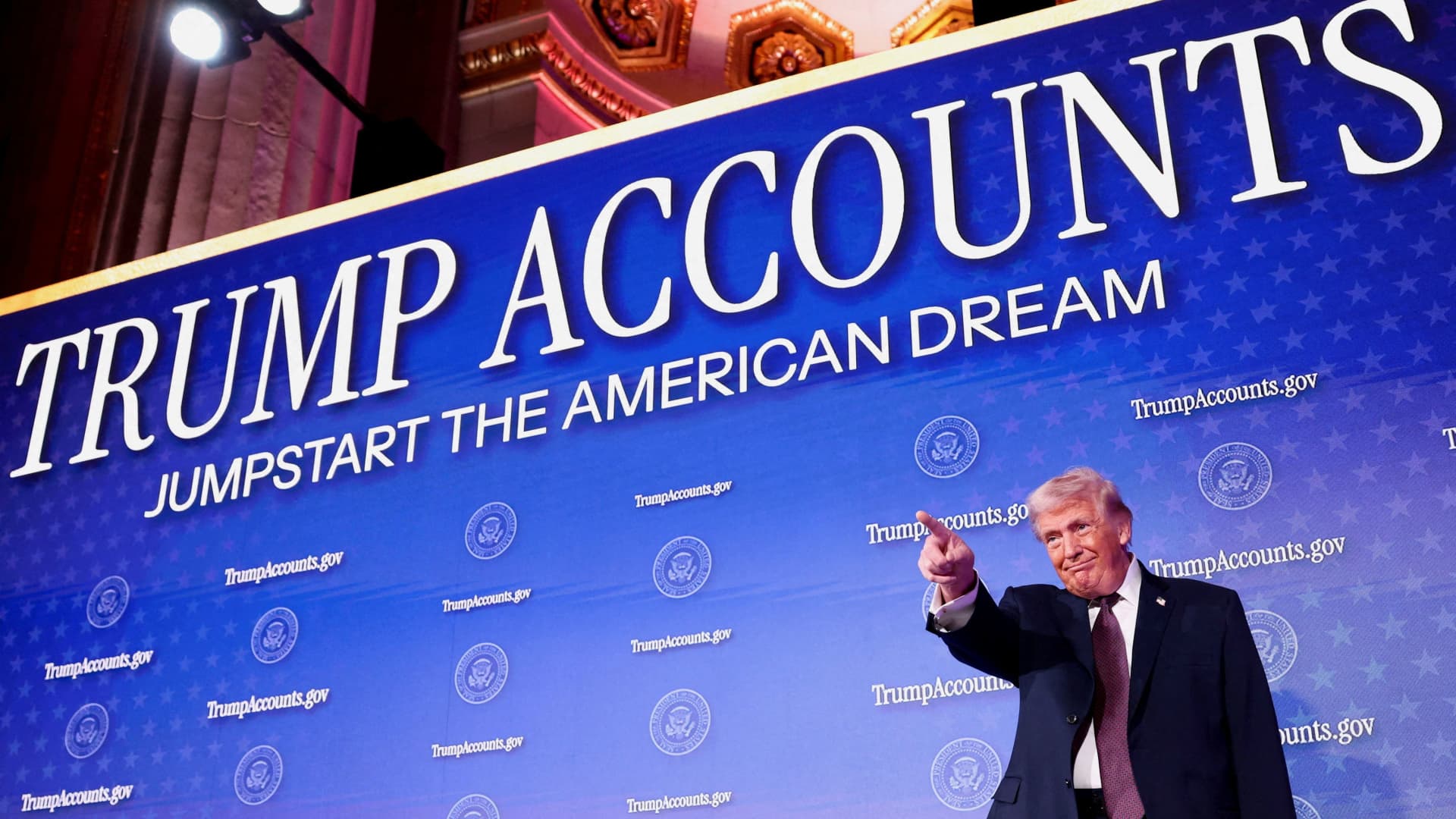
President Donald Trump onstage at the Treasury Department’s Trump Accounts Summit, in Washington, Jan. 28, 2026.
Kevin Lamarque | Reuters
A version of this article first appeared in CNBC’s Inside Wealth newsletter with Robert Frank, a weekly guide to the high-net-worth investor and consumer. Sign up to receive future editions, straight to your inbox.
With the Trump administration weighing whether to allow stock donations to “Trump Accounts” for American children, the potential expansion is raising questions about the legal path — and highlighting the powerful tax benefits — to doing so.
“We all want to maximize more multi-billion gifts into kids accts & the gifts may be cash / shares!” wrote Brad Gerstner, the hedge fund manager who pioneered the investment accounts, in a post on X last week after the New York Times first reported the discussions.
The move would mean a notable change to the program, which currently requires contributions to be made in cash. Michael and Susan Dell, for instance, have pledged to donate $6.25 billion to seed “Trump Accounts” for 25 million children aged 10 and under in ZIP codes with a median income of $150,000 or less.
The structure already comes with tax benefits: Donors can use pre-tax dollars for charitable contributions to benefit a qualified class of beneficiaries. But permitting stock contributions to the accounts would allow donors to offload appreciated shares without paying capital gains tax. Like with other charitable contributions, they can also deduct the stock’s fair-market value against their income.
The double tax benefit would be similar to that of gifting appreciated stock to donor-advised funds and other charitable entities.
“It’s a popular practice for particularly high-income taxpayers that would otherwise be paying a high rate,” said Will McBride, chief economist of the Tax Foundation. “I think it would make sense that they would try to extend the law to apply here.”
“This initiative has Trump’s name on it so I think they’re going to try to make this as taxpayer-friendly as possible,” he added.
A White House official told CNBC via email that the administration “is always open to finding new ways to build on the immense success of Trump Accounts” but said they had no updates to share.
A spokesperson for the Treasury Department declined to comment on the potential to accept stock donations.
“The U.S. Treasury Department is committed to maximizing the impact of Trump Accounts, driving sign-ups for all eligible children, and achieving our goal of having every American child own a Trump Account,” the Treasury spokesperson said via email.
McBride said he thought the change would highly motivate donors to seed the accounts.
“We know that for many of the very top billionaires, much of their wealth is held in stock that’s appreciated a great deal, so they’re sitting on a lot of unrealized gains,” he said.
Still, the practice is hardly new and wouldn’t offer benefits unique to “Trump Accounts,” according to Joseph Rosenberg, a senior fellow at the Urban-Brookings Tax Policy Center.
“My sense is it’s not, like, a game-changer in that sense, because people already have the ability to do it through private foundations and other vehicles,” he said.
Moreover, deductions for these donations presumably would still be subject to the cap 30% of adjusted-gross income, or AGI, that applies to long-term appreciated capital gain property. The tax benefits of charitable giving for top earners also was trimmed by last year’s tax and spending bill.
Manoj Viswanathan, law professor and co-director of UC Law San Francisco’s Center on Tax Law, said it would take more changes to make “Trump Accounts” more appealing from a tax perspective, such as raising the AGI cap for deducting donations to the investment accounts.
Raising that cap wouldn’t make a huge difference for the ultra-wealthy, as their income pales in comparison to their assets, according to Ellen Aprill, senior scholar in residence at UCLA School of Law.
However, donating stock does allow individuals to minimize or even eliminate their estate tax burden, she said. Unlike with income tax, charitable deductions for gift and estate tax are unlimited.
“The gift tax treatment deduction matters a lot to the super rich,” she said. “Making charitable gifts gets the assets out of their estate and still avoids tax on the built-in capital gain.”
The lawyers and tax policy experts who spoke with CNBC were divided on whether allowing stock donations would require legislative action or could be done via guidance from the Treasury or an executive order.
Viswanathan said he didn’t think an act of Congress would be required unless the Treasury wants to allow the accounts to hold individual shares of stocks.
Gerstner suggested in a post on X that “100% of all $$ in Trump Accounts will be in a free index fund that tracks the S&P 500.”
However, the X account for Invest America, the nonprofit advocacy group behind the accounts, said in another post, “Wouldn’t it be great if every kid in America got a share of SpaceX or Berkshire Hathaway or OpenAI?!”
McBride said expanding tax benefits for “Trump Account” donors would face an uphill battle in Congress with a razor-thin Republican majority.