




For well over a century, every car sold has had one thing in common: a physical, mechanical connection between the steering wheel and the front wheels. Steer-by-wire (SbW) removes it entirely.
It’s one of the most significant shifts happening in chassis engineering today, not because it’s new (the first production attempt dates back to 2013), but because the industry has spent the years since then solving the problems that kept it from scaling. In 2026, those problems are finally close to solved, and adoption is accelerating as a result.
This guide covers what steer-by-wire actually is, how it works, why automakers are adopting it now, and, using Automotive IQ’s interview with Bosch’s Dr. Dominic Neumann as a case study, how one of the world’s largest suppliers is tackling the redundancy and cost challenges that have defined SbW’s slow road to market.
What Is Steer-by-Wire?
Steer-by-wire is a steering system with no mechanical, hydraulic, or physical linkage between the steering wheel and the wheels that actually turn. Instead, the driver’s steering inputs are captured by sensors, converted into electronic signals, and sent to a motor-driven actuator at the steering rack that turns the wheels.
It’s the steering equivalent of a fly-by-wire aircraft: control is entirely electronic, with the “feel” of the system – resistance, weight, feedback – simulated rather than mechanically transmitted.
This is a meaningfully bigger step than Electric Power Steering (EPS), which most modern cars already use. EPS replaces the hydraulic pump with an electric motor to reduce assist effort, but it still keeps a mechanical steering column as a backup. Steer-by-wire removes that column altogether.
How Does Steer-by-Wire Work?
At a basic level, a steer-by-wire system is built from two decoupled units:
A steering wheel actuator (SWA), which senses how much and how fast the driver turns the wheel, and generates simulated resistance and feedback so the wheel doesn’t feel disconnected or lifeless.
A steering rack actuator (SRA), which receives the electronic steering command and physically turns the wheels via its own motor.
Because there’s no mechanical link between them, the two units only communicate via wiring and software. This is what unlocks most of SbW’s practical advantages, but it’s also exactly what makes redundancy so difficult: if the electronics fail, there’s no fallback mechanical connection to catch it. That single design trade-off explains almost everything about why SbW took over a decade to reach series production.
A Brief History: From Infiniti’s False Start to 2026’s Breakout Year
The first series-production steer-by-wire car was the 2013 Infiniti Q50, and it had a rough debut. Within months, Infiniti recalled a batch of Q50s over a fault that could disable the steer-by-wire system in freezing temperatures, and owner reviews at the time were mixed, with some drivers unsettled enough by unpredictable behaviour to stop trusting the system. It was a reminder that simulating “feel” electronically, and doing it reliably in every condition, is a genuinely hard engineering problem, not just a wiring exercise.
For most of the decade that followed, SbW stayed largely experimental. Then adoption began building quietly: Tesla’s Cybertruck, the Lexus RZ 450e, the GMC Hummer EV, the Rolls-Royce Spectre, and the Lotus Eletre all shipped with steer-by-wire in some form.
2026 looks like the year SbW crosses into the mainstream. Mercedes-Benz confirmed steer-by-wire for the facelifted EQS, becoming the first German automaker to bring it to production, paired with a new yoke-style steering wheel. Just as significantly, China’s new national steering standard, GB 17675-2025, took effect on 1 July 2026, for the first time formally permitting electronic steering systems without any mechanical backup at all, removing a major regulatory barrier in the world’s largest auto market. Market researchers currently value the steer-by-wire system market at $3.2 billion in 2026, projecting growth to $4.32 billion by 2030 at roughly a 7.8% CAGR.
Why Automakers Want Steer-by-Wire
The appeal isn’t just about removing a part. Decoupling the steering wheel from the rack unlocks capabilities that are difficult or impossible with a mechanical connection:
- Customisable steering feel and ratio. The same physical car can have a relaxed, low-effort ratio in comfort mode and a sharp, weighty ratio in a sport mode — all in software, with no mechanical redesign.
- Improved safety interventions. Because the rack can be moved independently of the driver’s hands, assistance systems can make corrections the driver never has to counteract. In µ-split braking situations (where one side of the car has more grip than the other), a system can actively counter-steer the instant the imbalance is detected, shortening braking distance without the driver noticing the intervention. Automatic evasive steering works similarly — the car can execute or assist a collision-avoidance manoeuvre without the driver over-correcting into a spin.
- Vehicle stability during aggressive manoeuvres. During double lane changes or emergency evasive actions, drivers often oversteer and then counter-steer too late. Multi-actuator systems can reduce that phase lag and cut yaw overshoot automatically.
- Interior packaging freedom. Without a steering column running into the dashboard, designers gain room for stowable steering wheels, new HMI layouts, and cabin configurations that a mechanical column simply doesn’t allow.
- A cleaner path to autonomy. Because steering is already a pure electronic signal, SbW integrates naturally with other electronic control systems and supports remote or automated vehicle control — a genuine prerequisite for higher levels of autonomous driving, not just a nice-to-have.
The Central Challenge: Redundancy
None of the above matters if the system isn’t safe when something fails — and that’s the problem that has occupied most of the industry’s engineering effort. With no mechanical backup, a steer-by-wire system has to be “fail-operational”: able to keep steering the car safely even after a fault, not just fail safely to a stop.
The two safety goals every SbW system has to satisfy are usually described as:
Loss of Steerability – the car must still be able to be steered after a single fault.
Loss of Feedback Torque – the driver must still get some meaningful resistance/feedback at the wheel, even in a degraded state.
Early production systems solved this conservatively, some retained an actual mechanical clutch that could physically re-engage the steering column if the electronics failed. It worked, but it undercut much of the point: you were still carrying the weight, packaging footprint, and cost of a full mechanical backup. The industry’s more recent approach solves redundancy electronically instead, typically through dual, independently-monitored actuators that can each detect the other’s failure and take over.
Traditional Steering vs. EPS vs. Steer-by-Wire
| Hydraulic / Traditional | EPS (Electric Power Steering) | Steer-by-Wire | |
|---|---|---|---|
| Mechanical link to wheels | Yes, direct | Yes, retained as failover | None |
| Failure fallback | Mechanical | Mechanical | Fully electronic (dual actuator) |
| Enables µ-split braking gains | No | Limited | Yes |
| Enables automatic evasive steering | No | Limited | Yes |
| Customisable steering feel / ratio | No | Partial | Full |
| Interior packaging flexibility (stowable wheel, new HMI) | No | No | Yes |
| Commercial maturity (2026) | Legacy standard | Mainstream | Early premium adoption, scaling |
Case Study: How Bosch Is Solving Redundancy and Cost
To see how a major supplier is actually engineering around the redundancy problem, Automotive IQ spoke with Dr. Dominic Neumann, Assistant to the President / Chief of Staff of Vehicle Motion at Bosch, at Automotive Chassis Systems Europe.
Bosch’s current architecture is built around two components:
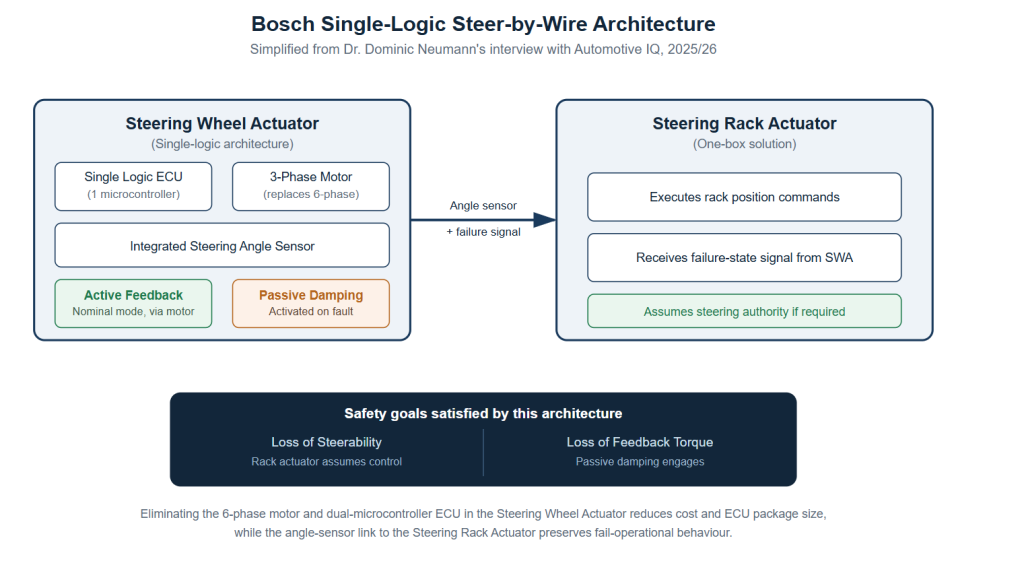
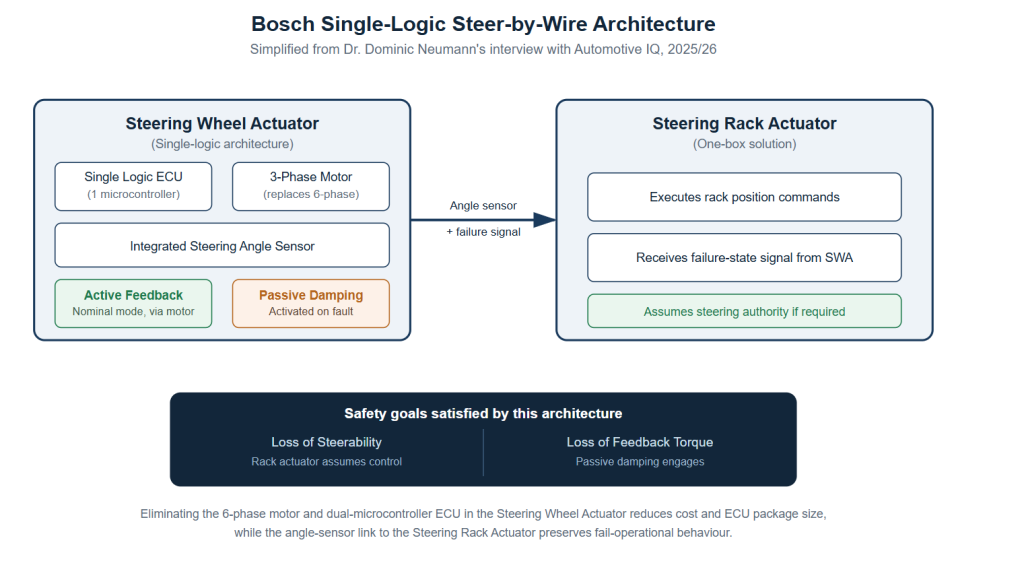
- A single-logic Steering Wheel Actuator (SWA) — a single logic ECU paired with a three-phase motor, replacing the dual-microcontroller, six-phase-motor designs used in earlier redundant systems.
- A “one-box” Steering Rack Actuator (SRA), which can assume steering authority if the SWA reports a fault.
The two communicate via an integrated steering angle sensor built into the SWA. If the SWA detects a failure, it signals the SRA directly, which Dr. Neumann described as sufficient to meet both the Loss of Steerability and Loss of Feedback Torque safety goals. On the feedback side, the architecture splits into active feedback (delivered continuously through the motor in normal operation) and passive damping, a fallback mode triggered automatically on error.
Diagram: Bosch’s single-logic steer-by-wire redundancy architecture
The commercial payoff is direct: dropping the six-phase motor and dual-microcontroller ECU cuts both cost and the physical size of the actuator housing — a meaningful packaging win for OEMs trying to fit SbW into existing platforms without a full redesign. On the safety benefits specifically, Dr. Neumann was direct about the µ-split braking case:
“With a steer-by-wire system, it is possible to actively counter-steer and remove the driver from the loop when such a situation is detected.”
Bosch’s view is that the remaining barrier to wider adoption isn’t safety engineering — it’s variance. Every OEM currently favours its own connector solutions and signal interfaces, forcing suppliers to validate more variants than the market needs and pushing costs up for everyone. Bosch has been here before: a coordinated industry push to standardise brake system connectors years ago meaningfully cut development, validation, and tooling costs across the board. Bosch’s EUCON connector applies the same logic to steer-by-wire, and the company has published its act-by-wire standardisation approach within COVESA, working directly with OEMs to define common interface signals — an increasingly important question as steering functions move toward centralised and zonal vehicle architectures.
What’s Next for Steer-by-Wire
The trajectory is fairly clear: safety-critical redundancy is largely a solved engineering problem at this point, adoption is moving from experimental to premium-mainstream, and the next real bottleneck is industry-wide standardisation rather than any remaining technical barrier. As that standardisation work (through bodies like COVESA) matures, expect steer-by-wire to move from a premium differentiator to a more standard fitment — much as EPS did before it.