




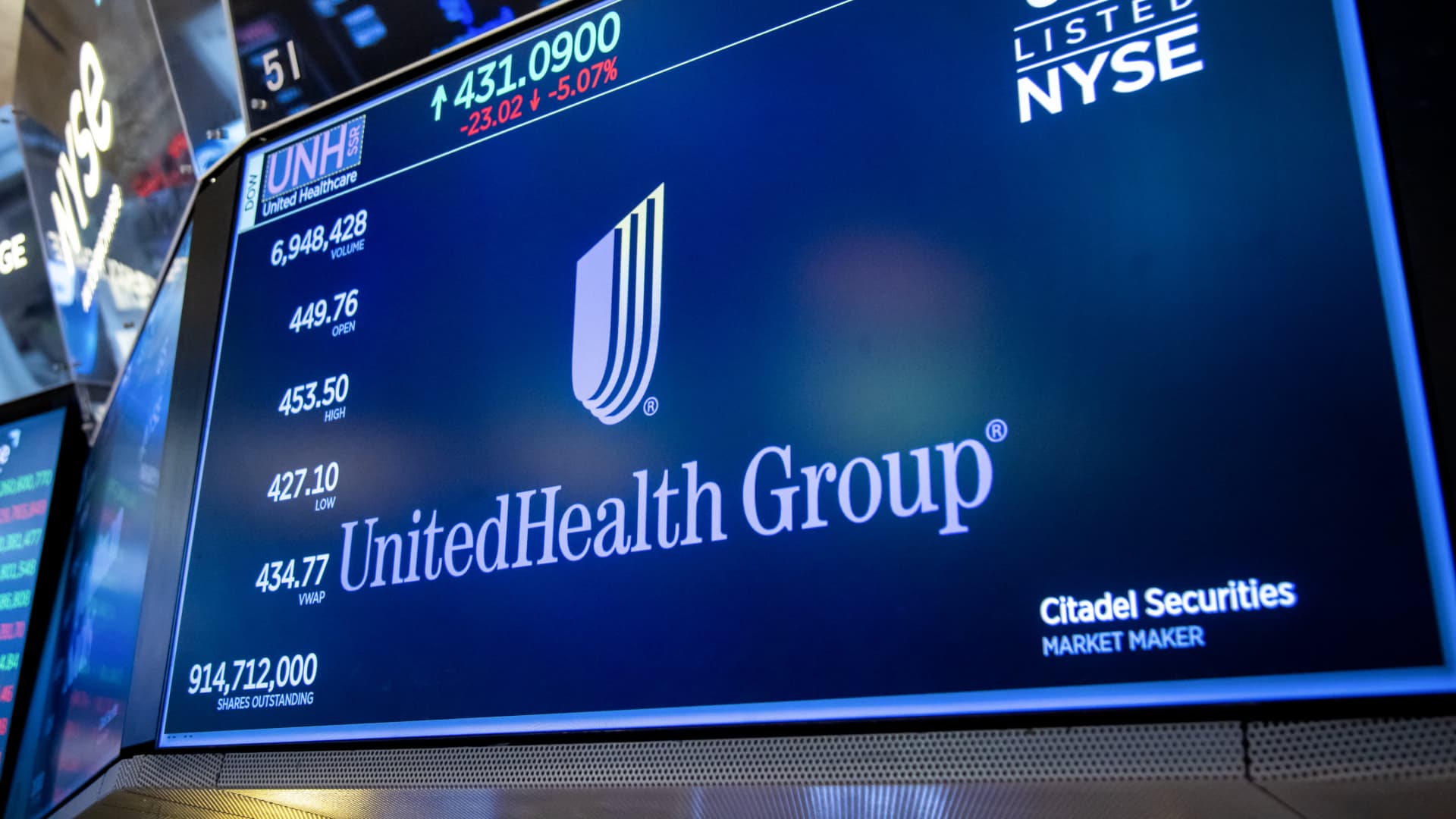
UnitedHealth Group on Thursday posted second-quarter earnings that blew past estimates and raised its full-year profit outlook, as the company better manages high medical costs and uses AI to help streamline operations.
The largest private insurer in the U.S. said it expects 2026 adjusted earnings of $19.50 to $20 per share, up from a previous outlook of more than $18.25 per share. UnitedHealth is maintaining its full-year revenue guidance of greater than $439 billion. But CFO Wayne DeVeydt said in an interview that he expects the company to “do better than that” given the second-quarter beat.
Still, he said medical costs in the quarter remained “elevated over historical levels” – an issue that has dogged the broader insurance industry for more than two years.
“These results are not a reflection of trend bending or coming under control, but rather our efforts to start pushing down what is already an elevated number,” DeVeydt said.
Here’s what the company reported for the second quarter compared with what Wall Street was expecting, based on a survey of analysts by LSEG:
- Earnings per share: $6.38 adjusted vs. $4.90 expected
- Revenue: $112.03 billion vs. $110.85 billion expected
The company’s stock jumped about 7% in premarket trading.
UnitedHealth’s turnaround plan is gaining momentum following restructuring and an executive shuffle designed to counter challenges in the industry. The healthcare giant is working to stabilize margins by shrinking membership, exiting unprofitable contracts and pouring $1.5 billion into artificial intelligence to streamline operations.
DeVeydt said the company is using AI to improve both efficiency and patient care. For example, AI is helping speed up processes like prior authorizations and improve payment accuracy by detecting potential fraud, waste and abuse. That can help lower costs while improving patient care. AI tools are not determining whether care is approved or denied, he said.
“I would say the turnaround, and I would emphasize that on our culture, it’s really happening … that turnaround is translating to strong, strong earnings,” DeVeydt told reporters. “So it shows that when we can do things the way we think they should be done, that we can be both a solution and be profitable.”
But he emphasized that the turnaround is a “multi-year journey.”
The company posted second-quarter net income of $5.48 billion, or $6.04 per share, compared with $3.41 billion, or $3.74 per share, in the same period a year ago. Excluding items like business divestitures, restructuring and the expected reduction of reserves for unprofitable contracts, UnitedHealth earned $6.38 per share.
Revenue climbed to $112.03 billion from $111.62 billion in the prior-year quarter. The company’s insurer, UnitedHealthcare, and its Optum health-care unit both topped analysts’ sales estimates for the quarter, according to StreetAccount.
UnitedHealth said rising healthcare costs are forcing insurers to raise premiums and adjust benefits, which is contributing to membership losses in both ACA exchange plans and privately run Medicare Advantage plans. The company said revenue has remained stable because higher pricing is offsetting the decline in enrollment.
But DeVeydt said that dynamic “is not a good thing for the system long term.”
UnitedHealthcare served 48.5 million people in the second quarter, down 525,000 from the previous quarter. DeVeydt attributed membership declines largely to affordability pressures driven by higher healthcare costs, forecasting a loss of roughly 500,000 ACA exchange members and 1.1 million Medicare Advantage members in 2026.
Insurers, particularly those that run Medicare Advantage plans, have been pinched by an influx of people seeking care they delayed post-pandemic and high-cost specialty drugs like GLP-1s, among other factors.
But UnitedHealth’s medical benefit ratio — a measure of total medical expenses paid relative to premiums collected — came in at 86.7% for the second quarter. That’s an improvement from the 89.4% reported in the year-earlier period. A lower ratio typically indicates that the company collected more in premiums than it paid out in benefits, resulting in higher profitability.
Analysts were expecting a ratio of 88.5% for the quarter, according to StreetAccount.
The results come about a year after UnitedHealth revealed it is facing Department of Justice investigations over its Medicare billing practices.
DeVeydt said the company has no updates but continues to be “supportive” of the probe.