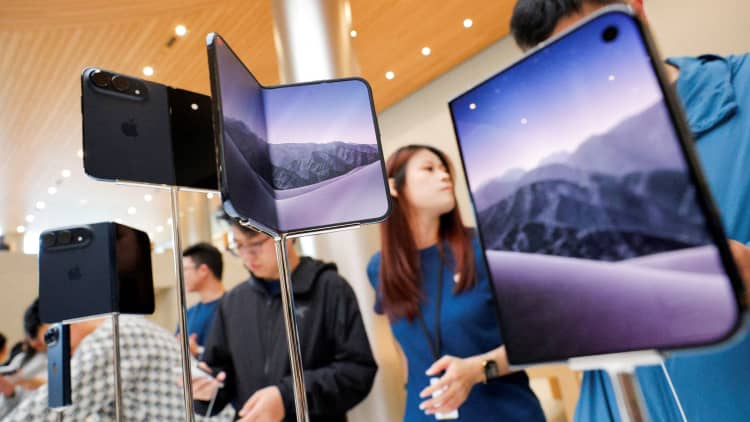




Visitors wear smart glasses during the sixth China International Consumer Products Expo CICPE in Haikou, south China’s Hainan Province, April 13, 2026.
Zhang Liyun | Xinhua News Agency | Getty Images
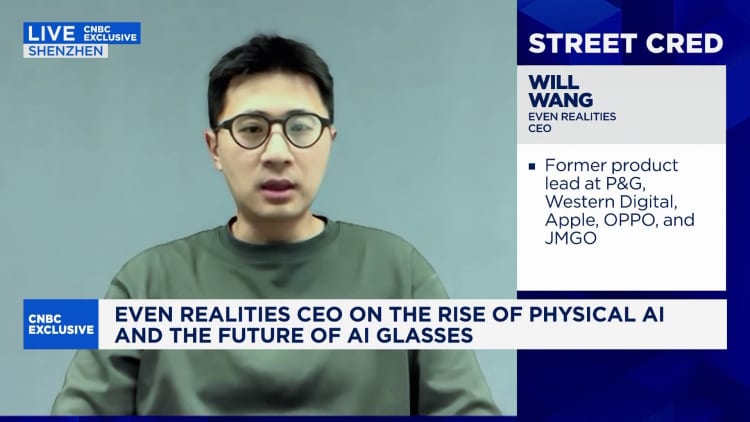
Startups building consumer electronics will have a better shot at becoming the next Apple in Shenzhen than in Silicon Valley, said Will Wang, CEO of China’s smart-glasses startup and the country’s newest unicorn Even Realities.
“If we wanted to create a future around consumer electronics — if we wanted to really build possibly the next Apple — we need to be at the center of hardware, which is Shenzhen,” Wang told CNBC’s Chery Kang on Wednesday, citing the city’s deep engineering talent pool and supply chain dominance.
The Shenzhen-based company said Monday it had raised $150 million at a $1 billion valuation, with investors including Meituan and Tencent. Wang, who worked at Apple from 2016 to 2018 on the development and mass production of the Apple Watch and iPhone, is eyeing the AI wearables market dominated by Meta Platforms.
Wang said that Silicon Valley has lost some of its appetite for founders who build hardware products, shunning the longer development cycles and less return upside, compared with AI applications, as well as inevitable supply chain hurdles.
“Silicon Valley seems to not really reward hardware people that much anymore,” he said, with talent and capital “intensively” flowing instead into AI and software agents. “You started to see less and less consumer electronics startups, or talents, around Silicon Valley.”

Across the Pacific Ocean, Shenzhen’s talent pool has, however, proven more vibrant, Wang said, with the city’s cluster of phone, drone and consumer electronics makers producing a deep bench of mechanical, electrical and optical engineers.
Shenzhen is home to a swath of Chinese tech giants, including Tencent, Huawei, drone maker DJI and EV behemoth BYD, and continues to draw a new generation of founders building companies from camera maker Insta360 to robotics firm UBTech.
The U.S., however, remains a critical market for the startup eyeing global expansion, with more than half of Even Realities’ users based in America.
Several Chinese startups are setting their eyes on AI-related consumer hardware, betting on the country’s manufacturing depth to offset America’s lead in software.
Even Realities’ domestic rival Rokid is valued at $2.58 billion after raising capital from investors including Singapore’s state-owned investor Temasek, according to PitchBook, while a smaller player RayNeo is worth $239.9 million.
When asked if the startup was deliberately raising funds only from Chinese-origin investors, Wang said its Chinese backers “simply move much faster, and they are closer to us,” although the next round will target “much more global investors” to support overseas expansion.
Even Realities has largely been funded by Chinese-origin venture firms including CDH Investments, Monolith Management and CVC Capital, and raised an undisclosed sum from Unicorn Capital Partners and Cyanhill Capital in January.
Founded in 2023, the company launched the Even G2 smart glasses late last year alongside the Even R1, a ring that controls the display. Unlike Meta’s camera-equipped Ray-Ban line, the G2 carries no camera or recording hardware, delivering notifications, navigation and live translation through a heads-up display in the lenses.
— CNBC’s Chery Kang, Jenny Lee contributed to this report.