




Lip-Bu Tan, CEO of Intel Corp., departs following a meeting at the White House in Washington, Aug. 11, 2025.
Alex Wroblewski | Bloomberg | Getty Images
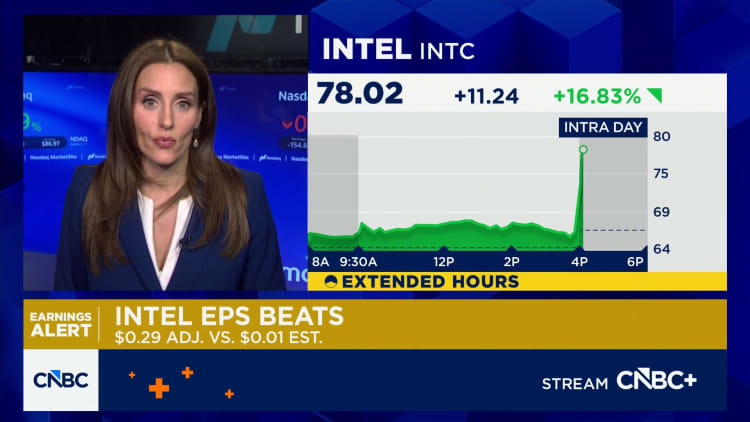
Intel reported first-quarter earnings Thursday that blew past Wall Street’s expectations, as the struggling chipmaker shows signs of a revival.
Shares of the U.S. chipmaker jumped 19% in after-hours trading.
Here’s how the company did, compared with estimates from analysts polled by LSEG:
- Earnings per share: 29 cents adjusted vs. 1 cent expected
- Revenue: $13.58 billion vs. $12.42 billion expected
Intel has been a Wall Street darling of late, with its stock up more than 80% this year as of Thursday’s close, after soaring 84% in 2025. The chipmaker has been championed by the Trump administration, which turned the U.S. government into the largest shareholder last year as part of an effort to bring chip manufacturing stateside. Nvidia and SoftBank also invested billions in Intel.
But the business, which fell way behind rivals Nvidia and Advanced Micro Devices during the early stages of the artificial intelligence boom, hasn’t been seeing much momentum.
That could finally be changing. Revenue increased 7.2% from $12.67 billion a year earlier. That follows year-over-year revenue declines in five of the past seven quarter.
Intel said it expects second-quarter revenue between $13.8 billion and $14.8 billion, and adjusted earnings per share of 20 cents. That’s well above analyst expectations for revenue of $13.07 billion and EPS of 9 cents.
Intel saw the strongest growth in its data center business, where it’s starting to get traction in AI thanks to surging demand for central processing units (CPUs). Revenue in that division climbed 22% to $5.1 billion.
The once-sleepy CPU market has taken off as agentic workloads shift compute needs beyond Nvidia’s graphics processing units (GPUs) that have ruled AI thus far. That growing CPU demand underpinned Intel’s recent $14 billion purchase of a 49% stake in its Ireland chip fab that it had previously sold to Apollo Global Management.
“The CPU is reinserting itself as the indispensable foundation of the AI era,” Intel CEO Lip-Bu Tan said on the company’s earning call. “This isn’t just our wishful thinking, it’s what we hear from our customers.”
Intel is still losing money. The company said its net loss widened to $4.28 billion, or 73 cents per share, from $887 million, or 19 cents a share a year earlier.
Intel has an unusual strategy when it comes to chips. As an integrated device manufacturer, Intel makes its own products while also manufacturing the silicon that powers them. Most chipmakers outsource the complex and costly manufacturing process to giant chip fabrication plants run by Taiwan Semiconductor Manufacturing Company.

Foundry revenue at Intel rose 16% from a year go to $5.4 billion, though much of its foundry business consists of making its own chips.
Intel’s Core Ultra Series 3 processor started selling in PCs in January, while its newest Xeon 6+ data center processors hit the market in March. Soon after, Google committed to using multiple generations of the Intel CPU to run AI workloads in its data centers.
Intel’s latest PC and data center processors are made on 18A process node at a giant new fab in Arizona. For now, Intel remains the only major customer of its 18A chip fabs, despite it being technologically similar to TSMC’s 2-nanometer node.
The challenge will be convincing longtime TSMC customers to make the leap.
Intel is recovering from years of delays on previous nodes, and some 18A wafers have had defects, making for a lower number of usable chips per wafer, typically referred to as yield.
Some analysts are waiting to see promising yields of Intel’s next-generation 14A technology, planned for 2028 or beyond. After previously indicating Intel would wait for a major customer to emerge before moving forward with the expense of ramping to the newest technology, Tan said on X in January that Intel is “going big time into 14A.”
Tan said on the earnings call that “multiple customers” are “actively evaluating the technology,” and that its development is happening at a faster pace than Intel saw with its the 18A technology.
A major customer could be Elon Musk, though details remain murky. Intel announced earlier this month that it will be joining Musk’s Terafab chip complex in Austin, Texas, to help “design, fabricate, and package ultra-high-performance chips at scale” for SpaceX, xAI and Tesla.
During Tesla’s first-quarter earnings call on Wednesday, Musk said Tesla plans to use Intel’s forthcoming 14A process to produce chips at the facility, which is mean to make chips for use in Tesla’s vehicles and robots, and in yet-to-be-constructed orbital datacenters for SpaceX.
Musk said 14A is still in development by Intel but, “by the time Terafab scales up, 14A will probably be fairly mature or ready for prime time.”
On Intel’s call, Tan said, “Elon and I share a strong conviction that global semiconductor supply is not keeping pace with the rapid acceleration in demand,” adding that together they are “looking for unconventional ways to improve manufacturing efficiency.”
Intel’s renewed focus on manufacturing chips for others came when Pat Gelsinger took the helm as CEO in 2021. Gelsinger was pushed out in 2024 and replaced by Tan early last year.
Intel slashed 15% of its workforce in July and canceled chip fab projects in Germany and Poland. In Ohio, Intel’s giant new chip fab is delayed until 2030, after initial plans had it starting production this year. Tan wrote in a memo at the time of layoffs that, “Over the past several years, the company invested too much, too soon – without adequate demand.”
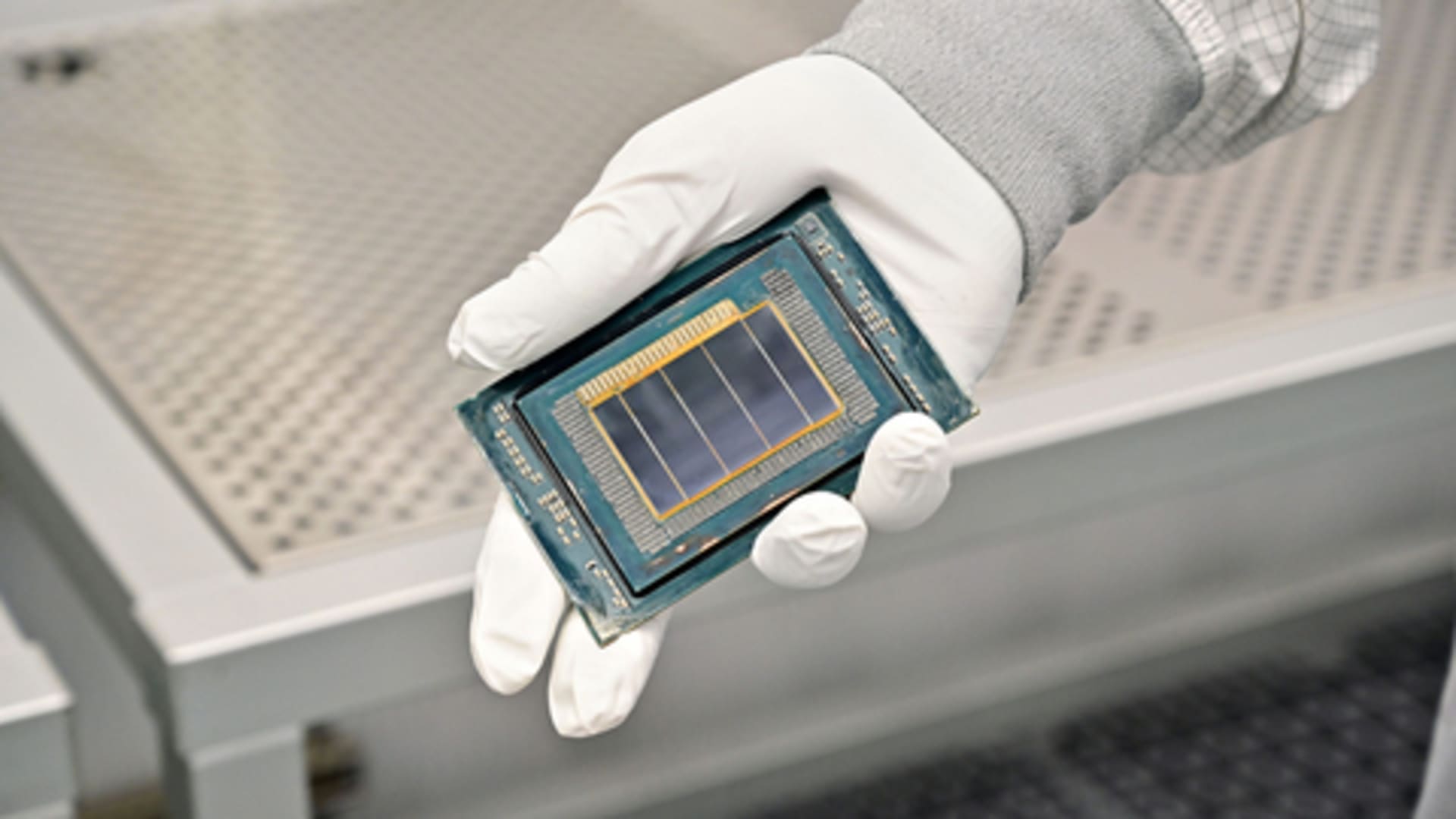
The latest guidance may also be strong due to another part of the chipmaking process where Intel excels: advanced packaging. That involves individual chip dies being connected to a larger system. Intel is one of only three global companies that offer the most advanced type of packaging, creating a new bottleneck in the race to make enough chips for AI.
CFO David Zinsner told CNBC that he’s confident advanced packaging will bring in billions of dollars per customer, after previously estimating that figure would be in the hundreds of millions. Intel’s advanced packaging customers include Amazon, Cisco, and the new commitment from SpaceX and Tesla.
—CNBC’s Kristina Partsinevelos contributed to this report.
WATCH: Nvidia snaps up capacity for a key part of AI chipmaking