




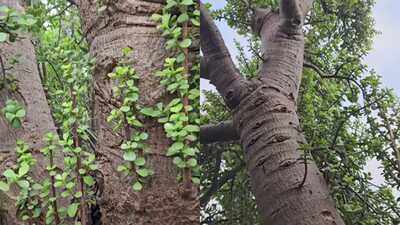
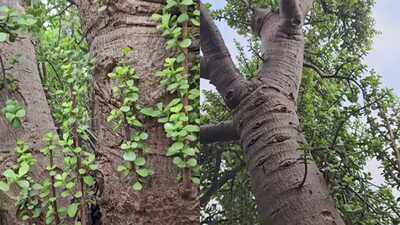
An immense succulent growing at an abandoned gold mine settlement in Western Australia is causing quite a stir among plant enthusiasts. Shown in a viral Instagram reel, the specimen has been identified in the video caption as Portulacaria afra – a species known as elephant bush or dwarf jade. Nonetheless, the comments section turned into a heated discussion about whether the succulent is indeed the one mentioned in the video, and some even suggested that the video was produced with the help of artificial intelligence. Regardless of the discussion, the amazing plant became extremely popular due to its incredible size and raised interest of people in the plant’s maximum possible growth.
Is it really a giant jade plant ?
The amazing succulent got people’s attention because of its similarity to the giant jade plant. Nevertheless, there is a debate over its identity online, as the video creator describes it as Portulacaria afra, which is commonly known as elephant bush and dwarf jade. Despite being similar to the true jade plant (Crassula ovata), it is not the same species. Moreover, the debate itself became as popular as the video with thousands of comments.
A centennial survivor of Australian gold rush
According to the Instagram post, the huge succulent grows on the place of an abandoned gold mine settlement in Western Australia. As the plant is not native to the region, the video assumes that it was introduced in this region in the mining era, over a century ago. According to the area’s history, the age of the plant is believed to be 110-130 years old. Over decades, the plant has grown into an immense tree-like structure while surviving the disappearance of the mining settlement.
So, what exactly is Portulacaria afra?
The origin of the Portulacaria afra is South Africa, where the plant naturally grows as a large shrub or even a small tree in a dry climate. Worldwide, it is used as an ornamental succulent, and there are numerous common names for it – Elephant Bush, Mini Jade, or Dwarf Jade. These common names are misleading, as people usually confuse it with the true jade plant, although the two species are different botanically.
A netizen commented:
“My Jade plant said it is AI.”“Is it real or fake?”“Are you serious right now! Hard to believe.”“My god is this real?”“I have never seen a jade tree this big.”
Here’s the video:
The comments section is full of theories
Although some viewers admire the specimen’s amazing size, some of them doubt if it is really Portulacaria afra. Some say that it looks like another succulent, while a few even claim that the footage seems to be AI-generated. However, there are people who defend the creator, noting that mature Portulacaria afra plants grow to be large with thick trunk and tree-like form if grown for decades under favourable conditions.
From potted succulent to tree-like giant
Everybody knows Portulacaria afra as a compact houseplant kept on the windowsill or balcony. With enough space, decades of constant growth, and a favourable climate, however, this species becomes much bigger than expected. The Australian specimen became an example of how a familiar ornamental succulent can become a truly impressive landscape plant.
One plant, countless discussions
Whether viewers describe it as an elephant bush, dwarf jade, mini jade, or a giant succulent, the amazing discovery inspired people to get acquainted with the plant better, which was considered to be well-known before. Besides, the discussion raises people’s awareness of natural resilience and longevity, as well as the ability of social media to start discussions that encourage people to look at the plants surrounding them.