





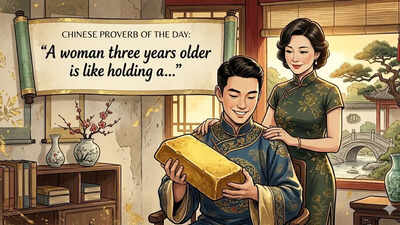
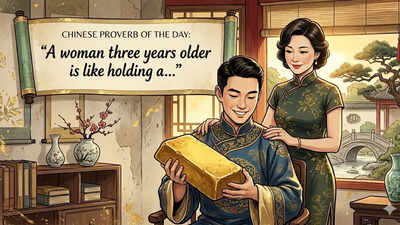
Some proverbs make perfect sense the moment they are heard. Others need a little unpacking.“A woman three years older is like holding a golden brick.”At first glance, it sounds unusual. Modern readers might wonder why a few years of age would be compared to something as valuable as gold. The image feels oddly specific. Three years, not five. A golden brick, not a golden coin. Like many traditional sayings, it comes from a world with its own assumptions, customs, and ways of looking at relationships.The proverb appears to reflect a belief that was once common in many societies: experience had value. Not just practical value, but everyday value. The kind that showed itself in conversations, decisions, family life, and the handling of difficult situations.In earlier times, people often associated age with judgment. Someone who had lived a little longer was assumed to have seen a little more. Whether that was always true is another matter, but the belief itself was widespread enough to find its way into proverbs and folk wisdom.
Chinese proverb of the day
“A woman three years older is like holding a golden brick.”
The comparison to gold is what keeps the saying alive
Without the image of the golden brick, this proverb might have disappeared centuries ago.People tend to remember pictures more easily than ideas. A saying about maturity could easily be forgotten. A saying about holding a golden brick stays in the mind.Gold has carried the same reputation for a very long time. Kingdoms fought over it. Traders travelled great distances to acquire it. Families passed it from one generation to another. Even people who never possessed much of it understood what it represented.Security. Value. Something worth keeping. That symbolism appears to be doing most of the work here.The proverb is not really talking about metal. It is talking about qualities that people believed became more noticeable with experience. Patience. Practical thinking. A steadier approach to life’s problems. The sort of things that rarely attract attention in youth but often become appreciated later.
Life has a habit of changing what people admire
When people are young, admiration often follows excitement.Confidence attracts attention. Charm attracts attention. Energy attracts attention.As the years pass, different qualities begin to stand out.Reliability becomes more impressive. Good judgment becomes more impressive. The ability to remain calm during difficult periods becomes more impressive.Many people eventually discover that the traits they valued at twenty are not always the traits they value at forty.Perhaps that helps explain why sayings like this emerged in the first place. They were created by communities that had already spent generations observing family life. Their conclusions may not always fit modern thinking, but they reveal what earlier generations considered important.And very often, what they considered important was stability.
Real relationships have never followed proverbs
Of course, no proverb has ever been capable of explaining every relationship. Life refuses to cooperate that neatly.Some couples are close in age and thrive together. Others have larger age gaps and thrive together. Some relationships succeed despite predictions that they will fail. Others collapse despite appearing perfect from the outside.Human beings are far too complicated to fit comfortably inside a single sentence. That is one reason old sayings are best understood as observations rather than rules.The Chinese proverb was not written as a scientific study. It was simply expressing a belief that circulated among ordinary people. Enough people recognised the idea for it to survive and pass into popular memory.That alone makes it interesting, even for readers who disagree with it.
Every proverb carries a piece of its time
Reading old sayings can sometimes feel like opening a small window into another era.The language remains. The world that produced it changes. People continue repeating the words, even though their lives may look completely different from those of their ancestors.This proverb offers that kind of glimpse.It comes from a society where age often carried significant social weight. Elders were respected. Experience was trusted. Family decisions frequently rested upon those believed to possess wisdom gained through years of living.Modern societies tend to place greater emphasis on individual choice and personal compatibility. Yet traces of older attitudes still survive in sayings like this one.They remind readers that every generation develops its own ideas about relationships, maturity, and what qualities matter most.
Why the proverb still sparks discussion
Many traditional sayings fade because nobody feels strongly about them anymore.This one continues to generate discussion. Partly because it sounds unusual. Partly because it reflects values that some readers embrace while others question.And partly because age remains a subject people find endlessly fascinating. Society talks constantly about youth, ageing, experience, and maturity. The conversation has never really ended.The proverb survives within that larger discussion.Some see it as a compliment to experience. Others view it as a historical curiosity. Many simply find it interesting because it reveals how differently earlier generations viewed the world.Whatever interpretation people choose, the saying continues to do what memorable proverbs have always done.It makes people stop for a moment and think.
Final thoughts on this Chinese proverb
“A woman three years older is like holding a golden brick” is less a rule about relationships than a reflection of traditional attitudes towards age, maturity, and experience. Through the image of gold, the proverb expresses the belief that certain qualities become more valuable with time and deserve appreciation rather than dismissal.Whether modern readers agree with its assumptions is ultimately a personal matter. What gives the saying lasting interest is its ability to preserve a small piece of cultural history. Centuries after it first appeared, it still offers a glimpse into what earlier generations admired, respected, and considered worth comparing to gold.