








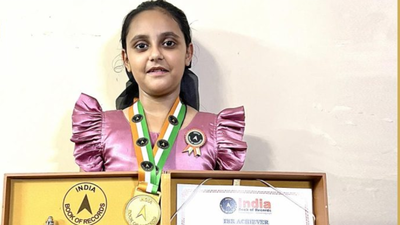
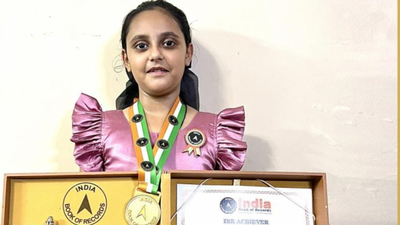
An 11-year-old girl from Noida has developed an artificial intelligence-powered smart cane designed to help elderly people and those with visual impairments navigate their surroundings, monitor certain health-related readings and alert family members in case of a fall. Called STAMBHA, the prototype combines obstacle detection, a camera, voice assistance and sensors in a single walking stick. Its components cost approximately ₹10,000.The young inventor, Aaradhya Jain, presented her creation at the Second World Summit on Sustainable Health and Well-Being at the United Nations Conference Centre in Bangkok on September 25, 2026. She was the youngest speaker at the event, according to a report by Digit. After her presentation, she also explained how the device worked to a World Health Organization regional adviser and Hungary’s Ambassador to Thailand.According to the official website of India Book of Records, she was also named ‘IBR Achiever’ for receiving the ‘Global Child Prodigy Awards 2025’ in Innovation and Technology at the House of Commons, British Parliament on June 25, 2026 .But the idea behind STAMBHA began much closer to home, with Aaradhya thinking about her grandparents and how their lives had changed as they grew older.
Why Aaradhya decided to build a smart cane
In a conversation with YourStory, Aaradhya explained that her grandparents had always looked after her when she was younger. They would check whether she was warm or safe. As they grew older, however, she noticed that nobody was checking on them in quite the same way.Another influence was the film ‘Srikanth,’ based on the life of visually impaired industrialist Srikanth Bolla. Watching the film made her curious about the difficulties visually impaired people face while moving around independently. She decided to experience some of those difficulties herself. Aaradhya closed her eyes and tried walking around her house to understand what navigating without sight might feel like.That experiment helped her think about how a walking stick could do more than simply help someone detect obstacles.
What makes STAMBHA different from an ordinary walking stick?
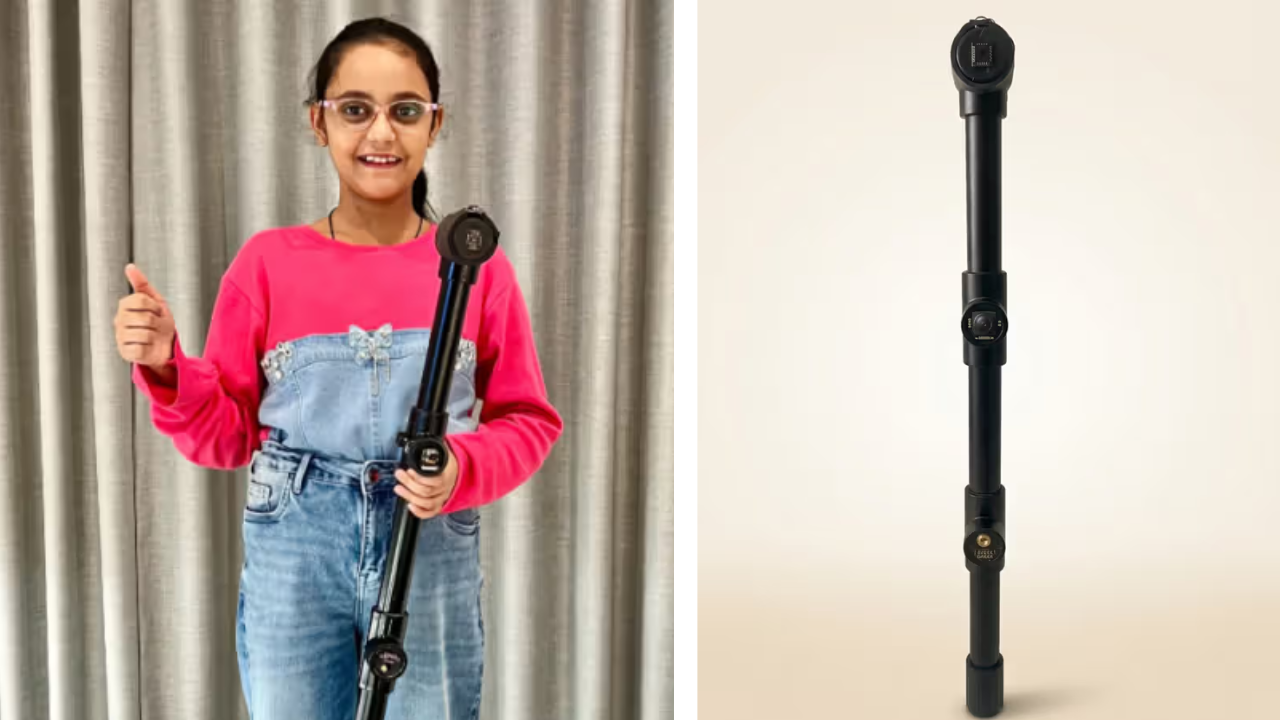
Image courtesy: Digit
Named after the Hindi word ‘stambha’, meaning pillar, the device is designed to assist users in two ways: by understanding the surroundings and by monitoring certain aspects of the person holding it. According to YourStory, STAMBHA uses a laser rangefinder to detect obstacles ahead. When it identifies something in the user’s path, it sends a vibration through the handle to alert them.It also has a camera that can describe the surrounding scene and read signs aloud. This could help users understand their surroundings without having to depend entirely on another person.The cane also supports voice interaction in Hindi and English. Users can ask questions such as, “What does this sign say?” or “Where is the nearest chemist?” and receive spoken responses.Beyond navigation, sensors fitted into the handle monitor pulse, blood oxygen levels and balance-related readings. The device can also detect whether the user is still holding the cane.One of its important features is its ability to distinguish between a stumble and a fall. If it detects a fall, it can alert family members and share the user’s location. This is intended to prevent unnecessary alerts when someone simply trips or loses balance momentarily. Another feature is that STAMBHA can function without a smartphone. This means the device does not depend on the user’s phone battery to provide its core functions.
How an 11-year-old developed the device
Aaradhya worked on STAMBHA for approximately a year, with support from her father and her uncle, Nitin Jain, who is the chief technology officer of ShareChat. The prototype runs on an ESP32-S3 microcontroller. While Aaradhya designed the system and worked on its programming and assembly, she acknowledges that she watched rather than performed the most difficult soldering work.Artificial intelligence tools also played a significant role in developing the software. According to Nitin, around 80% of the coding was done using AI-assisted programming tools.However, the development involved considerable trial and error. During the initial versions, some sensors stopped functioning depending on where they were placed. Aaradhya repeatedly changed their positions until she found arrangements that worked. She tested the prototype on her parents, grandparents and elder sister rather than on friends or classmates.
What is next for Aaradhya and STAMBHA?
After presenting the invention at the United Nations summit, Aaradhya also showcased STAMBHA during Innovation World’s global GIFT livestream on October 17 and 18. Her next step is to test the prototype with elderly people and individuals with visual impairments. She plans to use their feedback to improve the design and make it more suitable for everyday use.