







Anti-vaccine attitudes take hold in Pennsylvania
The dangerous slide in vaccinations is playing out in real time in Pennsylvania, especially among the close-knit Amish community.
In hard-hit Lancaster County, the share of kindergartners who got MMR vaccinations in 2025-26 was 87.6%, NBC News data found. Before the pandemic in 2017-18, the county’s immunization rate was 95.5%.
That decline precipitated a deadly outbreak of measles this year that has spread mostly among Amish families in the state.
Ben Riehl, an Amish man living in Lancaster County, said he has witnessed fast-changing attitudes about vaccines over the past decade.
“Back in our day, you got the vaccine. There was no question,” said Riehl, 61. “It was the proper thing to do.” He and his wife vaccinated all six of their sons, who are now grown. Though Amish tend to resist mainstream medical interventions, there is nothing in the Amish culture or religion that is inherently anti-vaccine.
Riehl said that over time, Amish people couldn’t help but be influenced by anti-vaccine rhetoric, particularly when the message was brought directly to his community.
Before Kennedy, a longtime vaccine critic, became the nation’s health secretary, he was a keynote speaker at a 2021 event in Lancaster County, during which he said, without citing scientific evidence, that vaccines are harmful. The event drew more than 1,000 people — mostly Amish.
“The anti-vax crowd got the Amish people’s ear,” Riehl said. “The Amish didn’t suck the anti-vax ideas out of their own thumb. They were influenced by outside information.”
Dr. Evan Shirey, a pediatric infectious disease physician at Penn State Health Golisano Children’s Hospital in Hershey, said parents increasingly come into his clinic with worries about vaccines.
“We know that very prominently, individuals have come to our community specifically to spread the message that this virus isn’t a big deal,” said Shirey, who has been treating children sick with measles. “When we see that people are dying, when we see that babies are suffering, when we see that children are having illnesses that, in some cases, are permanent, we know that that’s a big lie. It’s just false.”
The onslaught of cases in Pennsylvania has caught some doctors off guard.

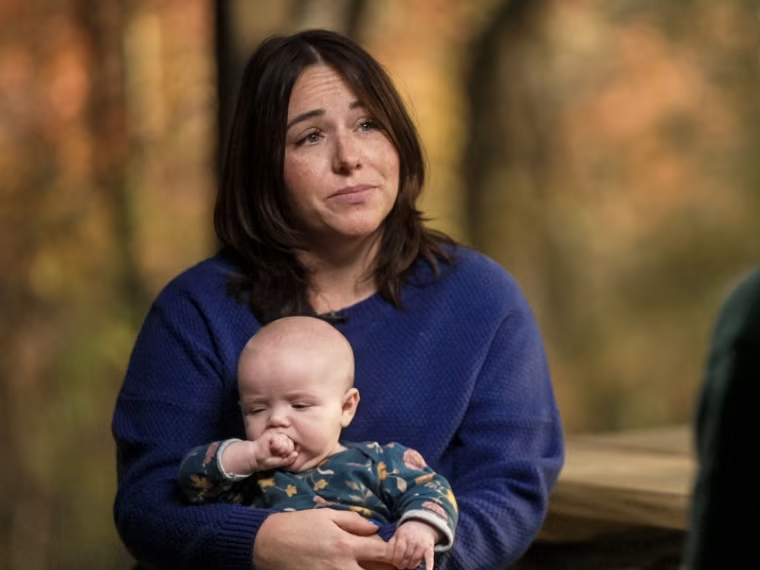
Lauren Shoup, 36, of Imperial, a Pittsburgh suburb, said she repeatedly questioned doctors about what to do after her 2-month-old daughter, Kieran, was exposed to measles during a routine visit with an allergist at the University of Pittsburgh Medical Center Children’s Hospital in early September. Because the first measles shot isn’t given until age 1, Kieran’s tiny body was defenseless against the virus.
Shoup said that when she took the baby in for a dose of antibody-rich immunoglobulin, which can be given within a short period of time after a measles exposure, she wasn’t given any directives about what her family could do to minimize risks to the community.
Three days after the baby received the antibody injection, Shoup said, an Allegheny County health department worker called her and said the infant should have been in quarantine since her exposure.
“I believe in science. I follow the science,” Shoup said. “But because no one knows the science, it’s very frustrating.”
In a statement, a UPMC spokesperson said the hospital system is “reviewing the concerns that have been raised and remain committed to working with public health officials and providing appropriate guidance to anyone who may have been exposed.”
In Allegheny County, which includes Pittsburgh, the measles vaccination rate dropped from 97.1% in 2019 to 92.9% last school year.
While babies are born with some protection if their mothers were vaccinated, it’s unclear how long that lasts. Kieran is now 4 months old, still too young for the MMR shots.
“It’s scary because she’s still not vaccinated,” Shoup said. “She’s still susceptible.”
Is measles already endemic in the U.S. again?
PAHO officials are looking at whether a single chain of measles transmission has gone on for more than 12 months, as well as whether there are a significant number of cases for which the source of infection is unknown.
In Utah, where measles flared up in June 2025, health officials haven’t yet declared an end to the outbreak. One case was diagnosed in the state recently, and the virus is still detected in wastewater samples.
Measles can spread so quickly that even one case is considered an outbreak.
Through the 1990s, the CDC and the FDA worked together with “a sense of common purpose,” along with federal and state leaders and pediatricians, to encourage MMR vaccinations, said Koplan, who was appointed head of the CDC by President Bill Clinton and continued in the role when President George W. Bush took office.
“Science is now ignored, and people die from ignoring science,” Koplan said.
If the U.S. loses its measles elimination status, it will join Canada — the only other country in the Americas that has lost control of the virus — paving the way for more illnesses and deaths.
“We’re going to have to stop the runaway train, and then we’ll need to turn it around and start going in the other direction,” Noel Brewer, the chair of an independent committee that assists the CDC in analyzing the country’s measles situation, said ahead of the PAHO meeting.
Before the MMR vaccine, about 500 people died from measles complications every year, most of them children.
That’s nearly half the number of kids who die annually in the U.S. from cancer.
“Measles has not disappeared because it’s harmless,” Koplan said. “It’s disappeared because vaccination programs have been effective.”