


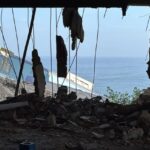
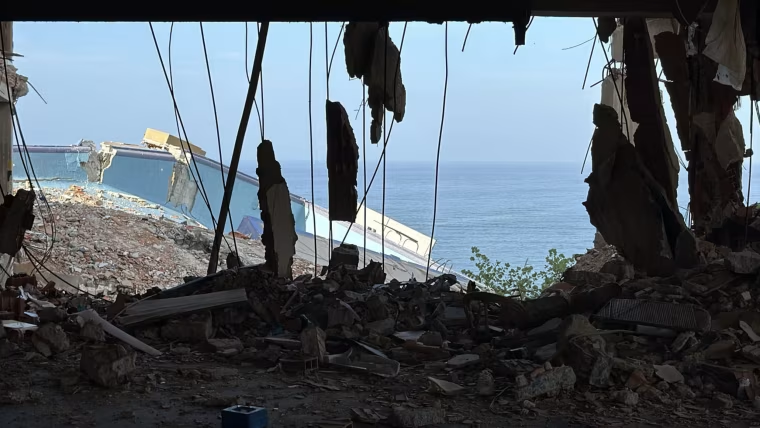
LA GUAIRA, Venezuela — Upon entering the ruins of the Jurel building, one hears two things: the murmur of a few curious passersby gazing at the tomb of memories left by the June 24 earthquakes and the creaking of the rubble.
Three months have passed since two earthquakes in quick succession shook this area of the Venezuelan coast. But the devastation continues to resonate for those who haven’t been able to properly say goodbye to loved ones.
Cristian Verdú, 23, lost his brother, his cousin and his mother that day. The bodies of the latter two remain buried in the building’s rubble. A drone search confirmed their location, along with the bodies of other victims.
The building’s collapse is so severe that his search has become — to say the least — nearly impossible after months of searching.
“I never left her alone while she was alive. Anyone who knew my family knew my mother and knew that no matter what happened, I was always there for my mother,” said Verdú, who survived on June 24 because he was in Naiguatá, a town about 45 minutes from Playa Grande, where the Jurel is located.

The search for Verdú’s family went viral following a video posted by journalist Maryorin Méndez in which Verdú pleaded for help recovering his loved ones’ bodies. Others had been able to retrieve their family members’ remains. Finding himself alone, Verdú set up a tent near the Jurel to oversee the search for his mom.
A Mexican rescue team tried to get her out, but the danger of the building collapsing was too great. The Jurel building had 12 floors. Verdú’s mother was on the eighth floor and ended up on the sixth: Its collapse wasn’t like others in that the lower floors partially withstood the earthquake, but the upper floors collapsed one after another.
What was revealed were the exposed rooms, bathrooms and halls. A swimming pool sloping toward a precipice warns passersby that a tragedy occurred in the building.

‘Still had a conversation to finish’
Verdú recounted that the Jurel was his family’s vacation home; they lived in Caracas, in the 23 de Enero neighborhood, a popular area in the western part of the city.
On the day of the earthquakes, Verdú went for the first time to the San Juan drumming festival, a coastal tradition honoring St. John the Baptist that is celebrated every June 24. Going to the festival is the reason he’s alive, he explained.
The day before, he was with his family and had spent a lot of time with his mother. “My little brother was in the pool, and I spent the day with her. We talked, and she took some secrets with her because I told her things that day, and we still had a conversation to finish,” he told Noticias Telemundo.
When the earthquake struck and he saw that practically nothing remained of his vacation home, he said he experienced a mental breakdown. “I ran out, screaming, not finding my family alive and then having to report that my cousin and a friend of my brother had also died,” Verdú said, adding that it was a difficult situation because other family members thought he had also died.
He immediately began searching for his family, especially his mother.
On the eve of his birthday, almost two months after the earthquake, Verdú announced on social media that he was ending his search for his mom and cousin. Without resources, there was no other option but to leave.
“I wasn’t feeling well anymore. I was exhausted,” Verdú said, adding that the situation was getting more complicated every day.
Even so, Verdú continues to wait and hope. “The case was closed on social media, but the search hasn’t stopped because there are still people who want to get her out and want to help me,” he said.
If they demolish the building with his mother’s and cousin’s remains still inside, Verdú is prepared to continue searching for her, even if it’s among what remains of the rubble.
“It won’t be easy, but believe me, after they demolish the building, I will go back for my mother,” he said, hoping perhaps he can find some peace.
Verdú said that every night he dreams that his mother wants to tell him something, but she always stops or gets scared.
“Many things were left unfinished. My mother’s birthday was coming up, and we had a trip planned, but life had other plans. Perhaps my mother and my little brother had to take a trip that I couldn’t go on,” he said.

Living in a camp, and waiting
Stories like Verdú’s are repeated throughout La Guaira. At Residencias Caribe, family members and volunteer rescuers continue the search for people.
Residencias Caribe was part of a residential development and consisted of three towers. Two of them remained standing; the other collapsed completely.
At the pool area, which overlooks the towers, residents wait for loved ones’ bodies to be recovered. Rescuers don’t have a precise number, but they estimate that more than 70 people’s remains are still in the complex, even though fewer than that number have been declared missing there. Residents have two theories for the discrepancy: Either some people’s relatives didn’t know they were there or entire families perished, with no one left to claim them.
Lying in a tent, next to a fan that cools the air and keeps the mosquitoes away, is Angie Sojo. She has lived in Residencias Caribe for over 20 years and for the past three months has been searching for her husband, Gustavo Adolfo Riascos Gómez, 51.
Her life collapsed along with her home in a single night, and now she awaits news from the rescuers. Sojo’s husband was on the second floor of Tower B of the residences. After the collapse, his body ended up in the parking lot, and for three months they have been trying to recover it without success. Sojo currently lives in the encampment with other neighbors and rescuers who stay overnight.
“At first we all slept on a mattress, and then they started bringing us tents,” she said.
The story of Residencias Caribe is not so different from that of other buildings in the area: There was no help, no rescuers, no supplies. Little by little, some help arrived, and even then, it wasn’t enough.
At Residencias Caribe, the problem isn’t just the collapse, but also the flooding. The first floors are full of water, and pumps have been needed to lower the water level.
On June 24, Sojo was working in Caracas, about 40 minutes from La Guaira. She said that when she got to the building, she was so disoriented that she just started shouting her husband’s name. She and her 20-year-old daughter have been waiting for news for three months and are happy every time a neighbor’s remains are rescued, but she said her heart breaks thinking about when her turn will come.
“It causes anxiety and joy at the same time because it’s another neighbor who’s leaving. I cling to our love,” Sojo said about her husband, “and if it had been the other way around, he’d be here looking for me, too.”

‘Something I owe her’
Valeria Alcalá has been searching for her mother since the earthquakes struck. Alcalá is 18 years old and will soon start university. But for now, she waits every day for news about the search for her mother.
“I’ve been here since it all happened. This has been a constant struggle because I feel like it’s something I owe her,” she said.
Alcalá lost track of her mother and stepfather on June 24. The last time she saw them was the day before, at the San Juan drumming festival. Alcalá remembers them telling her to behave.
They both died in the collapsed buildings; they were downstairs, having arrived five minutes before the earthquakes. Alcalá’s relatives helped her, but they didn’t know where to begin the search.
Her stepfather’s body was found a month ago. It was one of the hardest moments, she said. “Knowing they’re there is not the same as having the body pulled out and having to say, ‘Yes, it’s him.’ Recognizing the body is difficult,” Alcalá said.
She relied on neighbors who had become rescuers. One of them is named Chelo. He also lost his family in the earthquakes and stayed to continue helping fellow former residents.

Nayibe Geromes is searching for her mother, Leída Josefina Mata Cupido, 64. On June 24, she didn’t know if her mother had managed to escape, so she went to shelters hoping for an answer. There was none. Since then, she has been staying at the residences where her mother lived, waiting for her body to be found.
“I’m certain she’s here because they came in and took things that indicate she was here, like her ID, which I still have, her wallet with all her cards, and her cellphone. She’s here,” Geromes said.
The Residencias Caribe residents have become like family after spending three months searching for their loved ones in the rubble. Their only remaining support comes from volunteer rescuers and family members.
“I want to give her eternal rest and get her back so that we too can move on because life goes on. We have cried a lot,” Geromes said.
The neighbors explained that they no longer feel sadness when they find a body and are happy the person’s remains will get the rest they deserve.
“My mom deserves rest. Angie (Sojo)’s husband, all of us who are here I think deserve to be at peace and go home, because this is a tireless fight,” Geromes said, “but I assure you that we will be here until the very end.”

These rescuers aren’t leaving
Marcel Hernández is one of the volunteer rescuers at Residencias Caribe. He has been pulling bodies from the structures for three months. He was a construction worker by trade, but since June 24, he has done nothing but recover corpses. He recounted that the first bodies he recovered at Residencias Caribe were those of his family: his cousin, his cousin’s wife and their four children.
“We started with a pickax — breaking slab after slab. To this day, I haven’t stopped searching,” Hernández said. He got his family out 17 days later.
Hernández promised fellow resident Chelo that they wouldn’t leave until they found his family, and Chelo promised him the same. They insist they won’t leave until they’ve rescued everyone.
Yessamin Medina, known as “La Topito” (“Little Mole”), is another volunteer rescuer at Residencias Caribe. Medina explained that before the earthquakes, she was afraid of the dark and was claustrophobic, but she overcame that fear there.
“I became a ‘mole’ out of love and empathy, without receiving anything in return, simply out of love for my fellow man. I can’t be at home when they still need help here. I’m here out of love for them,” she said.
Medina is 20 years old and became a “mole” thanks to the foundation she created, Puente de Esperanza (Bridge of Hope), after the earthquakes. The volunteer rescuers have left family, homes and jobs to continue helping.
“We have practically been working here with our hands, but with our hands we have achieved many things,” she said, explaining that the lack of machinery and the disastrous nature of the collapse have made the work extremely difficult.
The anguish of the families is the hardest thing, according to Medina. “At home, I’m talking to myself and trying to figure out how I can get them out faster,” she said.
An earlier version of this story was first published by Noticias Telemundo.