




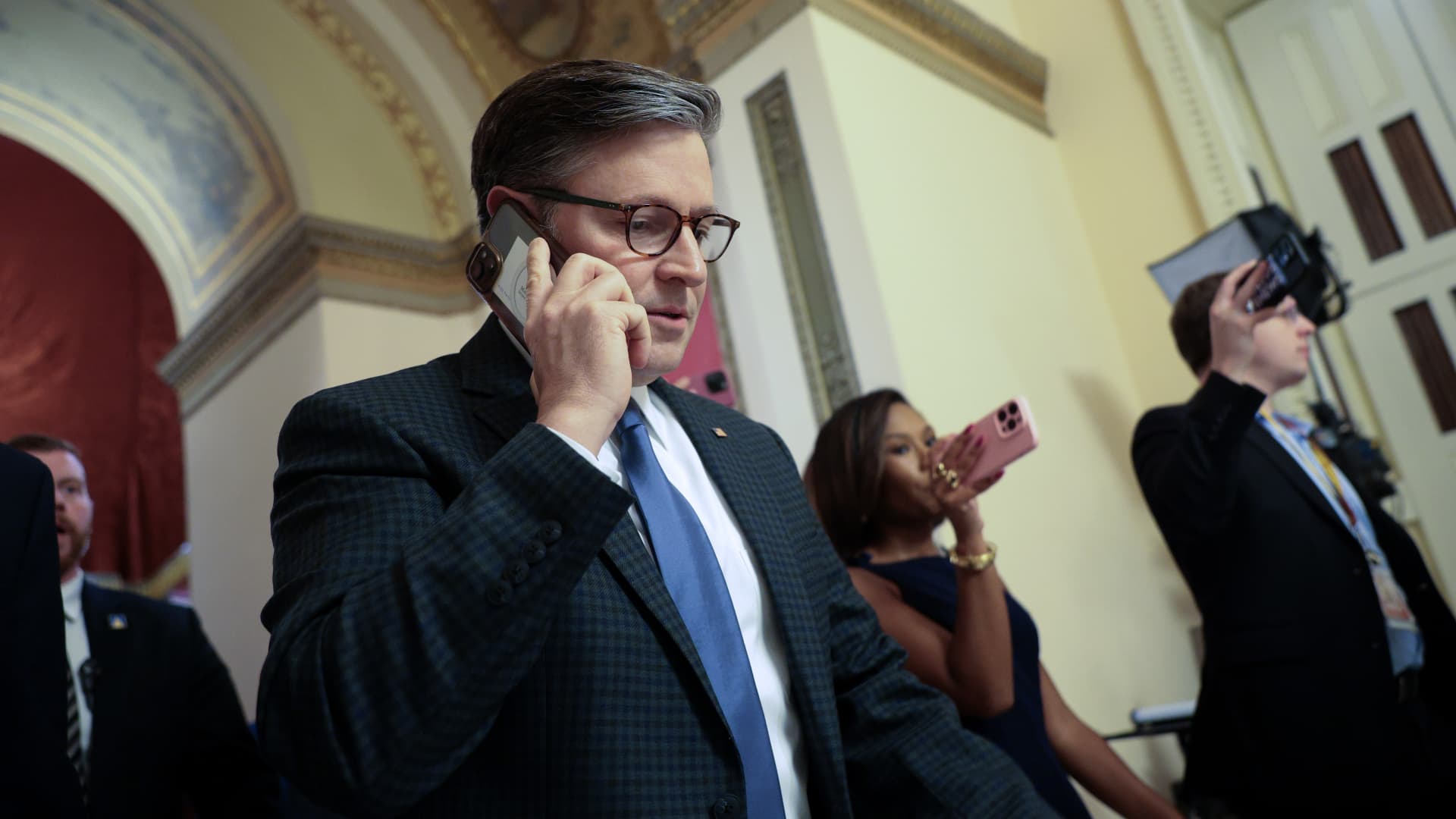
U.S. Speaker of the House Mike Johnson (R-LA) talks on the phone as he walks from his office to the House chamber at the U.S. Capitol on Sept. 14, 2026 in Washington, DC.
Chip Somodevilla | Getty Images
The House of Representatives adjourned Wednesday, leaving Washington and almost certainly punting action on a ballooning artificial intelligence crisis until after November’s midterm election.
The early jet-set comes after top AI executives practically begged Washington to regulate them after an Anthropic researcher resigned and claimed the technology “could kill us all by the end of the decade.” But the urgency with which Anthropic, OpenAI and xAI have sought to be regulated has not translated into action on Capitol Hill as lawmakers eye the midterms that loom less than seven weeks away.
The midterms will decide control of Washington for the remainder of President Donald Trump’s term, and lawmakers are eager to hit the campaign trail to make closing arguments as early voting has already begun in some states. Trump himself has aggressively opposed restrictive regulations on AI, calling reported threats a “hoax.”
“It’s time for our members to go home to their districts and make their case to the American people,” House Speaker Mike Johnson, R-La., said Wednesday, explaining to reporters why he had cancelled the House’s planned work on Thursday, according to MS NOW. Johnson appeared to put the onus on the Senate, which is in session for another two weeks, to pass legislation. For a bill to become law, it would need to clear both chambers and be signed by the president.
Earlier in the week, Johnson suggested he did not want Congress to move quickly on regulating AI, warning it could hand China a boon in the race for AI dominance if Congress rushed to slow the technology’s progress.
Johnson’s decision to send the House home early, however, runs counter to what Democrats and even some Republicans want.
Rep. Sam Liccardo, D-Calif., has been pushing for the House to stay in session to place regulations on AI. He led 107 Democrats in writing to Johnson on Tuesday, demanding the House remain in Washington to do so.
“While AI safety experts and Americans increasingly urge action to confront this conflagration of risk, Congress fiddles,” the letter read. “When we did return to work after the August recess, we consumed floor time with debates and votes on performative resolutions opposing socialism. After next week, the House resumes its vacation — for another six weeks.”
Rep. Sam Liccardo, D-Calif., walks down the House steps after the last vote of the week in the U.S. Capitol on Sept. 3, 2026.
Bill Clark | CQ-Roll Call, Inc. | Getty Images
Liccardo, a former mayor of San Jose, Calif., who now represents part of Silicon Valley, told CNBC he’s pushing for action because “our children will not forgive us for our inaction.”
“There is no human that wins a race to superintelligence that is beyond the control of humans,” Liccardo said. “At least Nero had the good grace to stay in town while he was fiddling when Rome was burning. This Congress is heading for the hills to go back and campaign for reelection.”
Liccardo called for immediate action on some “low-hanging fruit.” That includes action on the bipartisan bill sponsored by Reps. Jay Obernolte, R-Calif., and Lori Trahan, D-Mass., known as the Frontier Act. That measure would require third-party auditors to ensure AI labs are operating safely and introduce new transparency requirements. The bill would also allow the Commerce Department to suspend or restrict a developer’s model if it poses an “imminent catastrophic risk.”
Liccardo also suggested to CNBC that Congress should immediately consider a “kill switch” provision to shut down AI models that get out of control and explore a narrow antitrust exemption that would allow the top AI companies to collaborate on safety issues.
In a separate letter this week, Obernolte and Rep. Brian Fitzpatrick, R-Pa., joined a group of Democrats in urging Johnson and House Minority Leader Hakeem Jeffries, D-N.Y., to “as soon as practicable, advance legislation that ensures appropriate guardrails are in place around this powerful technology.”
Obernolte, speaking to reporters after Wednesday’s votes in the House, said: “The urgency of the moment requires action by Congress before the end of the year.” He said he will push to pass the Frontier Act and the Great American Artificial Intelligence Act, a comprehensive framework for AI regulation he has put together with Trahan, to be considered together when the House returns.
House Research and Technology Subcommittee Chairman Jay Obernolte (R-CA) presided during a hearing in the Rayburn House Office Building on Capitol Hill on January 14, 2026 in Washington, DC.
Chip Somodevilla | Getty Images
“Honestly, it was pretty clear to me that nothing meaningful was going to get done on AI regulation in advance of the election,” he said. “There are just too many unknowns, so I don’t think it makes a difference.”
The Senate could take initial steps toward action on AI before they leave at the beginning of October until after the election. But that remains far from clear.
Johnson said the House would return within 48 hours if the Senate passes any substantive legislation, though that pledge was not specific to AI regulation.
Obernolte, however, suggested there was never a window for the House to act before the election.
Senate Commerce Committee Chair Ted Cruz, R-Texas, Sen. Amy Klobuchar, D-Minn., and Senate Majority Leader John Thune, R-S.D., have been working on an AI safety bill that has not yet been released.
Cruz, in brief comments to reporters this week, said it’s possible the bill will be voted on in committee by the end of this month.
“I hope so; we’re working hard on it,” Cruz said. “The question is, do we get bipartisan agreement?”