



The Federal Reserve raised its benchmark interest rate at the conclusion of its September meeting after consumer prices rose again in August amid the war with Iran — and despite continued pressure by President Donald Trump to bring rates down.
In an effort to tame inflation, the central bank’s Federal Open Market Committee, led by Chairman Kevin Warsh, raised the federal funds rate by one quarter percentage point to a target range of 3.75% to 4.0%. The move is expected to ripple across the economy, with consequences for everything from credit cards and car loans to savings accounts.
The federal funds rate, which is set by the U.S. central bank, is the interest rate at which banks borrow and lend to one another overnight. While consumers do not borrow at that rate directly, Fed policy has a significant impact on consumer borrowing costs and savings returns.
In general, short-term consumer borrowing rates are closely tied to the prime rate, which is typically 3 percentage points higher than the federal funds rate. Longer-term interest rates are driven more by inflation expectations and broader economic conditions.
This quarter-point hike — the first since July 2023 — will correspond with a rise in the prime rate and immediately send financing costs higher for many forms of consumer borrowing, putting some U.S. households under increased financial strain.
“Wealthier and generally older households will navigate higher rates better, as they are less likely to need to borrow and, if they have any debt, it is a low-rate mortgage loan they locked in during the pandemic,” said Mark Zandi, chief economist at Moody’s. “They are also more likely to have savings accounts that will earn higher rates.”
How a Fed hike may affect you
Even though Trump has argued that maintaining a federal funds rate that is too high puts the U.S. at an economic disadvantage, tighter monetary policy is intended to slow spending and borrowing, helping to cool the economy and ease inflationary pressures.
“A rate hike is great news for savers, but it stinks for borrowers. It means that you’ll get better returns on high-yield savings accounts and [certificates of deposit], but you’ll also see higher interest rates on your credit cards,” said Matt Schulz, LendingTree’s chief consumer finance analyst.
Credit cards
Since most credit cards have a variable rate, there’s a direct connection to the Fed’s benchmark. As the federal funds rate rises, the prime rate does, as well, and credit card rates follow suit within a few billing cycles.
“Cardholders should expect their credit card’s APR to rise a quarter-point in the next couple of months following the Fed’s move,” Schulz said. “For most people, this one rate increase won’t amount to more than a dollar or two added to their monthly bill, but for those already struggling with card debt, any increase is definitely unwelcome.”
Combined, a 25-basis-point hike will cost credit card users roughly $2 billion in interest charges over the next 12 months, according to a recent analysis by personal finance site WalletHub.
Home loans
Because 15- and 30-year mortgage rates are fixed and tied to the yield on the 10-year Treasury note and the economy, homeowners won’t be affected immediately by a Fed rate hike.
However, given that bond yields are highly sensitive to inflation expectations and face many of the same pressures that drove this rate increase, mortgage rates on new home loans may tick higher as well, according to Michele Raneri, vice president and head of U.S. research and consulting at TransUnion.
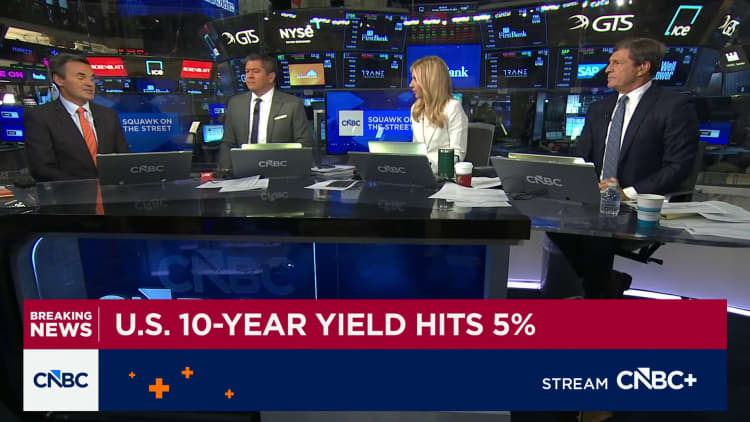
Treasury yields have been spiking on the expectation of higher prices in the economy, with the 10-year briefly surpassing 5% on Tuesday, its highest levels in 19 years.
“For perspective, a borrower financing the average new mortgage amount of $389,367 at an average APR of 6.78% could see monthly payments increase by approximately $65 if mortgage rates were to move one quarter point higher,” she said.
Other home loans are more directly tied to the Fed’s actions. Adjustable-rate mortgages, or ARMs, and home equity lines of credit, or HELOCs, are pegged to the prime rate. Most ARMs adjust once a year, but HELOCs adjust right away.
Car loans
Although auto loan rates are locked in once you buy a car, the Fed’s increase could raise rates on new loans, adding to the financial pressure facing car buyers.
“The direct financial hit to an individual car buyer’s monthly budget won’t look massive on paper — a quarter-point bump translates to a few dollars more each month on a typical $40,000 loan,” said Joseph Yoon, consumer insights analyst at Edmunds.
“The real headache is the overall borrowing landscape, as this rate hike stacks on top of auto loan rates that are already near multi-year highs and new-vehicle transaction prices hovering around $50,000 on average,” Yoon said.
Student loans
Federal student loan rates are also fixed for the life of the loan, so most borrowers aren’t immediately affected by the Fed’s move. However, rates are already higher for loans taken out during the 2026-27 academic year based on the last 10-year Treasury note auction in May, which took effect July 1.
Private student loans tend to have a variable rate tied to the Libor, prime or Treasury bill rates — and that means that, as the Fed rate rises, those borrowers will also pay more in interest. But how much more will vary with the benchmark.
Savings rates
The upside is that interest rates on savings accounts may head higher.
While the Fed has no direct influence on deposit rates, they tend to track movements in the federal funds rate.
“It’s a great time to shop for an online high-yield savings account, CD or money-market account,” said LendingTree’s Schulz. “Returns aren’t at the record levels we saw a couple years ago, but they’re still strong by historical standards, and a rate hike means they’re only going to get better in the near future.”