



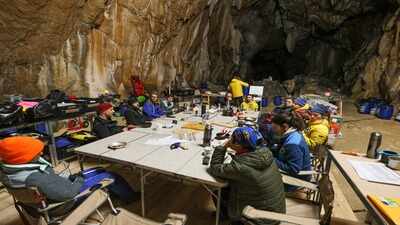
On March 14, 2021, fifteen volunteers, seven women and eight men aged between 27 and 50, entered the Lombrives cave in the French Pyrenees to begin a 40-day experiment with no clocks, no phones, no natural light and no contact with the outside world. Known as Deep Time, the project was led by French Swiss explorer Christian Clot through his nonprofit research group, the Human Adaptation Institute, and was designed to study how the human brain tracks time and how a group adapts psychologically and physiologically to prolonged isolation. When the volunteers finally emerged into daylight on April 24, 2021, most of them believed they had spent roughly 30 days underground, having lost track of more than a week and a half of real time despite the experiment’s rigorous scientific monitoring throughout.
What conditions the volunteers actually lived through
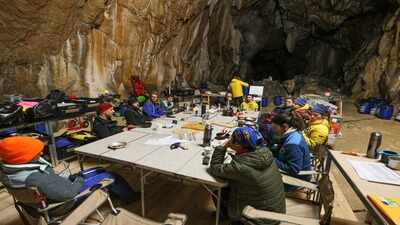
According to the project’s own registration on ClinicalTrials.gov, the experiment was designed to evaluate temporal cognitive perception and collective synchronisation in an underground environment lacking any external time cues, alongside the influence of group living on circadian rhythms in a free-running situation, meaning one with no light or dark cycle to anchor the body’s internal clock. The project operated under the oversight of France’s Ministry of Education, Research and Innovation.Inside the cave, temperatures held steady at around 10 degrees Celsius with 100 per cent relative humidity, and the volunteers had to draw their own water from a well roughly 45 metres beneath the surface. Three separate living spaces were set up within the cave system, one for sleeping, one for communal living and one dedicated to ongoing scientific work, including topography surveys of the cave’s flora and fauna. Participants wore biometric sensors throughout the experiment and swallowed a small capsule containing a thermometer that tracked internal body temperature until it passed naturally, giving researchers continuous physiological data for the full 40 days.
How the volunteers’ sense of time actually broke down
Without any clocks, sunlight or outside contact, the group had only one agreed rule, not to wake other members of the team, leaving each person to follow their own emerging internal rhythm rather than a shared, externally imposed schedule. According to reporting from the BBC, Clot said the group’s days gradually stretched well beyond the usual 24 hours, describing a shared surprise at how far their internal sense of time had drifted from the calendar by the time the experiment ended.When the volunteers were finally told the project was ending and prepared to leave, the mismatch became clear. According to the PBS NewsHour, Clot told journalists that in the group’s own minds, they had entered the cave roughly 30 days earlier rather than 40, while one team member, a maths teacher who had kept himself active by running 10 kilometre loops through the cave system each day, estimated he had only been underground for 23 days, having drifted onto a personal rhythm running as long as 40 hours in a single cycle.
Why the group’s days stretched so far beyond 24 hours
Sleep researchers have long understood that the human body’s internal clock relies heavily on external cues, particularly natural light, to stay synchronised to a 24-hour day. Deprived entirely of sunlight and any device capable of showing the time, the Deep Time volunteers appear to have drifted onto a self-reinforcing group rhythm considerably longer than a standard day, with some accounts from the expedition describing waking and sleeping cycles stretching past 30 hours by the experiment’s later stages.This pattern echoes earlier chronobiology research into isolated cave dwelling, including well-known experiments carried out by French geologist Michel Siffre beginning in the 1960s and 1970s, which similarly documented how completely removing external time cues can cause a person’s sleep-wake cycle to drift progressively away from a normal 24-hour rhythm the longer isolation continues.
What researchers hoped to learn from the experiment
Beyond documenting how far the group’s sense of time drifted, the Deep Time project was structured around a considerably broader set of scientific goals. According to its ClinicalTrials.gov registration, researchers aimed to study cognitive and physiological performance under extreme isolation, examine how the group organised itself socially and made collective decisions without external structure, and identify markers of successful adaptation versus maladaptation across biological, psychological and neurophysiological measures.Clot has said the research carries implications well beyond simple curiosity about time perception, pointing to potential relevance for fields including mining, submarine operations and long duration space travel, all environments where humans must function for extended periods without natural light or conventional time cues, and where understanding how quickly and how far a person’s internal clock can drift may carry real practical consequences.
What the experiment revealed about adapting to isolation
Despite the disorientation, several volunteers described the experience in largely positive terms once they emerged. One participant, 33-year-old Marina Lançon, described the sensation as feeling like time had been paused, saying she felt no particular urge to rush back into normal life immediately after leaving the cave. Clot himself noted that the volunteers’ need to remain socially connected as a group, rather than any purely biological driver, appeared to shape their shared rhythm underground, a detail he said the team planned to examine further in future research.More than four years on, Deep Time remains one of the most detailed modern studies of how completely humans can lose track of time once every external marker of it is removed, offering a rare, closely monitored glimpse into just how far, and how quickly, the human sense of time can drift once it is left with nothing external to measure itself against.