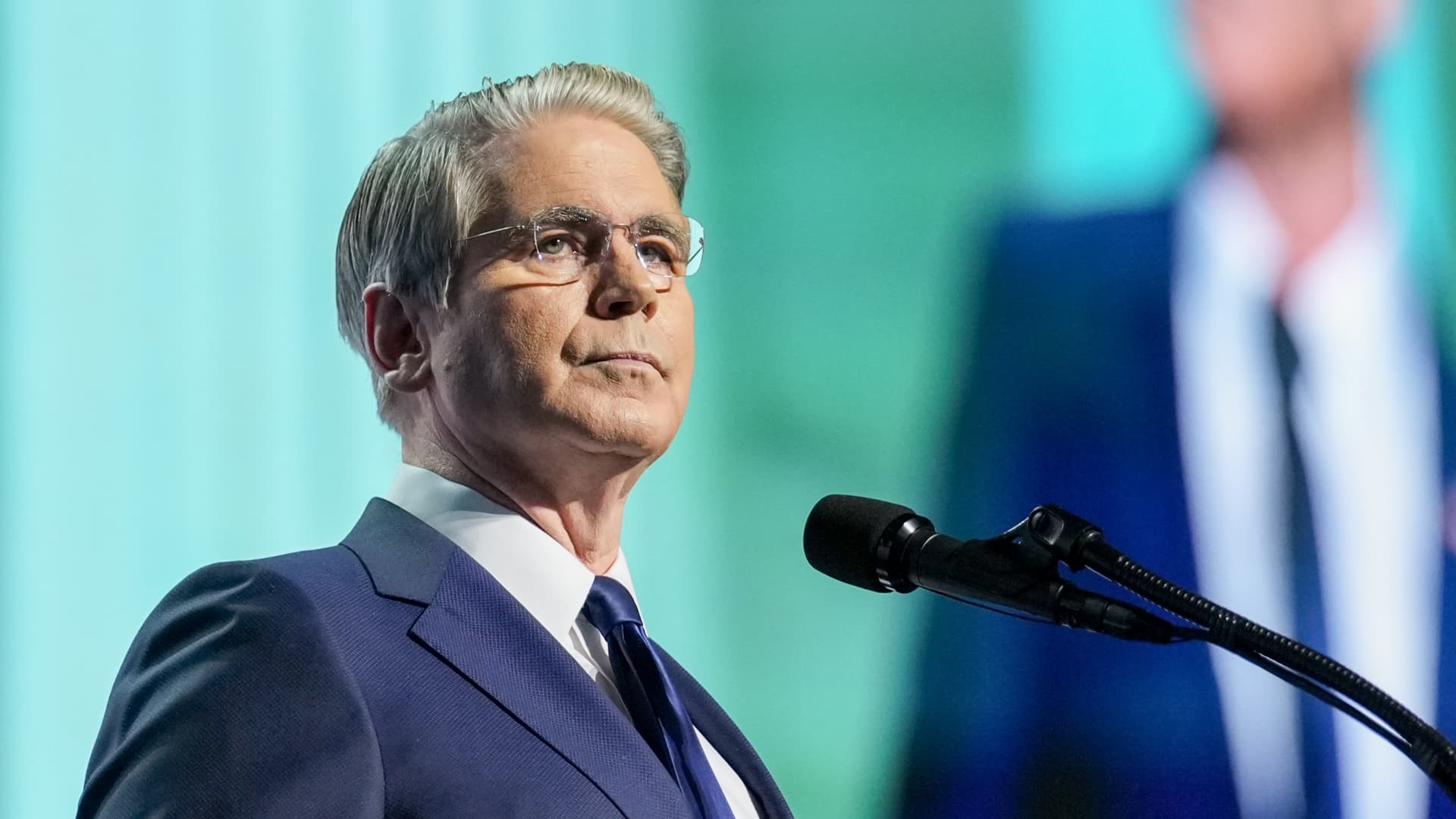





Tim Cook arriving at the annual Allen & Co. Media and Technology Conference in Sun Valley, Idaho on July 7th, 2026.
David A. Grogan | CNBC
Apple CEO Tim Cook had a lot to talk about on his last earnings call as CEO, as his company’s stock price trended lower on concerns about supply constraints. Regardless of the selloff, he told investors that Apple has “enormous opportunities” in artificial intelligence.
Cook, who will be assuming the role of executive chairman on Sept. 1, said Apple’s hybrid approach to AI, where some workloads can be run on iPhones and Macs is an advantage as his large tech peers rely on their massive clouds.
It’s an important signal to Wall Street about the company’s ability to run AI apps as Apple gears up for the launch of an updated Siri this fall.
“The ability to run some percentage of requests on device is also very strategic and sort of a competitive weapon,” Cook said.
Apple has bucked its hyperscaler peers by spending significantly less on capital expenditures as it tries to be a player in AI. Most of the spending across the industry is going towards Nvidia-based data centers to run advanced AI models from companies like OpenAI and Anthropic.
Alphabet, Amazon, Meta and Microsoft have each committed to shelling out well over $100 billion in capex this year. In the June quarter, Apple’s capex amounted to $2.46 billion, lower than a StreetAccount estimate of $3.44 billion. Cook noted that operating expenses are going up.
“We have been growing our opex and spending more in AI in general,” Cook said.
Instead of spending heavily on data centers, Apple emphasizes that much of its AI suite — Apple Intelligence — can be run on the devices themselves, using the full power of Apple’s chips and not radioing to the cloud.
Apple says it can do more in AI, potentially saving money for businesses that are spending heavily on AI software. He gave the example of Disney, where “creative teams are increasingly turning to Mac for on-device AI workflows that reduce overall cloud token costs and keep their IP secure,” Cook said.
Apple’s hybrid strategy will be tested when Siri AI is finally released to the public. The highly anticipated launch of Apple’s personal assistant will depend on the iPhone’s processor to decipher queries and use the appropriate on-device AI model.
However, there are tradeoffs in terms of what the local models can do. So for complicated AI tasks, Apple will use Google Cloud to serve those answers with infrastructure based on Nvidia’s graphics processing units and Intel’s central processors. Those tasks include things like image generation, Apple said in June, when it revealed the software.
Apple signaled at the time that it would cap users on its cloud models and that they might be able to increase their limits through iCloud. That would offer Apple a new way to monetize AI.
Cook said on Thursday that Apple didn’t have a “complete plan” for charging users, but that it aims to use AI as a selling point for iCloud subscriptions.
“We do believe there will be people that want to use it a lot, and so we will have some kind of upgrade possibilities on on iCloud+,” Cook said.