



People march through downtown Detroit, Michigan on Saturday, April 19, 2025
Dominic Gwinn | Afp | Getty Images
Social Security is the nation’s largest social insurance program, making payments to approximately 75 million Americans every month.
Yet the program faces an imminent funding shortfall.
Social Security’s trust fund for retirement benefits may run out in 2032, which could prompt an across-the-board benefit cut, according to projections from the Social Security Administration and Congressional Budget Office.
Social Security has been on the brink of funding cuts before. In 1983, when the last major reforms to the program were enacted, Social Security was just months away from not being able to pay full benefits.
At that time, lawmakers voted on bipartisan legislation that included taxes on benefit income and gradual increases to the retirement age to restore the program’s solvency.
With the program facing looming trust fund depletion dates, Washington leaders will need to come together again to shore up the program’s funding — or risk imminent benefit cuts if the program can’t pay benefits as promised.
During a March 25 Senate budget committee hearing focused on the “path forward” for the program, some leaders said Congress is up to the task.
“We can do this,” Sen. Sheldon Whitehouse, D-R.I., said of addressing the program’s shortfall. “It’s actually not all that hard or complicated. And the sooner we do it, the better off everyone will be.”
Because any new Social Security laws need to clear a 60-vote threshold in the Senate, changes to the program must have support from both parties, said Emerson Sprick, director of retirement and labor policy at the Bipartisan Policy Center.
Moreover, the 2026 class of senators will be the first federally elected group that must confront the program’s looming depletion dates within their six-year term, Sprick said.
“Members of Congress and their staffs are realizing this is something that has to be done,” Sprick said.
That starts with discussions between members of both sides of the aisle who can advance policy recommendations, he said.
Yet when it comes to making that reform a reality, Washington leaders still face one big question: How should it be paid for?
Here are some of the ideas that lawmakers and experts are talking about.
Option 1: Create a separate investment fund
In the next 75 years, Social Security faces a $25 trillion shortfall — the gap between estimates for revenue coming into the program and benefits to be paid out, according to projections from the program’s trustees.
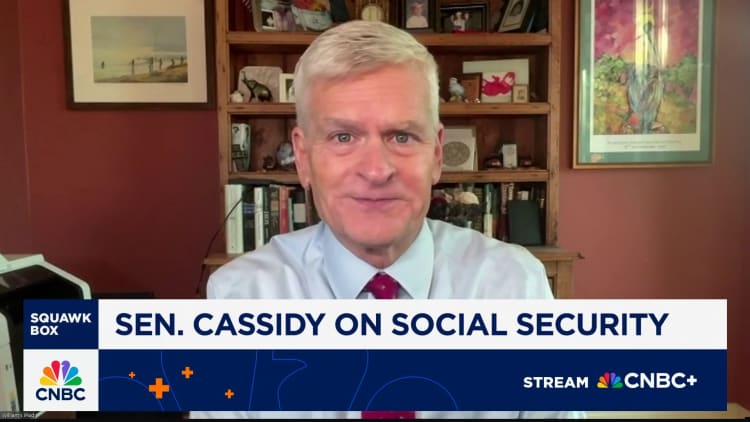
When adjusted for inflation, that total climbs to about $674 trillion, Sen. Bill Cassidy, R-La., said at the Senate budget committee hearing.
To address the shortfall, lawmakers have several options, Cassidy said — do nothing and let the estimated 23% to 28% benefit cuts happen; or enact a combination of tax increases and benefit cuts. Lawmakers last tried to do this with a commission under President Barack Obama, and it failed, Cassidy said.
Alternatively, lawmakers may opt for a third choice — to create a diversified investment fund to help shore up the program’s finances, according to Cassidy’s proposal, which has not yet been formally introduced as a bill.

Per Cassidy’s plan, the government would borrow $1.5 trillion that would then be invested similarly to a 401(k), the Louisiana senator said at the hearing. The fund would be separate from Social Security’s current trust funds and would be held in escrow for 75 years, he said. The balance would offset any borrowing required to help pay scheduled benefits, Cassidy said at the hearing.
The plan would include “strict legislative guardrails” to protect the funds, according to Cassidy, including independent management focused on maximizing returns while preventing political interference. That would include annual audits and full transparency, he said.
BlackRock CEO Larry Fink recently wrote in his annual letter to shareholders that Social Security’s funding should be allowed to grow with the economy. Rather than just the conservative Treasury bonds the Social Security funds are currently invested in, the money could be invested more aggressively, like other long-term pension plans, to achieve better returns, he wrote.
Yet some experts have criticized Cassidy’s proposal, particularly for the increased risk it would entail, given that the benefits are supposed to be guaranteed. Moreover, any gains would be limited by the cost of borrowing the funds.
During the hearing, Sen. Tim Kaine, D-Va., said he supports the proposal as one ingredient to help resolve the solvency crisis.
The amount borrowed could be adjusted to coordinate with other proposals to help address the solvency gap, Kaine said. Benefits paid would not be determined by the fund’s returns, he said. The strategy would build on other examples, particularly the National Railroad Retirement Investment Trust, established in 2001 to invest railroad retirement assets, according to both Cassidy and Kaine.
Option 2: Increase payroll taxes for high earners
At the Senate budget committee meeting, Whitehouse put forward another proposal that calls for individuals with incomes over $400,000 to pay more toward Social Security.
Social Security payroll taxes are capped at $184,500 in wages for 2026. Once that threshold is reached, high earners no longer pay into the program for the year. Million-dollar annual wage and salary earners stopped paying into Social Security as of March 9.
Whitehouse’s bill, called the Medicare and Social Security Fair Share Act, proposes a $400,000 threshold for Social Security that also applies to investment income, Whitehouse said at the hearing. The plan would also close a loophole that allows some wealthy owners of pass-through businesses to avoid paying Medicare taxes.

“The only way to extend solvency without cutting benefits or borrowing money, which would be also very dangerous, is to raise more revenue,” Whitehouse said during the hearing.
Whitehouse reintroduced the bill in 2025 with Democratic Rep. Brendan Boyle of Pennsylvania. The proposal would extend the solvency of both Social Security and Medicare by at least 75 years, according to analyses by the agencies’ actuaries.
Eliminating the payroll tax cap has been a popular proposal among Democrats, with Sens. Elizabeth Warren, D-Mass., Bernie Sanders, I-Vt., and others proposing to apply Social Security payroll taxes to all income over $250,000. Yet it remains to be seen whether Republicans would sign off on those tax increases.
Option 3: Cut benefits for those who can afford it
Instead of raising Social Security payroll taxes for high earners, lawmakers may opt to cap the benefits they receive.
During the Senate budget committee hearing, Sen. Lindsey Graham, R-S.C., said Social Security survivor benefits were an important part of his family’s life when his parents both passed away within about 15 months of each other.
“There was a time in my life where that Social Security check really, really mattered,” Graham said.
“Now, there’s the time in my life where I could probably get by with less, and if that’s what it takes to save Social Security, count me in,” Graham said.
The Committee for a Responsible Federal Budget recently put forward a proposal to cap Social Security benefits for high-earning married couples and singles at $100,000 and $50,000, respectively, who consistently had the taxable maximum earnings.
Mstudioimages | E+ | Getty Images
The proposal drew criticism from groups including the AARP, since it would go against the program’s premise of providing benefits that reflect what beneficiaries have earned and open up the possibility for further benefit cuts.
In a separate Senate Committee on Aging hearing on March 25, Warren brought up the idea of raising the retirement age, which some Trump administration officials have also suggested.
Raising the retirement age would mean an extra year of not receiving benefits, Dan Adcock, director of government relations and policy at the National Committee to Preserve Social Security and Medicare, said at the hearing.
“It doesn’t matter whether you claim benefits at 62 or 70 or how long you live, it is a benefit cut any way you slice it,” Adcock said.
Such a change could be particularly detrimental for those who need to retire early, he said.
Proponents of raising the retirement age say that Americans generally have longer life expectancies and that such a policy could be implemented in a way that protects lower-income individuals.
‘Open debate’ a first step towards reform
The AARP’s members, who are primarily age 50 and over, routinely say they want to see Social Security protected and strengthened, according to Jenn Jones, vice president of financial security and livable communities at the nonprofit representing older Americans.
To do that, Congress needs to get serious about talking about solvency and putting ideas on the table, Jones said. The Senate hearing allowed for the consideration of many approaches, she said.
“That’s what the process should look like,” Jones said. “It’s open debate.”
But because Social Security reform will likely include a combination of ideas, it is impossible to endorse any one approach at this stage, Jones said.
“We have to really be able to see and evaluate the entire package to understand what it will mean for millions of people,” Jones said, not just current beneficiaries, but also their children and grandchildren.