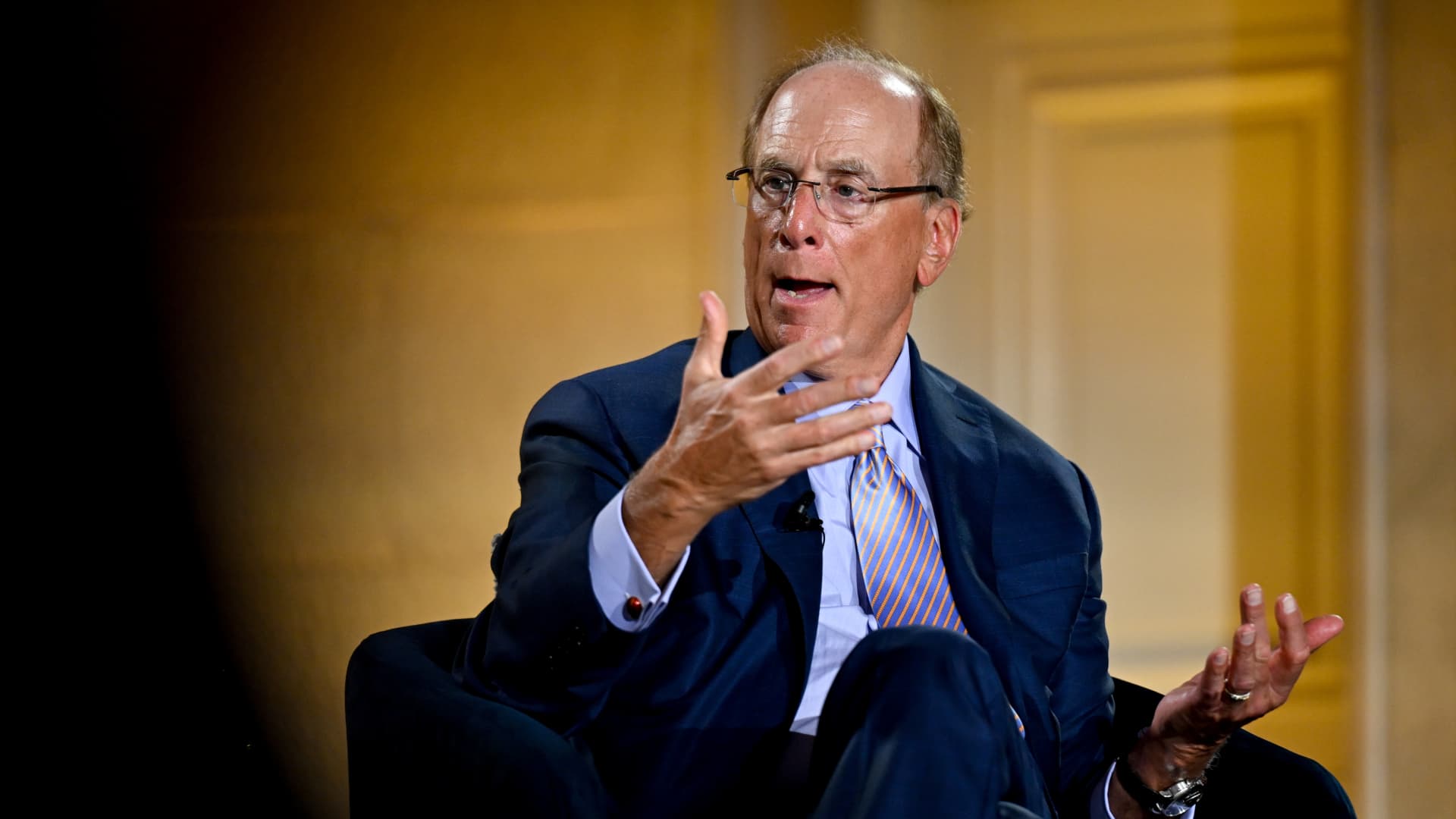





Blackrock CEO Larry Fink speaks on the set of CNBC on the floor of the New York Stock Exchange on April 11, 2025.
Timothy A. Clary | Afp | Getty Images
More than 70 million Americans — including retirees, disabled individuals and families — rely on Social Security benefits for monthly income.
It’s “one of the most effective poverty-prevention programs in history,” BlackRock CEO Larry Fink wrote in his annual chairman’s letter to investors, released Monday. Social Security keeps an estimated 29 million Americans out of poverty each year, Fink wrote, citing Census data.
Even with that “extraordinary achievement,” the 90-year old program could be improved, according to Fink.
“The issue is: Social Security provides stability, but it doesn’t allow most Americans to build wealth in a way that grows with their country,” Fink wrote.
Fink has called for investing on behalf of Social Security
As a pay-as-you-go program, Social Security is largely funded by payroll taxes. Both employers and employees contribute 6.2% toward the program, while self-employed individuals pay 12.4% on earnings up to $184,500 in 2026.
Money not immediately used to pay benefits is deposited into Social Security’s trust funds, which are invested in U.S. Treasury bonds.
The combined retirement and disability trust funds earned a 2.6% annual effective interest rate in 2025, according to Social Security Administration data.
Meanwhile, the stock market saw substantial gains last year, with the S&P 500 up about 16%. A 60/40 portfolio of stocks and bonds was up nearly 15% for 2025, based on the performance of the Morningstar US Moderate Target Allocation Index.
In his letter, Fink questioned whether Social Security’s assets should be allowed to grow with the broader economy. Doing so could generate higher returns, helping to repair the program’s financial shortfall without changes to benefits.
“Could a portion of the system be invested more like other long-term pension plans — carefully, broadly, and over decades — while ensuring the program remains a strong safety net?” Fink wrote.
It’s not the first time Fink has raised the idea. At BlackRock’s March 2025 retirement summit, Fink likewise called for more aggressive investing on behalf of Social Security.
Fink said at the time that he would not use the term “privatization” to describe those efforts, and reiterated that in his new letter.
“This would not mean privatizing Social Security or putting it all into the stock market,” Fink wrote. “It would mean introducing a measure of diversification” that would be similar to the federal Thrift Savings Plans, which allow participants to select from a menu of investment choices.

Some critics have said such a move would be privatizing the program, allowing private investment firms to help manage the public program’s assets.
While private firms may help provide returns that better reflect the market, it could also put the funds at higher risk for losses and poor performance, Rep. John Larson, D-Conn., told CNBC.com in a March 2025 interview.
Social Security has never missed a payment, even during steep market drops that hurt 401(k) balances, as in the 2008 financial crisis, Larson said.
However, other lawmakers — Sens. Bill Cassidy, R-La., and Tim Kaine, D-Va. — have proposed creating a new $1.5 trillion fund that would be invested in stocks and bonds. The strategy would complement, rather than replace, Social Security’s existing trust funds. The returns earned by the new fund could help cover Social Security’s trust fund shortfall without changing benefits, Fink wrote.
In an October briefing, Alicia Munnell, senior advisor at the Center for Retirement Research at Boston College, called the Cassidy-Kaine plan “a huge and risky financial maneuver with very little payoff.” The returns would be limited by the cost of borrowing, according to Munnell, and would divert Congress’ attention from addressing the imbalance between Social Security’s trust fund reserves and benefit payments.
‘The cost of waiting is only getting higher’
Social Security’s trust fund devoted to retirement benefits may run out in 2032, according to the latest projections from the Social Security Administration. If Social Security reform is not enacted before then, policymakers may face a tough choice as to how to implement benefit cuts.
In his letter, Fink said he was criticized two years ago for suggesting Social Security needed a fix and will probably face scrutiny again.
“But in my 50 years in finance, if there’s one thing I’ve learned, it’s that the problems we don’t talk about are the ones that should worry us most,” Fink wrote. “And that’s exactly why we need the conversation now — because the cost of waiting is only getting higher.”
Lawmakers and experts are scheduled to discuss the program’s future at a Senate committee hearing on Wednesday.