


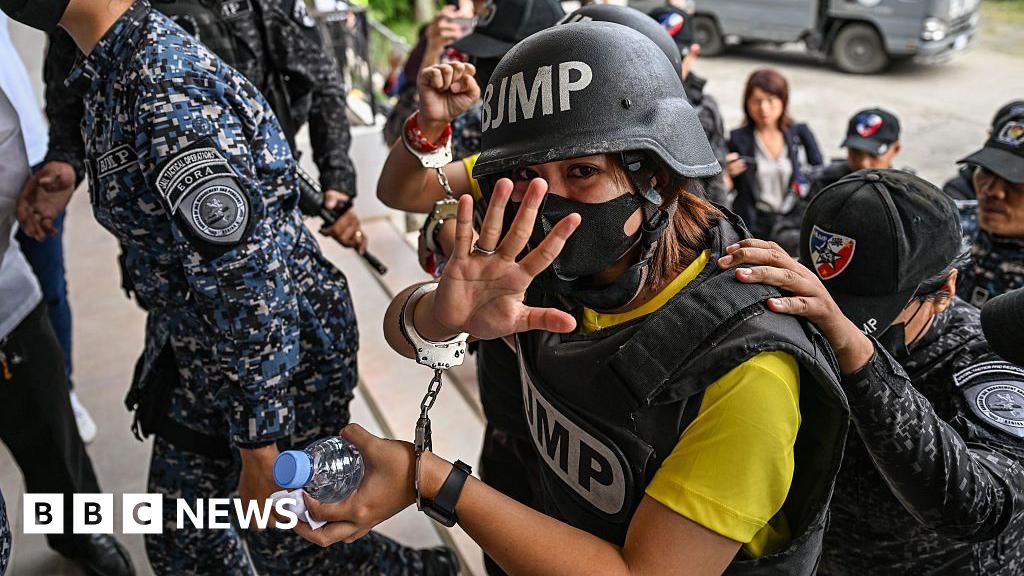
Filipino journalist Frenchie Mae Cumpio has been found guilty of financing terrorism and sentenced to at least 12 years in jail.
Cumpio, 26, was arrested in February 2020 after police and military raided her boarding house in the middle of the night and allegedly found a hand grenade, firearm, and communist flag in her bed.
Several thousand pounds in cash were also seized, which Cumpio has said were from a fundraising campaign.
On Thursday, after six years in prison without trial, she was acquitted of charges related to the illegal possession of firearms and explosives, but convicted on a terrorism financing charge, in a case press freedom groups have described as fabricated.
She faces 12 years behind bars.
“We are deeply concerned about the implications of this conviction, considering that there are many other cases, and I would say, trumped up cases, of financing terrorism that are still being prosecuted all over the country,” Atty Josa Deinla, one of Cumpio’s lawyers, told the BBC.
“The sad reality is that this decision carries grievous consequences for community journalism, because it’s really the community journalist – the ones on the fringes, the ones who don’t belong to the dominant media organisations, that really bring to light the conditions, especially in rural countryside, where the poorest people live.”
Prior to her arrest, Cumpio regularly reported on abuses by the military and police in the Philippines’ Eastern Visayas region, through articles for news site Eastern Vista – of which she is former director – and a show she hosted on radio station Aksyon Radyo-Tacloban DYVL.
Her case has drawn attention from a coalition of press freedom organisations and NGOs, who say the charges against her have been “fabricated” and her treatment in detention “inhumane”.
Independent media outlet Alermidya issued a statement on Thursday morning, local time, condemning the decision as “a miscarriage of justice”.
“We are outraged by the clear injustice of the court decision amid glaring evidence that the charges against Frenchie Mae, Marielle Domequil, and the rest of Tacloban 5 are all fabricated,” the statement said.
“The decision is a grave injustice and is a serious peril to the already dire state of press freedom and free expression in the Philippines.”
The Philippines’ International Association of Women in Radio and Television also issued a statement following the conviction, which it described it as “a blatant act of state-sponsored silencing”.
“The conviction of Frenchie Mae for terror financing is a travesty that seeks to legitimise the silencing of women who dare to speak truth to power, and her sisters from our community of women in media will not rest until she is fully vindicated and her name is cleared of these baseless charges,” the statement said.
“This sends a chilling message: that documenting the struggles of the poor has become a punishable offense.”
The Philippines is one of the most dangerous countries for reporters, according to Reporters Without Borders (RSF) data.