




Trevor Williams | DigitalVision | Getty Images
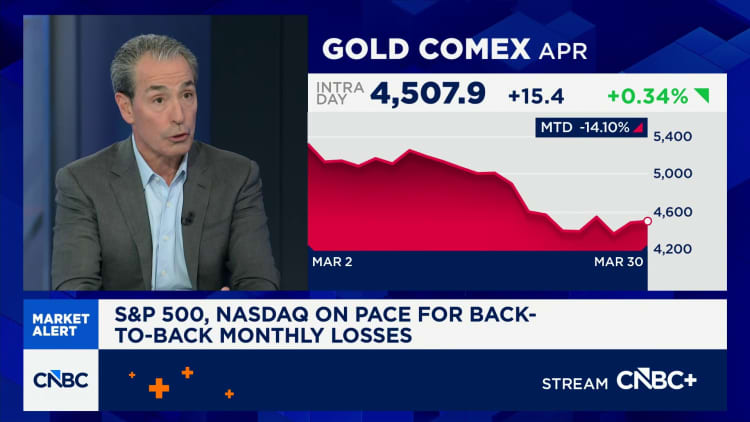
The stock market rallied on Tuesday, the last trading day of March, inspired by hopes for an end to the Iran war. But it was not an easy month for investors.
In March, the S&P 500, Dow Jones and Nasdaq indices each fell around 5% — capping off a losing quarter.
Investors may want to brace themselves for more dramatic swings: The markets are poised to be “extremely sensitive to headlines, both positive and negative,” said Jack Manley, global market strategist at JPMorgan Asset Management.
“Now is still a good time to be taking risk, but realize it is going to be a choppy, bumpy ride over the course of this year,” Manley said.
While jittery investors may be tempted to sit out the market turbulence, those who move in and out of investments stand to lose the most, JPMorgan Asset Management data shows.
In the past two decades, six of the market’s 10 best days happened within two weeks of its 10 worst days, according to the firm’s analysis of S&P 500 data. The second-worst day of 2020, March 12, was immediately followed by the second-best day of the year.
Investors who stay fully invested stand to earn the best returns, JPMorgan Asset Management found. The more “best days” investors miss by moving in and out of the markets, the worse their returns, the firm’s data shows.
To better weather the volatility, it also helps to stay diversified, Manley said.
U.S. equities a ‘great place to generate wealth’
A set-it-and-forget-it S&P 500 index investment strategy comprised of large-cap U.S. equities has been a winner, with three consecutive years of double-digit gains — around 16% in 2025, 23% in 2024 and 24% in 2023.
The S&P 500 is not on pace to match those gains in 2026, as it is down about 3.5% year to date.
“In any given year, you might have a bad year being a U.S. stock investor,” Manley said. “But over the long run, history has shown very clearly that U.S. equities are a great place to generate wealth.”
While headlines about the conflict in Iran sway the markets, other events like the U.S. intervention in Venezuela, talk of acquiring Greenland and the collapse of the Japanese bond market were already fueling uncertainty.
“It’s not like this market was on fire before the conflict kicked off,” Manley said.

To prepare for prospective market choppiness, it’s best to stay diversified, Manley said, with exposure to international, fixed-income and other categories like real estate or real assets that are uncorrelated to market returns.
Having a plan can also help investors stay the course when emotional or stressful unexpected events arise, said Brian Schmehil, a certified financial planner and managing director of wealth management at The Mather Group in Chicago.
Ideally, that includes enough cash to provide for short-term goals and a “good game plan” for long-term investments, Schmehil said.
By rebalancing regularly and understanding your personal risk tolerance, investors have a better chance of staying the course, according to Schmehil, rather than bailing if their portfolio balance or emotions reach uncomfortable levels.
It also helps to use a reputable financial advisor as a sounding board, Schmehil said.
“Everybody thinks the wealth advisor is supposed to pick the best stocks or give you the best tax strategy,” Schmehil said. “That is true, but with the age of AI, a lot of that stuff’s going to be table stakes.”
“What’s really going to matter is having somebody that can understand your emotions,” he said.