



Nvidia’s CEO Jensen Huang speaks during a keynote address at Nvidia’s GTC Conference on March 16, 2026 in San Jose, California. Nvidia’s GTC Conference focuses on recent developments and future uses of AI.
Benjamin Fanjoy | Getty Images
At Nvidia’s annual developer conference on Monday, CEO Jensen Huang took the stage to a packed house and said he expects purchase orders between Blackwell and Vera Rubin to reach $1 trillion through 2027.
Last year, the company had projections for a $500 billion revenue opportunity between the two chip technologies. Following Nvidia’s earnings report last month, Finance chief Colette Kress said the company expects growth this year to exceed what was included in that estimate.
Huang said demand is booming from startups and big companies alike. Nvidia shares rose about 2% on Monday.
“If they could just get more capacity, they could generate more tokens, their revenues would go up,” Huang said at GTC in San Jose, California.
Nvidia’s graphics processing units for artificial intelligence have turned the brand into a household name and the most valuable public company in the world, worth about $4.5 trillion. As mass AI adoption shifts from chatbots to agentic apps that spawn off other agents to accomplish tasks, the number of tokens being generated has exploded, creating even greater need for running inference at faster speeds.
The chipmaker said in February that year-over-year revenue this quarter will surge about 77% to roughly $78 billion. The company has reported 11 straight quarters of revenue growth above 55%.
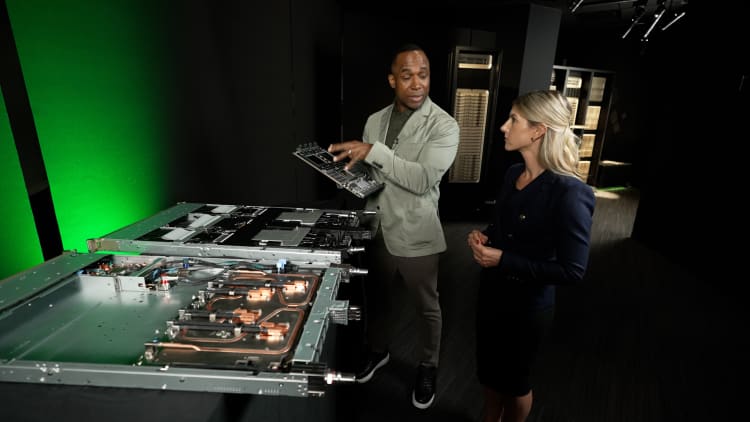
Nvidia is scheduled to roll out Vera Rubin later this year. The system, which is made up of 1.3 million components, will deliver 10 times more performance per watt than its predecessor, Grace Blackwell, the company claims. That’s a significant development when energy consumption is one of the most critical issues facing the AI build-out.
Also on Monday, Huang unveiled the Nvidia Groq 3 Language Processing Unit, or LPU, the company’s first chip from the startup that it mostly acquired through a $20 billion asset purchase in December, its largest deal ever. It’s expected to ship in the third quarter.
Groq was founded by the creators of Google’s in-house tensor processing unit, which has gained traction in recent years as a competitor to Nvidia’s graphics processing units. The Groq 3 LPU is built to enhance its technology, with one core optimized for speeding up the GPU.
Huang introduced a full rack dedicated to housing the new Groq accelerators.
The Groq 3 LPX rack will hold 256 LPUs, and is meant to sit beside the Vera Rubin rack-scale system that’s shipping to customers later this year. Huang said the Groq LPX rack can increase the tokens per watt performance of its Rubin GPUs by 35 times.
“We united, unified two processors of extreme differences, one for high throughput, one for low latency. It still doesn’t change the fact that we need a lot of memory,” Huang said. “And so we’re just going to add a whole bunch of Groq chips, which expands the amount of memory it has.”
Huang also showed off a prototype of Kyber, Nvidia’s next big rack architecture leap after Rubin. It will integrate 144 GPUs in compute trays that sit vertically instead of horizontally in order to boost density and lower latency. The Kyber design will be available in Vera Rubin Ultra, Nvidia’s next rack-scale system, expected to ship in 2027.
— CNBC’s Jordan Novet contributed to this report.