



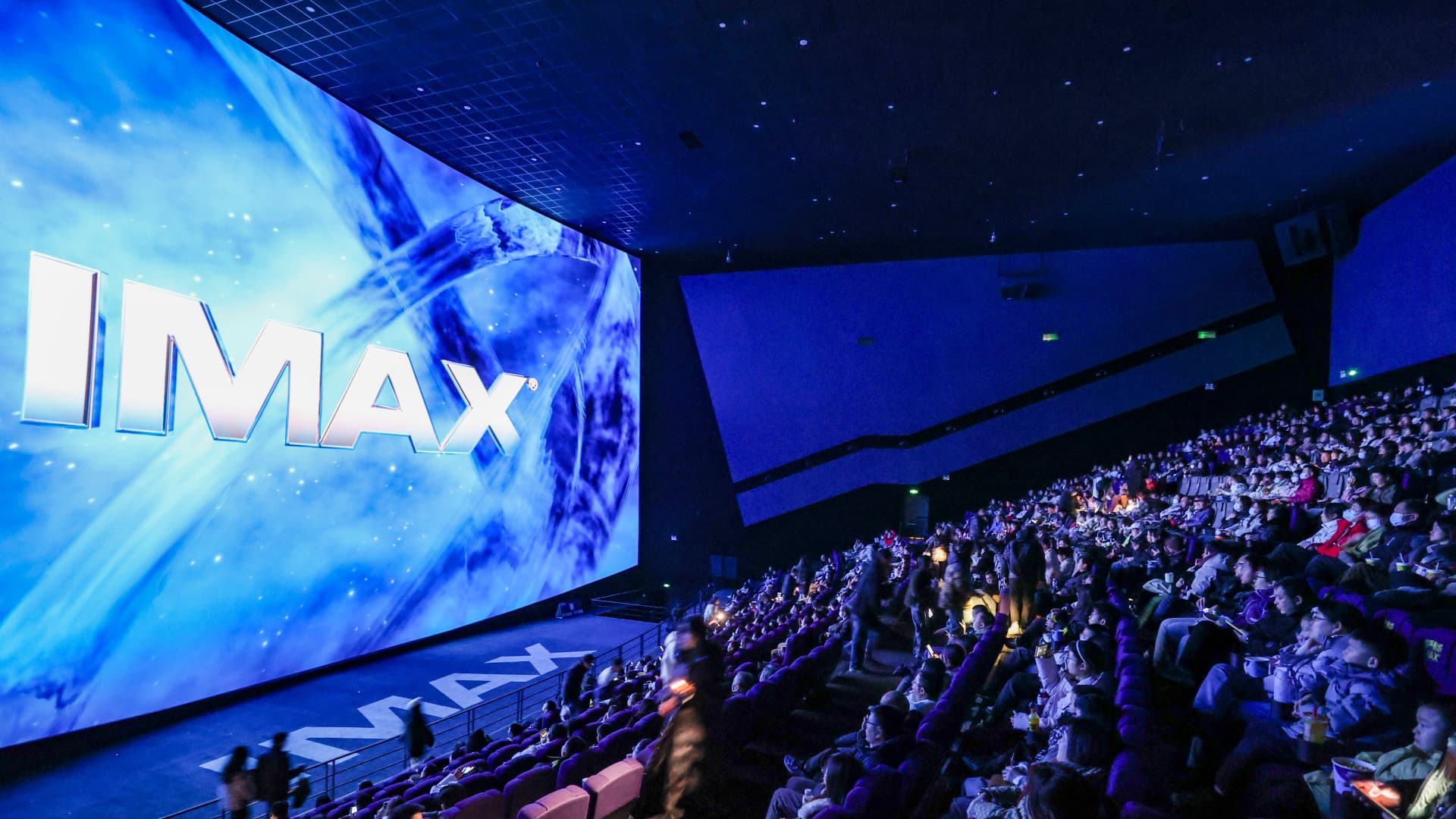
Moviegoers watch the film “Ne Zha 2” at an Imax GT Cinema on in Guiyang, China, Feb. 23, 2025.
China News Service | China News Service | Getty Images
In December, Imax CEO Rich Gelfond opened the door to a sale. Almost nine months later, the company’s stock has hit an all-time high, its box office is breaking records and the stage is set to carry its momentum through the end of 2026.
Yet, no major suitors have appeared.
Imax held preliminary talks with potential buyers earlier this year, but as of May hadn’t fielded any official pitches, CNBC reported at the time. Imax hasn’t hired new bankers and doesn’t have a formalized pitch book, according to a person familiar with the company, who spoke on the condition of anonymity to discuss confidential matters.
But it’s a busy time for dealmaking in the media space. Paramount Skydance is in the midst of a contested merger with Warner Bros. Discovery worth $110 billion, Fox agreed to acquire Roku in a deal worth $22 billion, and Comcast continues its corporate restructuring with the upcoming spinoff of NBCUniversal, which many in the industry say will give both resulting companies more flexibility to do deals.
With a nearly $3 billion market cap, Imax is a relatively inexpensive asset in the entertainment landscape. And it’s been on a hot streak in the wake of the pandemic as moviegoers have traded up for higher-priced premium large format cinema experiences.
The company’s momentum has been further fueled by strong box office sales from films like Universal and Christopher Nolan’s “The Odyssey.” Over the weekend, global Imax ticket sales for the film surpassed $400 million, the first film to exceed the benchmark in the company’s history. This haul represents nearly 30% of total global sales for “The Odyssey” — despite the fact that Imax screens represent less than 1% of movie screens worldwide.
And then there’s the strong pre-sales for the December release of Warner Bros. and Denis Villeneuve’s “Dune: Part Three,” which has already sold out specialized screenings into January.
Wall Street analysts foresee Imax setting a new global box office record in 2026, hot off the heels of the record $1.28 billion the company posted last year. Imax’s 2025 ticket sales were more than 40% higher than 2024 and 13% higher than its previous record, set in 2019.
“The brand value of Imax has never been higher,” Eric Handler, managing director and senior research analyst at Roth, told CNBC. “They have done a really good job of situating themselves right in the center of the eco-structure for Hollywood. So, it’s been a masterful, long-time-coming situation.”
Contributing to the momentum is Imax’s premium ticket prices, which, despite being higher than for other screenings, have not deterred audiences.
So far in 2026, the average adult Imax ticket cost $20.57 in the U.S., according to data from EntTelligence. That’s more than 60% higher than the average standard ticket, at $12.75 each, and nearly 18% higher than rival premium large format offerings, which average around $17.46 apiece.
The company’s slate of “filmed for Imax” content is also accelerating and expected to grow materially through 2028. It’s diversifying beyond the Hollywood landscape with partnerships in China, Japan and South Korea to screen local-language content.
The company is also actively expanding. Around 160 to 175 Imax systems are expected to be installed in 2026, with contracts to build hundreds more already in place, the company told CNBC last year.
The result, then, is less a question of what’s for sale and more a question of who would buy.
The TCL Chinese Theatre during opening weekend for “The Odyssey” in Imax in Hollywood, California, July 18, 2026.
Aaronp/Bauer-Griffin | Gc Images | Getty Images
The most — and least — likely suitors
Handler noted that a potential buyer would need to balance studio relationships and cinema partnerships, as Imax has for years. The company installs its special format screens in existing theaters and negotiates release windows for top-billed films.
Major studios, including Disney, Universal, Paramount and Warner Bros., would have an immediate conflict of interest if they acquired Imax, Wall Street analysts told CNBC.
Imax is “studio agnostic, and so they charge every studio the same,” said Eric Wold, executive director of equity research at Texas Capital Securities. “If some studio were to purchase them, I think the other studios would always feel that they’re kind of second in line for the key release slots in the holidays and summer, and so it may not be received well.”
Even in the scenario where a deal of that nature passed muster with Hollywood and regulators, a single studio would be hard-pressed to fill a 52-week theatrical calendar with only its own films. Premium large format, or PLF, is intended for blockbuster feature films, which moviegoers are willing to pay a higher price to attend. A smaller-budget film with less spectacle might not draw the same crowds for the same price on that kind of screen.
Not to mention, few studios have purchased cinemas even after the Department of Justice rescinded the 1948 Paramount Consent Decrees, which previously disallowed studios from owning movie theater chains. Those restrictions formally sunset in 2022, but so far only Sony has done a major deal for cinemas, acquiring all 35 Alamo Drafthouse locations in 2024.
Beyond movie studios, analysts have highlighted potential suitors in entertainment and tech: for example, Netflix, Apple, Amazon or Sony.
Netflix long vowed to build growth rather than buy it, but more recently it’s gotten a taste for M&A. The company entered into an agreement with Warner Bros. Discovery to buy its studio and streaming businesses before being outbid by Paramount Skydance.
Its foray into dealmaking has led many in media to wonder if Netflix could be on the hunt for another opportunity.
The streamer doesn’t rely on theatrical releases as part of its main programing strategy, therefore its conflict of interest if it were to acquire Imax would be smaller than for traditional Hollywood studios. Additionally, owning Imax would provide any filmmaker that signed on to work with Netflix the opportunity for premium theatrical runs.
Of course, Netflix historically has had limited interest in the traditional theatrical model. While the company does release some films in cinemas, it’s typically done so for short runs or for eligibility for Academy Awards contention.
As for Apple, Amazon and Sony, all three companies have strong technology businesses in addition to theatrical and streaming content, which may align nicely with Imax’s tech-heavy business. While Sony does not have its own streaming platform, it partners with Netflix to distribute new content. Meanwhile, Apple has AppleTV and Amazon has Amazon Prime.
Taking on a cinema tech firm like Imax could offer each company a new avenue for distribution.
There’s also the possibility that Imax could draw interest from a company or investor that wants to buy into Hollywood and the broader entertainment universe. Imax has a global presence and connections to most major studios as well as cinema partners worldwide.
Analysts also noted that a private equity buyer would eliminate any potential conflict concerns and could be most interested to ride the stock’s momentum.
Imax Corp. CEO Richard Gelfond attends the New York premiere of ‘A Beautiful Planet’ at AMC Loews Lincoln Square in New York, April 16, 2016.
Jamie McCarthy | Getty Images
‘Perfectly fine as a standalone company’
Shares of Imax hit an all-time high this week of $54.79. The stock is up almost 80% in the past 12 months.
That surge could be among the reasons it’s still going it alone, according to Alicia Reese, senior vice president of equity research at Wedbush.
“It’s a lot more expensive than it has been for a long time,” Reese said.
When Gelfond first floated the idea of a sale last year, the stock was trading at around $36 per share and had a market cap of about $1.95 billion. The price tag is now a billion dollars higher.
“Maybe those tech companies or potentially [private equity] who had considered it or had been kicking the tires would wait a little while and see what happens to the share price,” Reese said. “There’s a large probability that it’s just going to continue to gain share and gain global growth and remain at these elevated valuation levels for some time, as the growth isn’t likely to reverse.”
Several Wall Street analysts see further stock growth on the horizon, with price targets from some firms as high as $65 a share. On Monday, Drew Crum of B. Riley Securities raised his price target on the stock to $61, up from $52.
“Taken together, we continue to forecast record financials in 2026, with share gains, higher margins, and healthy cash flow generation, as reflected in our above-consensus estimates,” he wrote.
Potential suitors would also naturally be looking at what the future holds for the entertainment business at large. The North American box office is still chasing the pre-pandemic levels of 2019, and despite a blockbuster summer, ticket sales are still lagging.
Wedbush’s Reese noted that Imax is grouped in with the theatrical exhibition space, which is traditionally a slow-growth, dividend-paying business. These types of companies will likely get back to paying those dividends once they can sustain “some very low single-digit growth,” she said.
And because Imax is not actively seeking a sale, simply entertaining offers, its executives can afford to be choosey.
“I think the main point is that Imax is perfectly fine as a standalone company,” Reese said. “And so they’re not desperate in any way, shape or form. So, they’re not going to go for just any bid. They want a bid that’s a nice premium to where the shares are currently trading. And so it’d be hard to come to a deal, I think, right now.”