




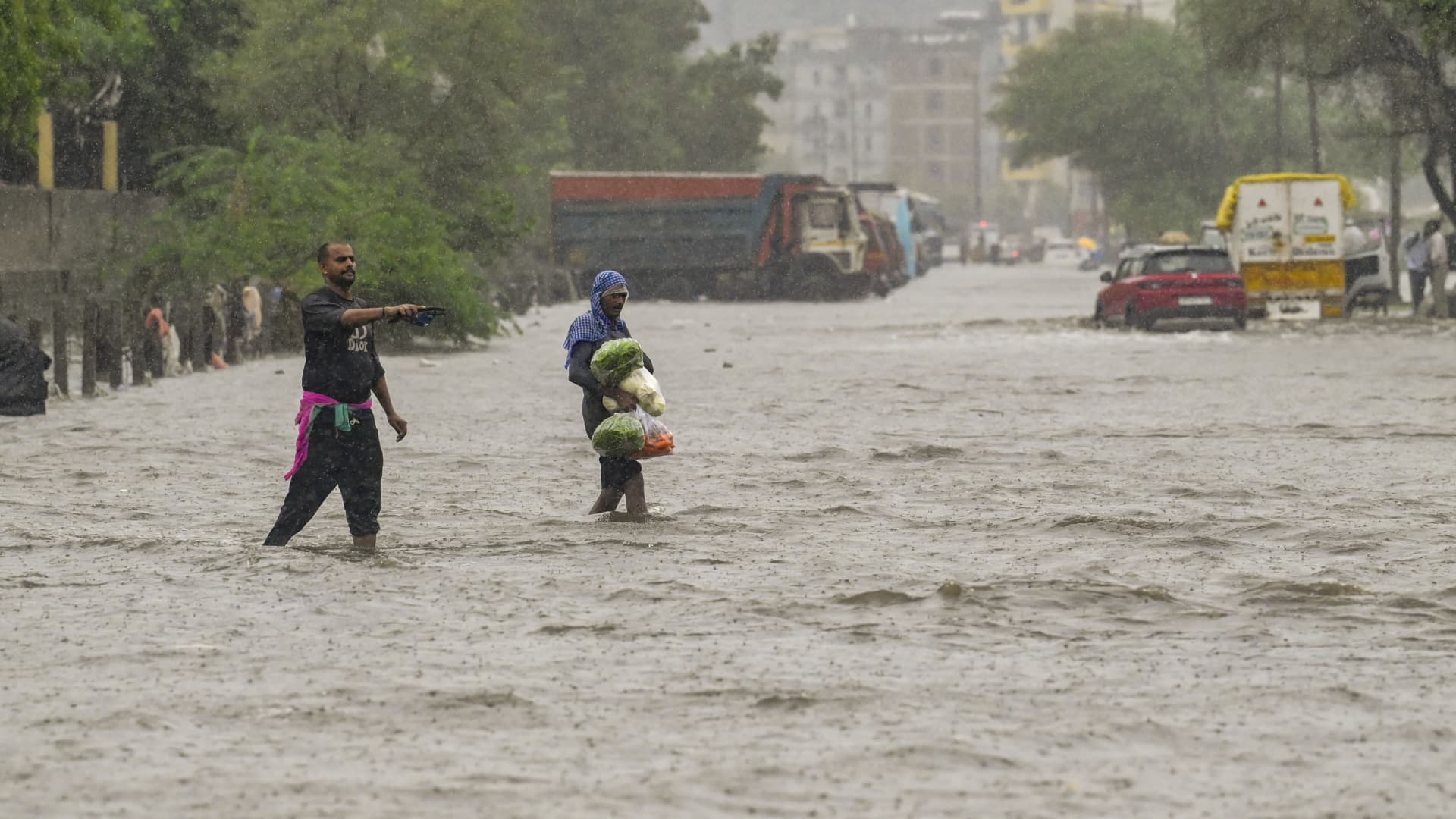
NEW DELHI, INDIA – JULY 9: People are seen crossing a waterlogged road after the heavy rainfall at Gazipur Sabzi Mandi on July 9, 2026 in New Delhi, India. (Photo by Raj K Raj/Hindustan Times via Getty Images)
Hindustan Times | Hindustan Times | Getty Images
India’s consumer price inflation rose to 4.38% in June, up from 3.93% in May as the U.S.-Iran war and a weak monsoon raised food and fuel prices, adding to cost pressures.
The headline inflation number was above economists’ expectations for a 4.30% rise, according to a Reuters poll.
The year-on-year inflation rate based on the All India Consumer Food Price Index (CFPI) for the month of June was 5.32%, India’s Ministry of Statistics and Program Implementation said in a Monday release. Transport inflation rose 4.3% in June, quicker than the 1.75% rise in May, it said.
Last month, India’s central bank kept interest rates unchanged but said it expects inflation to rise and growth to temper in the financial year ending March 2027.
The Reserve Bank of India forecasts inflation to shoot up to 5.1% as consumers pay higher fuel prices and the country faces a risk of crop shortages caused by weather-related disruptions from El Niño this year. It pegged core inflation at 4.7% for the same period.
After a brief ceasefire between Iran and the U.S. in June, hostilities between the two sides resumed last week.
Global oil prices have risen as the U.S. and Iran contest for control of the Strait of Hormuz, one of the most important trade routes for global energy supplies.
India, the world’s fastest-growing major economy, is among the countries most vulnerable to the supply disruptions caused by the Iran war. The South Asian country imports nearly 85% of its fuel needs and relies on the Strait of Hormuz for about 50% of its crude imports, 60% of its liquefied natural gas, and almost all of its liquefied petroleum gas supplies.
The South Asian country is also facing the risk of El Niño this year. Despite the copious downpour that led to flooding across many parts of the country in the last two weeks, India still faces the prospect of a deficient monsoon this year.
“Following a parched June, the monsoon advanced rapidly, reducing the all-India rainfall deficit from 40% to 15% as of July 8,” S&P Global-owned Indian research and rating firm Crisil said in a report on Friday.
But the India Meteorological Department (IMD) has forecast July rainfall will come in at 6% below the long-period average.
These swings between rainfall scarcity and surplus “can be as disruptive to agriculture as a weak monsoon itself,” as it influences sowing decisions, crop health and ultimately rural incomes, Crisil said.
The Indian central bank has repeatedly emphasized its focus on core inflation. While core inflation has yet to become a major concern, prolonged higher energy and food prices will increase core inflation through higher input, transportation, and operational costs.