




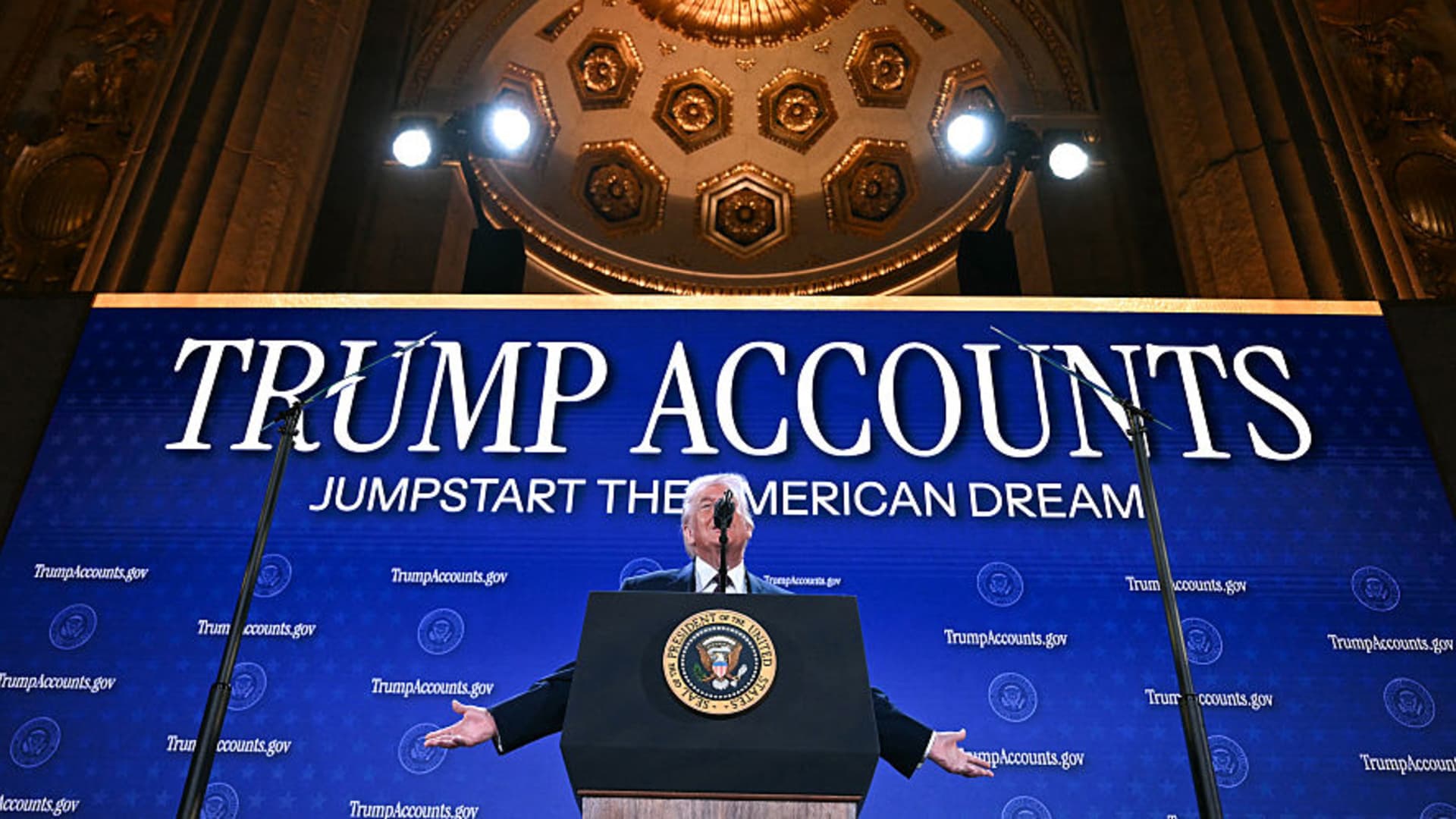
President Donald Trump speaks about Trump Accounts at the Andrew W. Mellon Auditorium in Washington, Jan. 28, 2026.
Brendan Smialowski | AFP | Getty Images
Trump Accounts officially launch on July 4. These new tax-advantaged investment accounts for children are geared toward long‑term retirement savings, rather than education or shorter‑term goals.
While some details are still forthcoming, this guide explains how these accounts work, including details about who is eligible, what free money is available and how to maximize the long-term growth potential.
What is a Trump Account?
Trump Accounts, also known as 530A accounts, are a type of individual retirement account for children, enacted via President Donald Trump‘s “big beautiful bill.” The accounts include a one-time $1,000 pilot program contribution from the U.S. Treasury Department for babies born from 2025 through 2028.
How does a Trump Account work?
The accounts function like an IRA, with some exceptions. Trump Accounts can receive contributions from multiple sources, such as family or employers, and the funds grow tax-deferred.
The money will be invested in U.S. stock funds, and Bank of New York Mellon will officially manage the initial accounts. Families can track account activity with the Trump Accounts app, which was designed in partnership with Robinhood.
Who is eligible for Trump Accounts?
Trump Accounts are available for all children age 18 or younger.
Any authorized individual — a legal guardian, parent, adult sibling or grandparent — can open a Trump account on behalf of a child, as long as the child is a U.S. citizen with a work-authorized Social Security number.
The deadline to enroll is the year before a child turns 18.
Who may receive Trump Account contributions?
Babies born between 2025 and 2028 will receive a $1,000 initial deposit from the Treasury Department, once a parent or guardian opens a Trump Account on their behalf.
Children born between 2016 and 2024 — who wouldn’t qualify for the $1,000 contribution — could get $250 if they live in a ZIP code where the median income is $150,000 or less, courtesy of a $6.25 billion pledge from tech CEO Michael Dell and his wife, Susan.
Eligible children will begin receiving the $1,000 pilot program contribution from the Treasury Department beginning on or after July 4, the agency has said. The $250 Dell gift is expected to follow soon after, as accounts are processed, according to the Dell Foundation.
In New York City, for example, roughly 754,200 children are eligible for the Dell grant, representing $188.5 million in Dell contributions, according to data provided exclusively to CNBC by a Dell Foundation spokesperson. Additionally, 186,900 children in New York City qualify for Treasury’s $1,000 seed deposit, representing $186.9 million in government contributions, according to the spokesperson.
A growing number of companies have pledged to match the accounts’ $1,000 Treasury deposit for children of employees, and philanthropists in several states have committed to additional gifts for certain qualifying families. There may be more commitments to come, Treasury Secretary Scott Bessent has said.
There are also reports that business leaders and philanthropists may, at some point, be able to donate stock to the new investing accounts.
How do you sign up for a Trump Account?
Parents or guardians can open accounts now by filling out IRS Form 4547 with their tax return or on TrumpAccounts.gov.
Families should then download the Trump Accounts app to activate the account, as well as track and manage account activity over time.
How can you avoid Trump Account scams?
For now, all official communication about your account will come via email from no-reply@trumpaccounts.treasury.gov, according to the Treasury Department: “If you receive a call or text about a Trump Account, do not respond, it is likely a scam.”
Always access your child’s Trump Account through the Trump Accounts app or by typing TrumpAccounts.gov directly into your browser, Treasury guidance says.
How can you fund a Trump Account?
After July 4, parents, guardians, grandparents and others can collectively contribute up to $5,000 a year in after-tax dollars up until the year before the beneficiary turns 18. The annual contribution limit indexes for inflation after 2027.
Employers can also contribute up to $2,500 per worker per year, which is part of the $5,000 limit and won’t count as taxable income, according to the IRS. This figure also adjusts for inflation after 2027.
Additionally, qualifying charitable organizations and state and local governments may make contributions that do not count toward the $5,000 limit.
How much could Trump Accounts grow?
TrumpAccounts.gov projects that accounts could grow to $6,000 by age 18, $15,000 by age 27 and $243,000 by age 55, assuming the account gets the initial $1,000 Treasury deposit and no further contributions.
It also projects that accounts that get the initial $1,000 Treasury deposit and an additional $5,000 contribution each year could grow to $271,000 by age 18, $742,000 by age 27 and $13 million by age 55.
These estimates are based on the S&P 500 historical annual average return of over 10%.
However, to reach nearly seven figures by a child’s late 20s, parents would need to max out Trump accounts for many years while earning “fairly strong, uninterrupted market returns,” according to certified financial planner Douglas Boneparth, president of Bone Fide Wealth in New York.
Some market analysts say U.S. stock market returns could be lower over the next decade, with Morningstar’s market simulations producing an average return of 6.3% per year, according to data provided to CNBC.
When can you withdraw funds from a Trump Account?
Generally, it’s not possible to withdraw Trump account funds before age 18. But there are limited exceptions, including certain rollovers, distribution upon death and for excess contributions, according to the IRS.
Once the child reaches age 18, the standard rules for traditional IRAs apply. Withdrawals before age 59½ are generally subject to income taxes and a 10% penalty. There are certain penalty exceptions, such as for distributions for higher education expenses or to purchase a first home.
How could Trump Accounts affect the wealth gap?
Proponents of the new accounts say investing in U.S. stocks creates wealth-building opportunities for children across all income levels.
“The returns on capital today are radically greater than the returns on labor, which means we have a growing wealth gap,” Altimeter Capital CEO Brad Gerstner, who helped spearhead Trump Accounts, said during a June 12 appearance on CNBC’s “Halftime Report.”
“Now we need to get capital into the pockets of every child born so that they can compound in the upside of SpaceX, in Alphabet, in all of our great companies, like everybody else in the market,” Gerstner said.
The Urban Institute, a nonprofit research organization, says research shows that overall participation rates, especially among low-income families, may be low, and family contributions will vary sharply by income, which could compound wealth disparities over time and concentrate the benefits among higher-income households.
How do Trump Accounts compare with 529s and Roth IRAs?
So far, families have signed up more than 6 million children for Trump Accounts, the Treasury Department said in mid-June. But Trump Accounts are not the only game in town.
When it comes to long-term savings, families could also consider a 529 college savings plan, a custodial account for minors under the Uniform Gifts to Minors Act or Uniform Transfers to Minors Act, also known as UGMA and UTMA, and, if a child earns income, a Roth individual retirement account. Those options may be as good as or better than the Trump Accounts, depending on your child’s needs and long-term goals, experts say.
For some, claiming the initial grant money is enough of an incentive to open a Trump Account. But there could be another reason to consider these accounts — namely, for a Roth individual retirement account conversion.
This strategy would entail the transfer of pretax or nondeductible IRA funds held in the Trump Account — including the seed money, employer matches and philanthropic gifts — to a Roth IRA. It’s a way to sidestep the earned income requirement and kickstart future tax-free growth, experts say.