


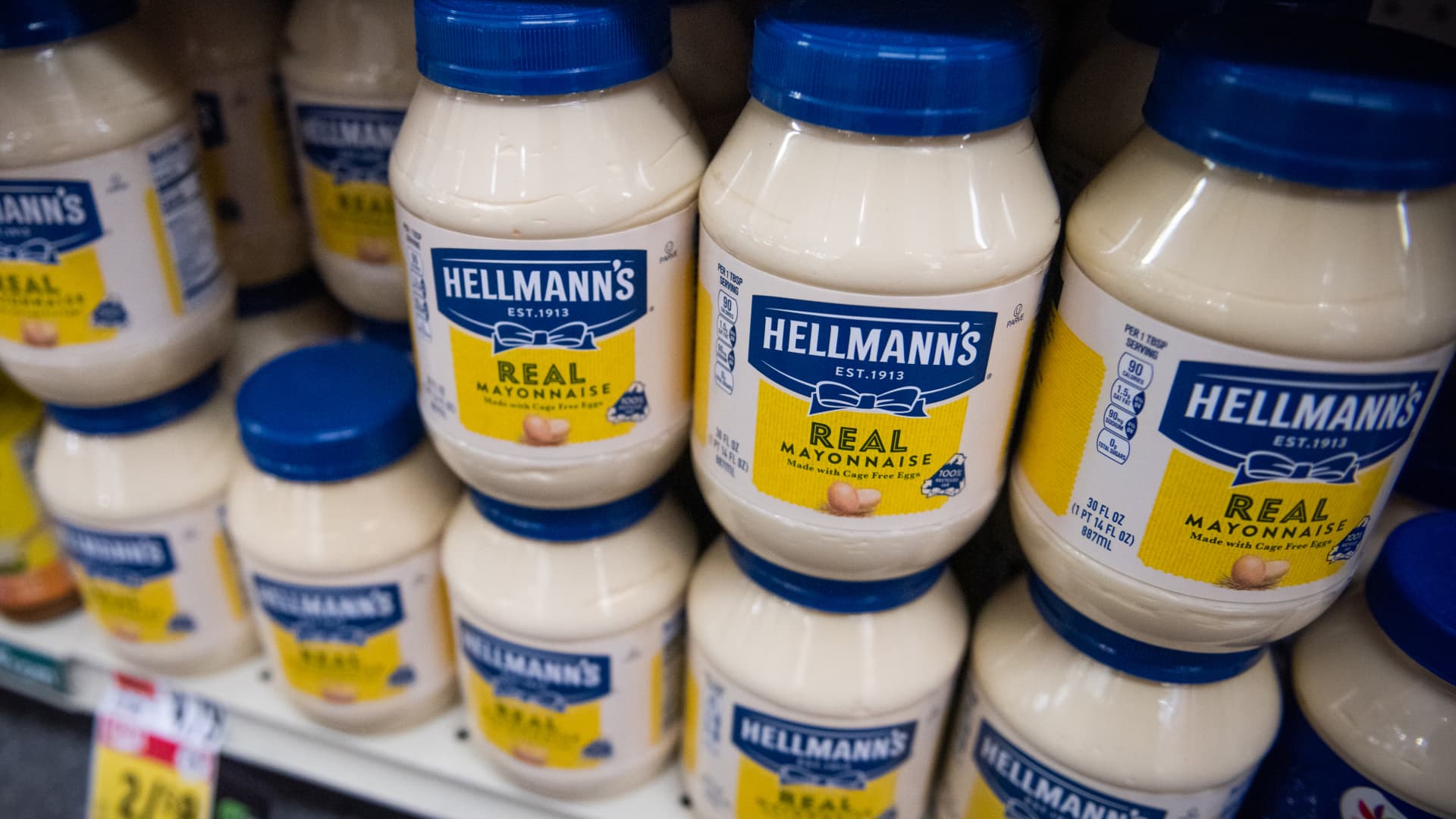
Jars of Unilever brand Hellmann’s mayonnaise for sale at a store in Dobbs Ferry, New York, U.S., Wednesday, Jan. 19, 2022.
Tiffany Hagler-Geard | Bloomberg | Getty Images
McCormick will buy Unilever’s food business for a combination of cash and equity, in a deal that values the Unilever unit at nearly $45 billion, the two food companies announced.
To buy most of Unilever Foods’ portfolio, including Hellmann’s mayo and U.K. favorite Marmite, McCormick will pay $15.7 billion in cash. Unilever shareholders will own 55.1% of the combined company, while Unilever will hold a 9.9% stake.
The deal will add billions of dollars in annual sales for McCormick and expand the spice giant’s portfolio further into spreads and condiments. It already owns Frank’s RedHot and Cholula hot sauces and French’s mustard. About 70% of Unilever Foods’ sales come from Hellmann’s and Knorr, a food brand known for its seasonings, stock cubes and soups.
For Unilever, divesting much of its food business allows the company to focus on its personal care segment, which is growing faster. In December, Unilever spun off its ice cream business, now trading separately as Magnum Ice Cream Company.
The two companies expect that the deal will close in mid-2027, pending shareholder and regulatory approval.
When the deal closes, Unilever will appoint four out of the 12 members on the combined company’s board. For the first two years, one of those directors will be a Unilever executive.
McCormick plans to maintain its global headquarters in Hunt Valley, Maryland, and to add an international headquarters in the Netherlands, the long-standing home for Unilever Foods. The combined company will also have a secondary stock listing in Europe.
The deal follows a broader trend among Big Food. Many packaged food and beverage companies have been getting leaner through divestitures and spinoffs as consumers buy less of their products. In 2024, nearly half of mergers and acquisitions activity in the consumer products industry came from divestitures, according to consulting firm Bain.
Shares of McCormick rose 1% in premarket trading, while Unilever’s stock was roughly flat, reflecting investors’ hesitance about the mega-merger.
“We acknowledge the significant strategic merit and likely compelling [earnings per share] accretion from this potential transaction but also concede the hefty likely deal value, execution risk and resultant majority ownership of the combined entity by Unilever shareholders could dampen initial investor enthusiasm,” Barclays analyst Andrew Lazar wrote in a note to clients on March 20, after the Wall Street Journal reported the initial talks between the two companies.