




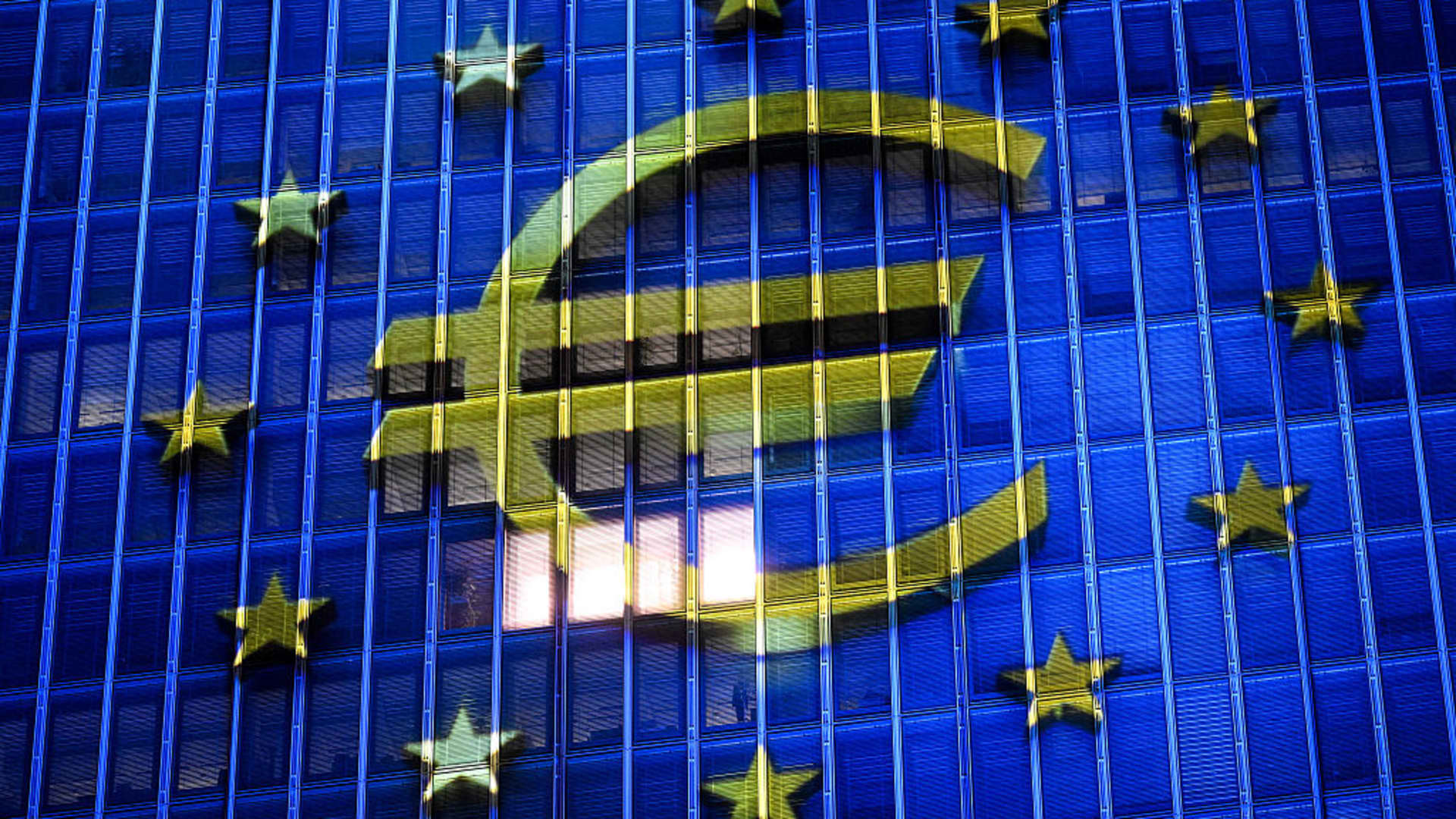
A projection of a Euro currency sign is pictured on the facade of the European Central Bank (ECB) headquarters in Frankfurt am Main, western Germany, on Dec. 30, 2025.
Kirill Kudryavtsev | Afp | Getty Images
Before the war on Iran began in late February, Europe’s central banks enjoyed a more benign inflation outlook as interest rates looked set to remain stable or keep falling across the region.
But the conflict has upset the economic equilibrium, threatening Europe’s energy supplies, growth and the outlook for consumer prices. Expectations for interest rates across the continent have been upended.
On Thursday, the European Central Bank, Bank of England, Sweden’s Riksbank and Swiss National Bank are all set to deliver their latest monetary decisions. Each central bank is also likely to deliver it first comments on how the U.S. and Israel’s war on Iran, which began in late February, is likely to impact their decision-making.
Expectations upended
Even before the war began, the ECB was not expected to change its stance on its benchmark interest rate, with euro zone inflation data remaining near the central bank’s 2% target. The latest flash data from Eurostat showed inflation in the euro zone rose to 1.9% in February, up from 1.7% in January.
ECB President Christine Lagarde had, at the central bank’s last meeting in February, repeated a mantra that the euro zone’s economic outlook was “in a good place” but warned against complacency. Her caution now appears to be well-founded.
Traders will pay close attention to ECB guidance on Thursday for clues as to how the bank could respond, as Iran’s closure of the Strait of Hormuz reduces oil and gas supplies to the region, pushing up energy costs and inflationary pressures.
“On Thursday, we expect the ECB to keep the deposit rate at 2% for a sixth consecutive meeting,” Konstantin Veit, portfolio manager at PIMCO, noted this week, adding: “We expect the ECB will stress heightened geopolitical uncertainty and signal a more hawkish tone rather than move policy immediately.”
“In our view, the new staff projections will likely show a short-term inflation overshoot driven by higher energy prices, before inflation returns to 2% next year,” he said, expecting headline inflation to peak at around 3% this year, with energy contributing roughly 1 percentage point.
Bank of England
The Bank of England had been expected to cut its key interest rate, known as ‘Bank Rate,’ at its March meeting, easing pressure households and businesses grappling with high borrowing costs.
Andrew Bailey, governor of the Bank of England (BOE), during the Monetary Policy Report news conference at the bank’s headquarters in the City of London, UK, on Thursday, Aug. 1, 2024.
Bloomberg | Bloomberg | Getty Images
But economists say the fallout of the war has left the likelihood of cut increasingly remote. The central bank’s monetary policy committee (MPC) is now likely to err on the side of caution and keep Bank Rate at 3.75% as it waits to see how long the conflict might last.
“The Bank of England is unlikely to surprise this week,” John Wyn Evans, head of Market Analysis at Rathbones, said in emailed analysis.
“Rate cuts once seen as plausible for spring have been fully priced out, and a rise later in the year can’t be dismissed,” he noted. With the duration of the conflict unclear, “the most probable outcome is a holding pattern: not tightening, but certainly not loosening until the fog lifts,” Wyn Evans said.
Swiss National Bank
The Swiss National Bank is also expected to keep its main policy rate on hold at 0.00% on Thursday. Switzerland’s economy is less exposed to macroeconomic shocks as a result of turmoil in the Middle East than others, according to Dani Stoilova, UK and Europe Economist at BNP Paribas Markets 360.
“Switzerland’s economy is better positioned to navigate a potential energy price shock than European peers, our analysis suggests, limiting the impact on growth and inflation on a relative basis,” she said in emailed comments.
The Swiss National Bank (SNB) in Bern, Switzerland, on Thursday, Dec. 12, 2024.
Stefan Wermuth | Bloomberg | Getty Images
While elevated volatility and aggressive fluctuations in the Swiss franc (CHF) could increase the scope for foreign exchange intervention, BNP Paribas do “not expect market views on the potential for SNB intervention to meaningfully dampen safe-haven inflows amid geopolitical uncertainty”.
“We see the CHF remaining supported”, the bank said.
Sweden’s Riksbank
Like its fellow European counterparts, Sweden’s Riksbank is also widely expected to keep its main policy rate on hold at 1.75% at its meeting on Thursday.
“Incoming growth and inflation data have been weak, with inflation still set to drop sharply to 1% this year,” JPMorgan economists Allan Monks and Fabio Tomasoni noted in emailed comments last week.
“But higher energy prices should reduce concerns about a potential fall in inflation expectations,” they added. JPMorgan expected the rate path to remain flat for the next three quarters.