





Amid a war in Iran, inflation pressures, a weakening job market and an uncertain outlook for tariff policy, Federal Reserve officials will meet next week and announce a decision on interest rates.
The federal funds rate, set by the Federal Open Market Committee, is the rate at which banks lend to one another overnight, but it also has a trickle-down effect on many consumer borrowing and savings rates.
For now, experts think the central bank will stay on hold. Futures market pricing is implying almost no chance of a rate cut, according to the CME Group’s FedWatch gauge.
“Fed officials will sit on their hands until they get some clarity around how the war with Iran is playing out and which of its mandates, low and stable inflation or full-employment, is most in jeopardy,” said Mark Zandi, chief economist at Moody’s. “That could take weeks, if not two to three months.”
For consumers caught in the crosshairs, that means there will be little relief to come. “Anyone expecting the Fed to ride in and save the day anytime soon is likely going to be disappointed,” said Matt Schulz, chief credit analyst at LendingTree.
In the meantime, “the attack on Iran has made life more expensive and more uncertain for American households,” said Brett House, an economics professor at Columbia Business School. “Oil and gasoline prices have shot up, as have the yields on 10-year Treasuries, which are the benchmark for mortgage rates.”
The consumer price index, or CPI, a key measure of inflation, rose 2.4% in February from a year earlier, according to the latest reading by the Bureau of Labor Statistics. But that was before the Iran war, which caused energy prices to spike, feeding into longer-term inflation fears.
Higher oil prices could complicate the inflation picture in the months ahead, economists say, as those increases filter through to airfares, shipping and other costs.
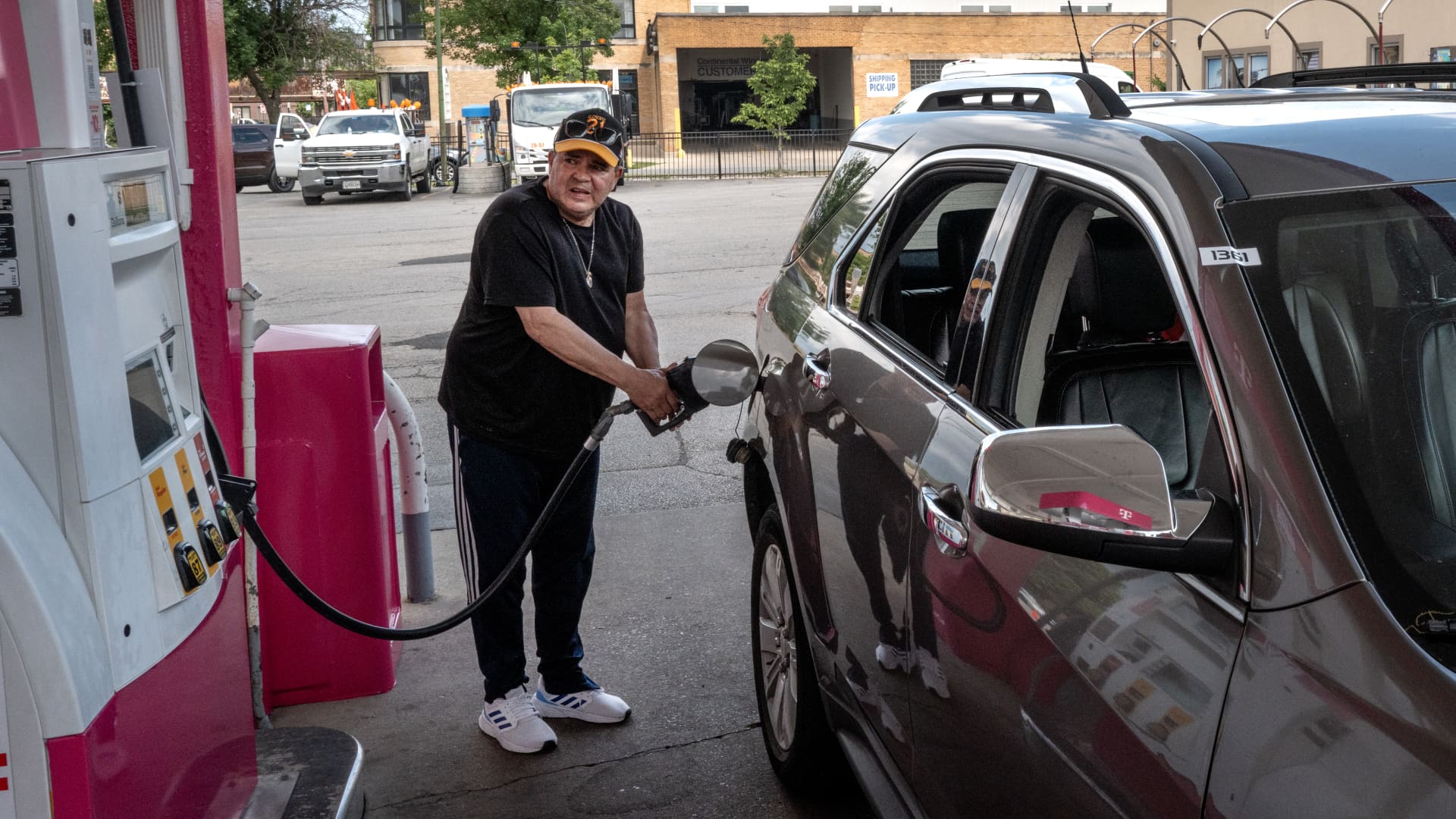
Brent crude futures briefly hit $100 a barrel again on Thursday, and the national average gasoline price climbed to $3.59 a gallon, up 22% from a month ago, according to AAA.
Inflationary pressures in the wake of the joint U.S.-Israel strike also pushed the yield on the benchmark 10-year Treasury — the barometer for mortgage rates — up to 4.173%.
“Nothing about this war is making life more affordable for average Americans,” House said.
The ‘rockets and feathers’ effect

Even if the war ends “very soon,” as President Donald Trump has said, and those spikes prove short-lived, when oil prices fall, gasoline prices may come down more slowly.
Economists call this the “rockets and feathers” effect, according to a Thursday research note by Sung Won Sohn, professor of finance and economics at Loyola Marymount University and chief economist at SS Economics. “Gasoline prices shoot up like a rocket but float down like a feather,” he wrote.
Because fuel distributors buy gas from refineries and store it before selling it to consumers, they may still be unloading inventory purchased at higher prices long after crude supplies have stabilized. “Until that inventory is replaced with cheaper fuel, prices at the pump tend to fall gradually rather than immediately,” Sohn wrote.
Even before the expanding U.S. war in the Middle East fueled inflation fears, the high cost of living and a softening labor market had created an affordability crunch for many U.S. households.
The U.S. economy lost jobs in February, and the unemployment rate edged up to 4.4%, the Bureau of Labor Statistics reported Friday.
“The Federal Reserve and the Treasury Department are likely examining options to ease the burden on households, though the available tools are limited,” said certified financial planner Stephen Kates, a financial analyst at Bankrate.
“The Federal Reserve’s task has become more complicated,” Kates said. “Although the labor market showed signs of weakness in February, concerns about accelerating inflation are likely to keep the Fed from cutting rates at either of the next two meetings.”