




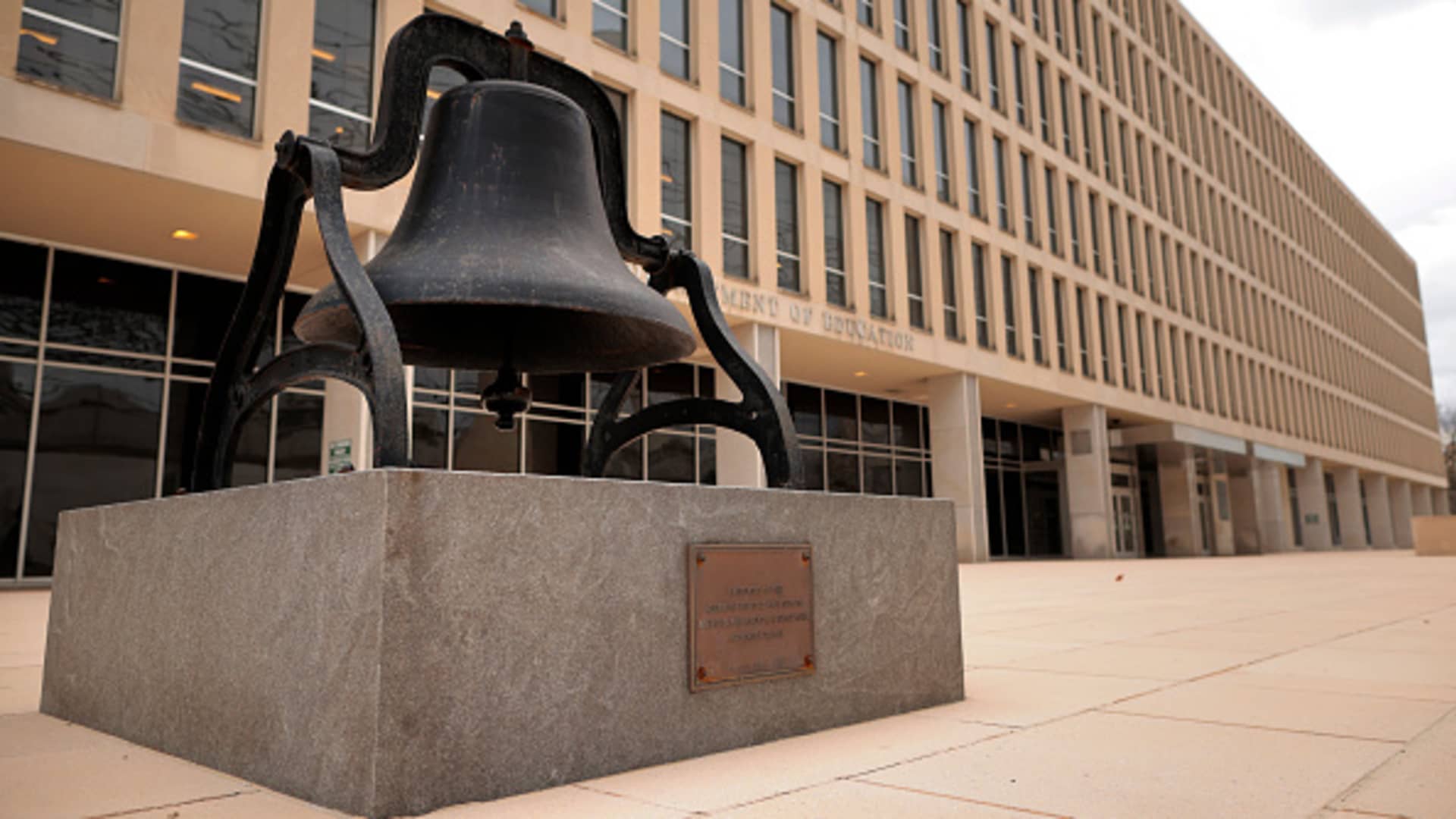
A school bell from Milford, Pennsylvania, stands in front of the Department of Education’s headquarters on March 06, 2025 in Washington, DC.
Chip Somodevilla | Getty Images News | Getty Images
The U.S. Department of Education has scaled back its oversight of the companies that manage federal student loans, a new congressional watchdog report found.
In February 2025, the department stopped “assessing servicers on accuracy and call quality,” according to the report from the nonpartisan Government Accountability Office. That change occurred shortly before the Trump administration terminated around 50% of the Education Department’s staff.
Without its evaluation of student loan servicers, the GAO wrote, the Education Department “can’t be sure that borrower records are correct and servicers are giving borrowers quality information.” The office also said that borrowers could be placed into the wrong repayment status or overbilled as a result.
“Instead of providing relief to 43 million Americans who are drowning in student debt, the Trump Administration has made it harder for them to understand how much they owe and how long it will take to pay back,” said Sen. Bernie Sanders, I-Vt., in a statement. Sanders was among the lawmakers who requested the GAO investigation.
The Education Department did not immediately respond to a request for comment.
Student loan servicers have a spotty history
The Education Department contracts with different companies to service its federal student loan portfolio. It pays these companies more than $1 billion a year to manage borrowers’ accounts, according to higher education expert Mark Kantrowitz.
The servicers process borrowers’ loan payments, supply information to borrowers and help them access repayment plans and forgiveness opportunities.
The Federal Student Aid Office at the Education Department managed the assessments of these student loan servicers. However, the Trump administration has reduced the staff at FSA to 777 people from 1,433, GAO said.
Student loan servicers have long faced criticism from advocates and lawmakers for misleading borrowers or failing to provide them with sufficient support.
“Without oversight to ensure that loan servicers provide borrowers with correct information, borrowers may make decisions that negatively impact their finances, such as choosing the wrong repayment plan, not qualifying for forgiveness and defaulting on their student loans,” Kantrowitz said.
The Biden administration withheld $7.2 million in payment from Mohela in 2023 for not sending timely billing statements to 2.5 million borrowers, resulting in more than 800,000 borrowers becoming delinquent.
In 2017, days before Trump took office, the Consumer Financial Protection Bureau sued Navient. It accused the then-servicer of steering student loan borrowers away from affordable repayment plans and into expensive forbearances, which caused many to incur steep interest charges.
Navient stopped servicing federal loans in 2021 and, in 2024, reached a $120 million settlement with the CFPB. As part of that deal, the CFPB banned the company from ever again managing federal student loans.
Mohela and Navient did not immediately respond to a request for comment.